USOH crypto is a newly launched Solana token that presents itself as “United States Oil Holdings,” an on-chain asset connected to American oil reserves. The pitch seems engineered for the 2026 market: combine U.S. energy security, tokenized commodities, Solana’s expanding real-world asset ecosystem, and claims of institutional backing. The problem is that the promotional story currently runs far ahead of the verifiable evidence.
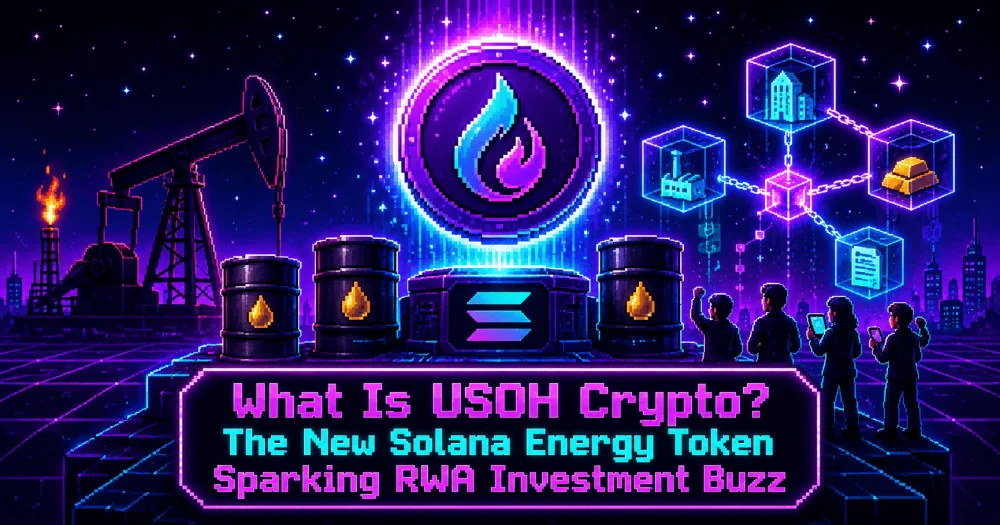
The token exists and trades on Solana. However, there is no public proof that USOH crypto owns oil, represents a legal claim on barrels held in the Strategic Petroleum Reserve, or has a formal partnership with the U.S. government, BlackRock, or Coinbase. For now, investors should distinguish the token’s branding from a genuine, regulated real-world asset.
Contents
- What Is USOH Crypto?
- USOH Crypto Market Snapshot
- Why Is USOH Crypto Attracting Attention?
- Is USOH Really an RWA Crypto Token?
- USOH Crypto vs a Verified Tokenized Asset
- Main USOH Crypto Risks
- What Would Make USOH Crypto More Credible?
- Could USOH Crypto Still Rise?
- Final Verdict: What Is USOH Crypto Really?
- FAQ
What Is USOH Crypto?
USOH crypto is an SPL token using the name United States Oil Holdings. The widely promoted Solana contract address is:
BGuwU5SdeH93cT3WyN2K4e4vJuqyaFBAkzaZ2wtJUSoH
The project website describes USOH as a tokenized oil reserve and claims that each token provides fractional exposure to American strategic oil holdings. It also uses phrases such as “one barrel, one token,” “BlackRock-partnered,” “sovereign backed,” and “Coinbase listed.”
Those claims are the center of the USOH crypto narrative, but they are not supported by the type of documentation expected from a legitimate RWA product. There is no published legal structure identifying the issuer and tokenholder rights, no reserve attestation, no named oil custodian, no redemption mechanism, and no independently verified proof that one token corresponds to one barrel.
Read more: What Is GDWR Crypto: Can This Emerging Token Deliver Outsized Gains?
Coinbase hosts a price-information page for the token, but the page explicitly states that United States Oil Holdings is not tradable on Coinbase. A market-data page is not the same as an exchange listing.
USOH Crypto Market Snapshot
USOH crypto remains a small and highly speculative asset. On July 13, 2026, Solana Compass displayed a price near $0.0058, a market capitalization of roughly $5.8 million, around $162,000 in 24-hour volume, and approximately 2,400 holders. Other trackers reported different volume and liquidity figures, which is common for new DEX-traded tokens with several pools and inconsistent data indexing.
| Metric | Approximate status |
|---|---|
| Blockchain | Solana |
| Token standard | SPL |
| Price | Around $0.0058 |
| Market capitalization | Around $5.8 million |
| Reported holders | Around 2,400 |
| Main trading pair | USOH/USDC▼$0.9998 |
| Main venue | Meteora |
| Verified oil backing | Not publicly demonstrated |
| Coinbase trading | Not available |
These figures can change quickly. More importantly, a quoted price does not prove that the token is backed by oil or that large positions could be sold near the displayed valuation. Liquidity across the main pools is far smaller than the headline market capitalization, increasing slippage and volatility risk.
Why Is USOH Crypto Attracting Attention?
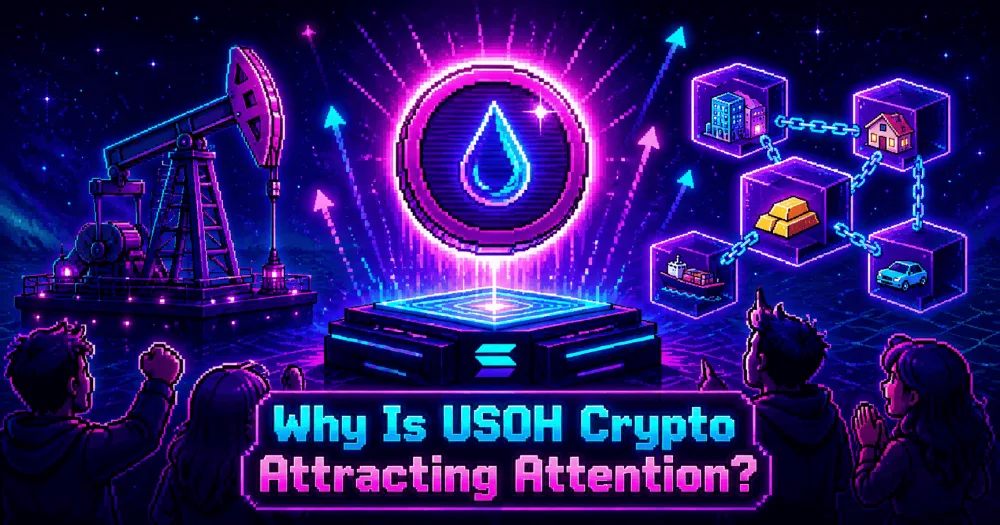
The token is tapping into three powerful narratives at once.
First, real-world asset tokenization is one of crypto’s strongest institutional growth themes. RWA.xyz reported more than $30 billion in distributed tokenized asset value globally, while Solana said its RWA ecosystem crossed $3 billion in June 2026. Tokenized Treasuries, equities, funds, and commodities have made the idea of bringing traditional assets on-chain increasingly credible.
Second, oil is politically and economically recognizable. The U.S. Strategic Petroleum Reserve held about 336.8 million barrels as of June 25, 2026, according to the Department of Energy. Branding a token around those reserves gives USOH crypto an immediate story involving scarcity, national security, and commodity exposure.
Third, Solana makes launching and trading a token fast and inexpensive. That helps legitimate issuers, but it also allows anonymous teams to build convincing narratives before legal rights, reserves, or operating infrastructure exist.
Related: Sentient (SENT) Price Prediction: Can This AI Crypto Hit a New All-Time High in 2026?
Is USOH Really an RWA Crypto Token?
At present, calling USOH crypto a verified RWA is not justified.
A real-world asset token needs more than a commodity-themed website. Investors should be able to identify the underlying asset, its legal owner, the entity issuing the token, the custodian holding the asset, the jurisdiction governing the arrangement, and the rights attached to each token. Reliable products also publish attestations, audits, offering documents, or redemption procedures.
USOH currently does not provide those essentials publicly. Its website claims that each token corresponds to oil reserve exposure and references institutional partners, but it does not show contracts, custody records, reserve reports, corporate details, or official confirmations from the organizations named.
There is also a basic numerical problem with the “one token, one barrel” language. The token’s reported supply is one billion USOH, while the Department of Energy reported 336.8 million barrels in the Strategic Petroleum Reserve on June 25. Even before legal ownership is considered, a literal one-to-one relationship would not match those figures.
USOH crypto may be inspired by the RWA trend, but inspiration is not collateralization. Until the project provides independently verifiable documentation, it is more accurate to describe it as an oil-themed speculative token.
USOH Crypto vs a Verified Tokenized Asset
| Feature | USOH crypto today | Established RWA structure |
|---|---|---|
| Identified issuer | Unclear | Named legal entity |
| Asset ownership | Unverified | Documented ownership |
| Custody | Claimed, not proven | Named regulated custodian |
| Investor rights | Not clearly defined | Stated in legal documents |
| Reserve reporting | No independent attestation found | Regular attestations or audits |
| Redemption | No clear process | Defined mint and redemption rules |
| Regulatory basis | Not disclosed | Jurisdiction and exemption disclosed |
| Institutional partners | Promotional claims only | Confirmed by all parties |
This distinction matters because a tokenized asset is not automatically the same thing as the asset it references. For comparison, established tokenized products identify the underlying security, custodian, eligible investors, ownership structure, and minting or redemption process.
Holding a legitimate oil-linked security may create contractual economic exposure. Holding an unverified token with oil branding may provide nothing beyond the ability to sell that token to another trader.
Related: Robert Kiyosaki Just Issued Another Crash Warning: Here Are His 5 Biggest Predictions Ever
Main USOH Crypto Risks
Unverified Backing
The largest risk is that the promised oil exposure may not exist. Without legal documents and reserve evidence, buyers cannot know whether USOH represents ownership, debt, a revenue claim, a derivative, or no enforceable right at all.
Misleading Institutional Language
References to BlackRock, Coinbase, and U.S. strategic reserves create credibility by association. Coinbase’s own page says the token is not tradable there, while no official confirmation of a BlackRock or Department of Energy relationship was found in the materials reviewed.
Contract Confusion
Multiple unrelated tokens use the USOH ticker and the United States Oil Holdings name. Buying by ticker alone can lead to the wrong asset. Traders must verify the full Solana contract address rather than trusting a logo, token name, or social-media post.
Low Liquidity and Extreme Volatility
USOH crypto has a multimillion-dollar headline valuation but much smaller DEX liquidity. A sudden wave of selling could cause severe slippage, while a few large wallets or coordinated promotions could move the price sharply.
Narrative-Driven Promotion
A significant part of the token’s attention comes from viral posts, speculative videos, and claims involving politics, oil, institutional adoption, or supposed predictions. None of that replaces evidence of ownership and enforceable tokenholder rights.
What Would Make USOH Crypto More Credible?
USOH crypto would need to publish several items before the RWA label could make sense:
- The issuer’s legal name, registration, management team, and jurisdiction.
- Documents explaining exactly what each token represents.
- Proof that the issuer owns or controls the underlying oil exposure.
- A named custodian and direct confirmation from that custodian.
- Independent reserve attestations with reporting dates and methodology.
- Clear minting, burning, redemption, and liquidation procedures.
- Confirmation from any institution named as a partner.
- Regulatory disclosures explaining who can legally buy the token.
A polished website is cheap. Verifiable ownership, custody, compliance, and redemption are the expensive parts that turn a crypto narrative into an actual financial product.
Related: What Is GORP Crypto? Why This Viral Meme Coin Could Become a Serious Market Player
Could USOH Crypto Still Rise?
The short answer is yes. Tokens do not need verified fundamentals to rally, especially when they combine several popular themes and trade in shallow liquidity. USOH crypto could gain from stronger oil prices, renewed Solana speculation, RWA enthusiasm, influencer promotion, or rumors of an institutional partnership.
But those same conditions work in reverse. If the backing claims are challenged, liquidity disappears, large holders sell, or the market decides the project is merely an oil-themed memecoin, the price could collapse quickly.
The bullish case therefore depends less on existing fundamentals than on future proof. Genuine confirmation of custody, reserves, tokenholder rights, and institutional involvement would materially change the analysis. Without it, USOH remains a narrative trade rather than verified oil exposure.
Final Verdict: What Is USOH Crypto Really?
USOH crypto is a real Solana token wrapped in an unverified RWA story. It trades publicly and has attracted a growing holder base, but there is no evidence of actual U.S. oil reserve backing, oil redemptions, government approval, BlackRock partnership, or Coinbase listing.
That does not mean the token cannot appreciate. It means buyers are currently speculating on attention and future validation, not purchasing proven fractional ownership of American oil. Until detailed legal and reserve documentation appears, USOH crypto remains a high-risk, oil-themed Solana token—not an institutional commodity product.
FAQ
Is USOH Crypto Backed by Real Oil?
No independently verified evidence currently proves that USOH is backed by physical oil or legally enforceable oil exposure.
Is USOH Listed on Coinbase?
No. Coinbase provides a price-information page but states that United States Oil Holdings is not tradable on Coinbase.
Is USOH Connected to the U.S. Strategic Petroleum Reserve?
No official Department of Energy document confirms any relationship between the token and the Strategic Petroleum Reserve.
Is USOH Crypto a Legitimate RWA?
It has RWA branding, but it lacks the public legal, custody, reserve, and redemption documentation needed to verify it as a genuine tokenized real-world asset.
Where Does USOH Trade?
The promoted Solana token primarily trades against USDC through Meteora pools. Traders should verify the full contract address because multiple tokens use the USOH ticker.