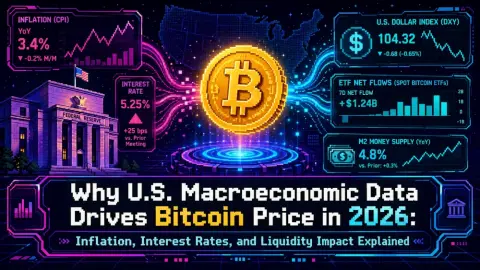
The Federal Reserve left its benchmark interest rate at 3.5 to 3.75% at its June policy meeting, marking the fourth consecutive policy meeting to leave the rate unchanged.
Policymakers cited persistent inflation pressures, the continuation of economic growth, and uncertainty in the outlook as reasons for taking no immediate action towards policy adjustment.
Contents
- Fed Holds Rates Steady at Warsh’s First Policy Meeting — What Changed?
- Fed Signals Possible Rate Hike Before Year-End — What It Really Means
- Immediate Crypto Market Reaction to Fed’s Decision
- Strong Dollar and Yields: Hidden Pressure on Crypto
- What Traders Are Watching Next
- Bull vs Bear Case for Crypto After Fed Signals
- FAQ
Fed Holds Rates Steady at Warsh’s First Policy Meeting — What Changed?
Why the Federal Reserve Decided to Keep Interest Rates Unchanged
However, updated forecasts also suggested that inflation would remain above the central bank’s long-term target despite signs of easing pressure on prices.
The Fed interest rate decision reflects sensitivity to the challenge of continuing to control inflation while avoiding putting too much pressure on the economy.
Although the move had been widely anticipated in markets, central bank officials noted that the fight against inflation was not over, reinforcing the view that the Fed keeps rates unchanged because inflation risks remain elevated.
| Key Fed Signal | Current Situation | Potential Market Impact |
| Fed interest rates decision | Rates held at 3.5%-3.75% for a fourth consecutive meeting | Markets continue adjusting to a higher-for-longer policy outlook |
| Fed keeps rates unchanged | Policymakers remain concerned about persistent inflation | Expectations for immediate monetary easing remain limited |
| Federal Reserve rate hike | Officials still see a possibility of additional tightening | Treasury yields and the U.S. dollar may remain supported |
| inflation and Federal Reserve policy | Inflation forecasts remain above the long-term target | Future CPI data will play a larger role in policy decisions |
| Kevin Warsh Fed policy stance | Reduced forward guidance and stronger focus on current data | Investors may face greater uncertainty around future Fed actions |
What Kevin Warsh’s “Debut” Signals for Future Monetary Policy
Kevin Warsh’s first meeting as chair of the Fed drew attention less for the decision on the path of rates than for changes in the Fed’s communications strategy under his chairmanship.
His statement in June was shorter than statements in previous years, and omitted much of the forward guidance that had been included under his predecessors; Warsh argued that it was better to focus on the current economy.
Market participants also track Warsh’s broader policy review, which may include his views on Fed communications, inflation targeting rules, data use, and balance-sheet policies. Warsh may also pursue institutional reform and a stronger emphasis on market-friendly communication of policy positions.
Read More: Elon Musk Net Worth More Than Bitcoin — Could Musk Actually Buy Every BTC on Earth?
At the same time, Warsh reaffirmed the Fed’s commitment to re-establish price stability, a position that reflects the broader Kevin Warsh Fed policy stance emerging under the new leadership.
Though he gave no solid signal as to where interest rates would go next, his comments reinforced the view that officials are willing to raise rates still further if inflation proves more stubborn than expected.
Market Interpretation: Neutral Pause or Tactical Delay?
Market participants interpreted the decision as a pause rather than a pivot, but the updated projections showed that a large majority of Fed officials expect at least one more interest rate hike to occur before the end of the year, in contrast to the forecasts just after the final meeting of the previous year.
More recently, the divergence has led to debate over whether the June meeting could be seen as a neutral holding pattern or a tactical delay before a Fed rate hike.
On futures markets, expectations for a prolonged restrictive policy had increased as inflation data continued to surprise to the upside.
Investors’ takeaway from the meeting is that the Fed isn’t shutting the door on further tightening, as evidenced by the inflation forecasts, lack of forward guidance, and the gradual policy pace.
But they have little information about the trajectory of policy beyond this meeting and will be particularly attuned to data and changing CME FedWatch expectations going forward.
Fed Signals Possible Rate Hike Before Year-End — What It Really Means
Inflation Outlook and Why the Fed Is Not Done Yet
While policymakers left rates unchanged in June, the Fed’s latest projections show that officials expect inflation to be restrained. Officials raised their forecasts, however, as price pressures remain stronger than expected amid rising energy prices and uncertainty surrounding geopolitical risks.
That helps explain why the Fed’s shift in policy talk has returned to the forefront. Former Fed governor Kevin Warsh has said the central bank remains committed to restoring price stability first.
With inflation likely remaining above the Fed’s target for longer than expected, inflation and Federal Reserve policy will remain a focal point for market participants.
How Likely Is Another Rate Hike in 2026?
After June’s meeting, the likelihood that rates will rise again has increased, with nearly half of Fed officials now seeing rates ending the year at a level higher than currently, while previously some expected cuts.
Markets are starting to configure themselves to a higher-for-longer scenario, with futures markets tracked by CME FedWatch expectations pricing in a better-than-even chance the Fed will hike rates at least one more time.
The projected interest rate forecast 2026 remains highly conditional on incoming inflation and labor market data.
Historical Patterns: What Happens After Late-Cycle Hikes
Late-cycle hikes have historically occurred when central banks believe inflationary threats are not curbed even with tight monetary policy, in order to convey their credibility to maintain subdued inflation expectations within the economy.
The historical record of tightening cycles has also shown that tighter monetary policy may push bond yields higher and increase risk-sensitive market volatility.
What’s key for investors scanning the entire macroeconomic outlook 2026 is whether that hike would mark the start of a fresh tightening cycle or the final step needed to bring inflation back to target.
Immediate Crypto Market Reaction to Fed’s Decision
Bitcoin Price Sensitivity to Interest Rate Expectations
Bitcoin remained sensitive to expectations of monetary policy changes and traded near $64,500 after falling about 2% in the past 24 hours, following a rise in the market pricing in tightening expectations later this year, ahead of the Fed meeting. Futures markets also moved toward pricing in a higher chance of an interest rate increase in December.
In the wake of the Fed statement, Treasury rates were higher, and the dollar was stronger as traders reacted to Chair Kevin Warsh’s more hawkish comments on monetary policy and his revised rate forecasts. Interest rates have historically brought headwinds to risk markets, and this fact can help explain the strong correlation between Bitcoin price and interest rates.
Altcoins vs Bitcoin: Who Gets Hit Harder?
While Bitcoin constitutes the largest cryptocurrency market portion, altcoins offer greater price volatility during periods of economic hardship, when risk capital has historically tended to leave smaller, more speculative digital assets first. In these environments, Bitcoin typically maintains its value better, due to a larger market capitalization and institutional investment.
A pattern that arose during sell-offs in the last few months was that in larger corrections earlier this year, Ethereum and many large market cap altcoins tended to drop more than BTC▲$62,630.00, which would indicate how they are more sensitive to changes in sentiment and funding conditions. An outsized movement in crypto market reaction Fed could thus be translated into the altcoin sector.
Liquidity Conditions and Risk Appetite in Crypto Markets
Along with that, the Fed’s message was also felt for liquidity conditions crypto market. In particular, the market is pricing in another hike this year while Treasury yields are running higher as a result of the central bank’s outlook.
Higher rates often lead to higher capital costs and lower appeal for leveraged trading, illustrating how interest rates affect cryptocurrency prices through weaker liquidity and reduced demand for riskier digital assets.
Read Also: Bitcoin Price Could Still Fall, But Bitwise CIO Says Top Matters More
Reuters said that cryptocurrencies have become more correlated to market sentiment and to riskier assets and that they are more sensitive to monetary policies.
The market will also lend its ear to any incoming economic data pointing to a shift in the Fed’s rate expectations – a relief in inflation and a pullback of its rate hike projections could calm risk asset volatility.
Strong Dollar and Yields: Hidden Pressure on Crypto
How Rising Bond Yields Compete With Bitcoin
Following the June Fed meeting, Treasury yields surged as Fed officials said another rate hike was possible later in the year. The 2-year yield surged to 4.21%, its highest in about sixteen months. At the same time, the yield on 10-year Treasury notes rose to 4.47%, and the futures markets expected an increased likelihood of a year-end rate hike, indicating a more hawkish monetary policy stance.
Higher yields reduce the attractiveness of non-yielding financial assets like Bitcoin for investors who can earn more than 4% annually on low-risk government debt instruments.
This feeds into the bond yields vs Bitcoin debate seen throughout the monetary policy tightening cycle.
DXY Strength and Its Correlation With Crypto Downtrends
The U.S. dollar shot up against a basket of currencies after the Fed’s announcement, hitting a level not seen in more than two months, as markets adjusted to the increasingly likely prospect of yet another rate hike. Futures markets were pricing in an 85% chance of a hike in December, according to Reuters.
Historically, dollar appreciation tightens global financial conditions by raising the relative price of dollar-denominated assets compared to higher-risk assets.
The recent recovery of the dollar index toward the 100 level remains the main driver of the dollar index impact on crypto, alongside weakness across other risk-sensitive markets like cryptocurrency market.
Bitcoin’s troubles this year have coincided with a fresh rise in the dollar. According to Reuters data, Bitcoin was down to about $63,000 in early June, a drop of about a third for the year, as investors rotated into different assets and re-evaluated macro risks.
Institutional Flows: ETFs and Macro Sensitivity
The proliferation of institutional players has made crypto market more sensitive to macroeconomic developments, with spot Bitcoin ETFs being one of the most important routes for professional investors to get exposure to crypto market. Their capital flows are closely attuned to interest-rate expectations.
Read Also: Wintermute: Bitcoin Holds Above $66K, But It’s Too Early to Call a Trend Reversal
Recent data suggests institutional crypto flows have slowed down in the short term as the market caught up with the higher-for-longer rate regime. Per industry flow reports, crypto ETF products had more than $4 billion in outflows in the three weeks leading into early June, including some of the largest U.S. spot Bitcoin ETF outflows of the year.
So, the wider crypto market outlook 2026 is likely to continue to be driven by Treasury yields, the US dollar, and expected Fed monetary policy. Although on the adoption and infrastructure side, progress is still positive, demand from institutional buyers is more sensitive to macro factors.
| Factor | Bullish for Bitcoin | Bearish for Bitcoin |
| Treasury Yields | Stable or falling yields improve risk appetite | Rising yields offer attractive low-risk alternatives |
| U.S. Dollar | Weaker dollar supports demand for alternative assets | Stronger dollar tightens global liquidity |
| Spot Bitcoin ETFs | Sustained inflows support prices | Large outflows signal weaker institutional demand |
| Fed Policy | Pause or dovish shift may boost sentiment | Additional tightening can pressure risk assets |
| Market Liquidity | Expanding liquidity supports capital inflows | Restrictive conditions reduce speculative activity |
What Traders Are Watching Next
Upcoming CPI and Inflation Data as Key Catalysts
The Fed is set to keep rates on hold but might tighten again. Inflation is now the market’s main focus, with CPI accelerating in May to 4.2% year-on-year. Some recent estimates still show core inflation measures through June.
That means that any inflation report now has the potential to shift expectations for how the Fed will respond going forward. Higher-than-expected inflation in the months to come could strengthen the Federal Reserve rate hike case. Weaker inflation could take some pressure off the current interest rate forecast 2026.
Fed Speaker Commentary and Forward Guidance
As Fed chair, Kevin Warsh moved away from providing forward guidance. The Fed’s statement became shorter, and members conveyed less information about future policy to the public.
Thus, public speeches by Fed officials get wider scrutiny while guidance matters less. Futures markets, as reflected in the CME FedWatch expectations tool, have gained wider monitoring, with traders tracking the likelihood of interest rate increases or decreases.
Crypto Volatility Scenarios If Hike Expectations Increase
While any further interest rate hike expectations might further weigh on digital currencies, Treasury yields and the dollar have both risen following the June meeting. Historically, this has weighed on digital currencies and other risk-sensitive assets.
However, if inflation remains stubbornly high, investors may start to price in a larger chance of another hike before the end of the year, with a subsequent impact on risk assets volatility as traders reassess liquidity and growth.
For crypto markets, the importance of how the Fed approaches a shift towards a tighter policy cycle is focused on sentiment, as higher yields absorb capital into low-risk assets, and Fed signals rate hike impact on crypto market narrative is greater in a high-yield environment.
Bull vs Bear Case for Crypto After Fed Signals
Bear Case — Liquidity Tightening and Risk-Off Sentiment
The bearish case would be that the Fed will have a higher policy rate for longer, with almost half the board supporting one more increase in June. Markets had anticipated a high probability of further tightening by the end of the year, increasing Treasury yields and the US dollar, following the release.
For crypto, that means liquidity conditions crypto market participants carefully watch, such as how easily and cheaply they can borrow and sell their assets, may be affected by higher yields for fixed income and a strong dollar.
Read Also: Strategy’s Saylor Unveils Five-Layer Bitcoin Economy Model — How It Works
Subsequent Reuters polls show the number of economists predicting a Fed easing in 2026 has declined, extending out expectations of monetary policy tightening.
Bull Case — “Peak Rates” Narrative and Relief Rally Potential
The bullish case assumes that the markets have already priced in their anticipations. Bitcoin has faced downward pressure in 2026, as expectations have shifted from anticipating rate reductions on the part of the Federal Reserve to anticipating rate increases. BTC, for example, traded from the $70,000s to the low-$60,000 level during these selloffs.
Some market participants expect a relief rally for digital assets if inflation normalizes and the Fed delivers fewer than the currently priced-in hikes. Standard Chartered’s Geoff Kendrick held his year-end price target on Bitcoin at $100,000, as he expected crypto market to be more constructive 2026, even if macro winds might be against it.
Key Levels Bitcoin Must Hold in a Macro Tightening Cycle
From a technical perspective, the $60,000 zone has been the most important BTC support zone. According to Reuters technical analysis, BTC held above the $60,000 level during the February sell-off. Various reports suggest that $60,000-$61,000 is the bottom range for buyers at present.
Reuters technical analysts note that a breach of that level could see the next level of support around $50,000. On the upside, the first level of resistance is around the 30-day moving average at $75,685 and near the 200-day moving average of around $78,840. Traders have been watching those levels to see what does Fed rate decision mean for Bitcoin now and whether the weakness will continue to untangle.
Whether will crypto go down if Fed raises rates is finally a question of whether BTC can continue holding the $60,000 level while the markets get used to the idea of a potentially higher-for-longer rate environment. Recent price action would suggest that the $60,000 level is one of the most important macro factors for crypto.
FAQ
Why does the Federal Reserve’s interest-rate policy matter for crypto?
Higher interest rates affect levels of liquidity, the cost of borrowing, and risk-taking. Should interest rates be high or continue rising, capital is likely to cycle to lower-risk, safe havens.
Can Bitcoin perform well in an environment of high rates?
Yes. Even if the rates are rising, Bitcoin can still benefit from institutional adoption, ETF demand, and market sentiment, even in higher interest rate environments. However, macro conditions are not the only variables that influence price action and behavior.
Why do Treasury yields affect cryptocurrency markets?
An increase in Treasury yields forces higher yields on safer forms of debt, like government bonds, making it plausible that investors are rotating into safer markets like the US Treasury securities market, away from speculative markets.
What should crypto traders watch for after a Fed meeting?
The largest effect is typically seen around data relating to inflation, the labor market, Treasury yields, and public statements by Federal Reserve officials, all of which shape interest rate expectations and dominate short-term market moves.