The question if Bitcoin can be banned arises any time governments announce new crypto prohibitions, a Bitcoin crackdown, or enhanced Bitcoin regulations. The concern is that a government may be able to officially ban Bitcoin, shut down BTC▲$77,666.00 exchanges, render the currency useless, or make Bitcoin disappear altogether.
Restrictions may limit adoption, but history suggests that governments cannot outright ban Bitcoin.
Read more: Can Bitcoin Crash to $20K in 2026? What Could Trigger a Historic Crypto Market Collapse
Authorities may take steps to ban or restrict cryptocurrency exchanges, banks, mining, and payments. They might punish local companies or prosecute crypto firms. However, Bitcoin is not a centralized exchange or software with a single server or location. The network comprises numerous nodes, wallets, software, and miners across several jurisdictions.
A government can enforce a Bitcoin ban, which usually affects the accessibility and ease of use of the decentralized software. Meanwhile, the system remains operational.
Contents
- Can Governments Actually Ban Bitcoin?
- Countries That Have Tried to Ban Bitcoin
- Has Bitcoin Ever Been Successfully Banned?
- How Governments Can Restrict Bitcoin Without Banning It
- Could Major Economies Ban Bitcoin?
- What Would Happen to Bitcoin's Price If a Ban Were Announced?
- Can Investors Still Own Bitcoin if Governments Tighten Regulations?
- FAQ
Can Governments Actually Ban Bitcoin?
What “Banning Bitcoin” Really Means
A Bitcoin government ban entails restricting an area vital to the cryptocurrency economy. It might involve forbidding exchanges, limiting banking access to crypto firms, banning mining activities, restricting payments, or prohibiting ownership. In most cases, Bitcoin laws and regulations seek to control or restrict the flow of funds in or out of the crypto space.
This is why the legality of Bitcoin is often situational. It depends on jurisdiction, with a cryptocurrency being illegal to mine, trade, or possess in one region while being legal in another. Bitcoin may also be illegal tender in some places but permitted on crypto exchanges. Additionally, crypto regulations might take different forms, such as forbidding anonymous transactions while requiring licensing for exchanges.
Why Bitcoin Is Difficult to Shut Down
Bitcoin is hard to ban because the system does not have a CEO, a server, or a country of jurisdiction. Its nodes, miners, software, and wallets are spread across many regions and countries. If a government attempts to ban or restrict one aspect of the system, such as mining, the activity may shift to another jurisdiction.
Bitcoin’s decentralization and lack of central authority do not make the network impervious to government restrictions. However, compared to a traditional technology or financial application, it is significantly more challenging to halt the Bitcoin protocol on a global scale.
The Difference Between Restricting Use and Stopping the Network
Authorities can restrict the use of Bitcoin by banning or regulating exchanges, banks, miners, advertising, and payment processors. By doing so, governments can make it challenging or expensive to use the currency within their jurisdiction.
Related: Eric Trump’s American Bitcoin Loses $600M as Miners Pivot to AI
However, stopping the entire network requires taking down nodes, exchanges, and payment processors worldwide. A country can enforce a local economic ban, but it is unlikely to halt the usage of Bitcoin outside its borders.
| Type Of Restriction | What It Means | Impact On Bitcoin |
|---|---|---|
| Exchange Ban | Users cannot legally trade through local crypto platforms | Reduces access and liquidity |
| Banking Restrictions | Banks cannot serve crypto companies or process crypto payments | Makes deposits and withdrawals harder |
| Mining Ban | Miners are forced to shut down or move abroad | Can reduce hashrate short term |
| Payment Ban | Bitcoin cannot be used for goods or services | Limits real-world adoption |
| Full Crypto Ban | Buying, selling, using, or holding crypto is prohibited | Creates the strongest legal risk for users |
Countries That Have Tried to Ban Bitcoin
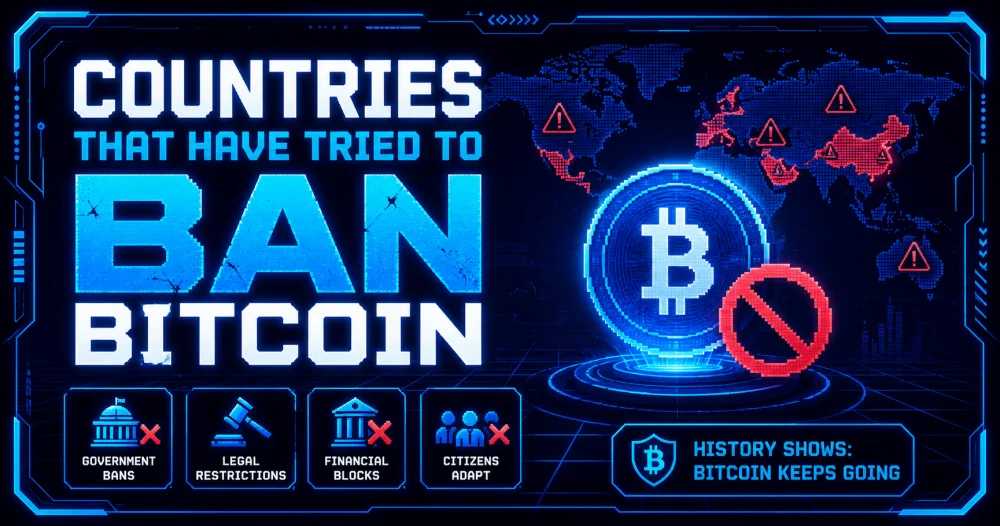
China’s Crackdown on Crypto Mining and Trading
China has implemented the most comprehensive crackdown on cryptocurrencies. The country has enforced stringent rules on crypto trading and, in 2021, announced a nationwide ban on crypto mining. As a result, the price of Bitcoin dropped significantly due to the deluge of negative news about one of the world’s largest economies.
However, Bitcoin did not disappear. Nodes continued operating, and miners worldwide responded to the deluge of pending transactions by adjusting the difficulty of the blockchain. The changes demonstrated that Bitcoin’s hashrate distribution was not concentrated in one region or with one group of miners.
According to research conducted by the Cambridge Centre for Alternative Finance, Bitcoin hashrate was on the rise even after the alleged China Bitcoin ban.
Several other countries have enacted strict cryptocurrency laws. For instance, Algeria is often considered one of the most crypto-hostile countries. In contrast, other nations have enforced economic restrictions, such as limiting access to banks, crypto exchanges, and processors.
Related: Is Michael Saylor Losing Faith in Bitcoin? Strategy Sells 3,588 BTC Worth $226M
Bolivia, Algeria, And Other Nations With Strict Crypto Bans
Bolivia, Algeria, China, and Morocco are often mentioned in discussions about countries that banned Bitcoin or imposed strict crypto restrictions. Algeria has one of the clearest prohibition-style rules, banning the purchase, sale, use, and holding of virtual currencies.
China took a different route, focusing on a major Bitcoin mining crackdown and restrictions on crypto trading. Morocco banned crypto in 2017, while Bolivia was also known for restrictive rules before later changing course.
Countries That Reversed or Softened Earlier Restrictions
Bolivia, Nigeria, and Morocco show how Bitcoin restrictions can soften over time. Bolivia lifted its crypto ban in June 2024, after years of restrictive policy. Nigeria moved from a banking restriction toward rules for bank accounts used by virtual asset service providers.
Morocco has also prepared a draft law to regulate crypto assets after banning cryptocurrencies in 2017. This shows that some governments prefer crypto regulation, licensing, AML checks, and KYC rules instead of keeping a full crypto ban in place.
| Country | Restriction Type | What Happened |
|---|---|---|
| China | Trading And Mining Crackdown | China banned crypto trading and mining in 2021, but Bitcoin mining activity later partially returned despite the ban. (Reuters) |
| Algeria | Strict Crypto Ban | Algeria prohibits the purchase, sale, use, and possession of virtual currencies. (Freeman Law) |
| Bolivia | Ban Reversed | Bolivia lifted its crypto ban in June 2024, and digital asset transactions increased sharply afterward. (Reuters) |
| Nigeria | Banking Ban Softened | Nigeria’s central bank lifted its ban on crypto-related banking activity in 2023 and shifted toward regulation. (Reuters) |
| Morocco | Ban Moving Toward Regulation | Morocco banned cryptocurrencies in 2017 but later prepared a draft law to regulate crypto assets. (Reuters) |
Has Bitcoin Ever Been Successfully Banned?
What Happened After China’s Mining Ban
China’s mining ban serves as one of the most prominent examples of a government attempting to impose a ban on Bitcoin or severely restrict its usage. Shortly after the announcement, Bitcoin’s price dropped significantly as traders feared that one of the world’s largest economies would take additional restrictive measures. Meanwhile, the deluge of restrictions impacted several mining operations, with some being forcibly shut down.
Bitcoin’s hashrate dropped considerably soon after the regulations were tightened. The reduction indicated that China had once operated the majority of the world’s mining facilities. However, several days later, hashrate began climbing as the remaining miners continued operating, and new competitors joined the market.
Although the Chinese Bitcoin ban impacted the market, it did not halt the advancement of the protocol. The adjustments to the difficulty ensured that the time required to mine a block remained consistent throughout the process.
How Hashrate Recovered After Government Crackdowns
The Bitcoin hashrate is a reliable metric that indicates the network’s overall health. If a significant proportion of miners is impacted, the number usually declines, signaling that the system is either weak or under attack.
After China’s mining ban, the hashrate recovered, further demonstrating that a government ban on Bitcoin rarely stops the advancement of the protocol. In fact, authorities’ attempts to localize or nationalize the cryptocurrency have only hastened its development and prompted it to move to other jurisdictions.
Bans can cause volatility and disrupt the market, but they cannot eliminate a decentralized currency with no central authority.
Lessons From Previous Bitcoin Restrictions
Prior government intervention offers valuable insight regarding the likelihood that Bitcoin can be banned. For one, the examples illustrate that a government Bitcoin ban is significantly more challenging than prohibiting a centralized crypto exchange. Although the latter option may halt activity and transactions, banning an exchange does not stop the entire network.
Another lesson is that markets often speculate before evaluating new regulations. As such, the announcement of policies or the mere suggestion that they may be adopted can cause panic among investors. However, the Bitcoin economy has proven to be remarkably resilient despite various restrictions.
The final lesson is that governments’ aggressive actions can cause Bitcoin activity to relocate to jurisdictions that are more inclined to embrace it. In other words, a local crackdown rarely results in a complete disappearance of the cryptocurrency.
How Governments Can Restrict Bitcoin Without Banning It
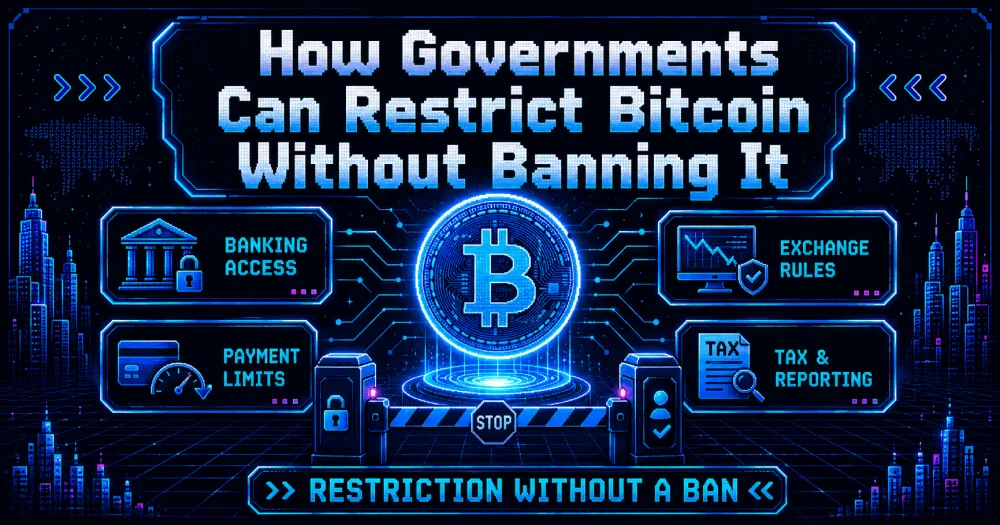
Regulating Crypto Exchanges
A government can choose to regulate a crypto exchange, which is the preferred method of interacting with Bitcoin for most people. This approach is usually applied when authorities realize that a total ban will be challenging to enforce or achieve.
For instance, authorities can mandate that crypto exchanges operate under their guidelines, ensuring that wallet addresses and customers are subjected to screening and verification. Exchanges would also be required to report suspicious transactions and confirm that they hold sufficient reserves to satisfy customer withdrawals.
Read more: The End of Crypto Privacy? How Global Regulations Are Changing Everything in 2026
Taxation, AML, and KYC Requirements
Bitcoin can also be regulated through taxation, with the government imposing significant charges on capital gains, payments, transfers, and mining proceeds. Moreover, a government can take indirect actions, such as prohibiting anonymous transactions.
Authorities can enforce KYC (Know Your Customer) and AML (Anti-Money Laundering) rules, which are standard in traditional finance. For instance, the Markets in Crypto-Assets (MiCA) regulation provides a unified framework for crypto-asset service providers, disclosure, and market conduct rules in the EU. Rather than banning Bitcoin, the policymakers set out guidelines for the cryptocurrency industry.
Banking Restrictions on Crypto Businesses
Crypto-related businesses can also be restricted via banking limitations, with the government intervening in fiat on-ramps and off-ramps. The restrictions can severely challenge the operations of crypto exchanges and miners, especially when the former cannot process customer deposits, and the latter cannot withdraw their earnings.
Such a scenario usually creates the impression that a government has initiated a total ban of Bitcoin. In essence, authorities do not need to prohibit the currency outright to ensure that it is not used within their jurisdiction.
Limits on Mining and Energy Consumption
Authorities can impose limitations on mining activities or the electricity supply that funds the mining process. Restrictions can take various forms, such as auditing, licensing, tariffs, and jurisdiction-specific rules for crypto-native companies. Additionally, governments can eliminate crypto mining by imposing a Bitcoin mining ban.
A mining ban can challenge the growth and performance of the network in a particular country or region. However, the restrictions are unlikely to derail the entire system as the mining equipment can be relocated to another jurisdiction that permits the activity.
Could Major Economies Ban Bitcoin?
The United States’ Regulatory Approach
While the U.S. is unlikely to completely ban or restrict Bitcoin, many policymakers are considering implementing harsher rules and increasing oversight of the crypto industry. In most cases, the focus is on custody and regulation rather than prohibiting the existence of the currency. For instance, in March 2026, the SEC published guidance concerning several crypto assets, including non-security tokens and protocol mining.
U.S. policymakers could enact additional restrictions, such as enhanced oversight of exchanges, custody rules, exchange of reports by brokers, and sanctions policies. However, the combination of these factors is unlikely to constitute a direct ban of Bitcoin.
Europe’s Focus on Compliance Rather Than Prohibition
Europe has adopted a similar approach to the U.S., with the region focusing on regulating crypto rather than banning it. For instance, the Markets in Crypto-Assets (MiCA) regulation provides a uniform framework for crypto-asset service providers, disclosure, and market conduct rules. The approach suggests that the policymakers do not intend to end the existence of Bitcoin through a formal government ban.
The region is not entirely receptive to the idea of a decentralized digital currency, but the policymakers understand the potential benefits of adopting a measured approach to regulation and supervision. It is essential to recognize, however, that compliance can be as challenging and nuanced as direct prohibition.
Why Global Coordination Would Be Difficult
A coordinated effort to restrict or ban Bitcoin would be extremely challenging, even if several countries are willing to participate in it. The approach would require the collaboration of several economies, offshore financial centers, mining operations, and developing markets. The challenge is compounded by the fact that the members of such a diverse group of participants would have different objectives.
Some nations and entities want to impose stricter limits and bans, such as enhanced compliance requirements and capital controls. In contrast, several developing countries are willing to loosen restrictions and encourage the growth of crypto startups and mining operations within their jurisdiction. A few states are apprehensive about the widespread adoption of a decentralized digital currency.
What Would Happen to Bitcoin’s Price If a Ban Were Announced?
Historical Market Reactions to Regulatory News
The Bitcoin price after a ban often plummets immediately after the news breaks, with traders eliminating exposure to the volatile asset. Leverage is unwound as liquidity tapers, impacting the short-term price performance of the decentralized digital currency. The reaction is often dependent on the size and reputation of the country that announced the adverse news.
The adverse developments in China were particularly shocking to the market, considering the size and reach of the economy. At the same time, the impact was short-lived, with the long-term implications being lower than the immediate reaction to the news.
Short-Term Panic vs. Long-Term Recovery
Announcements concerning a government Bitcoin ban or restrictive regulations usually create short-term panic. Traders and investors who are not particularly interested in the long-term prospects of Bitcoin are the first ones to bail out, with the leverage positions being unwound. In the short term, exchanges and miners are also vulnerable, with the former experiencing a significant loss of liquidity and the latter delaying expansion plans.
Moreover, altcoins are always at higher risk, with their prices often dropping faster than those of Bitcoin. At the same time, the long-term outlook depends on the specifics of the announcement, with a ban being significantly more damaging than limitations concerning exchanges, custody, or payments.
Factors That Would Determine the Impact
Several aspects of a government announcement would influence the impact on the Bitcoin price. First of all, the status and size of the country that issued it are critical considerations. For instance, a ban in the U.S. would have a much more significant impact than a similar development in a small economy.
The announcement’s scope and potential impact on the market are also crucial aspects. For instance, a coordinated effort among advanced economies will have a much more significant short-term impact than restrictive measures imposed by a single state. Finally, it is essential to distinguish between a complete prohibition of Bitcoin and limitations imposed on its usage, such as those concerning exchanges.
Can Investors Still Own Bitcoin if Governments Tighten Regulations?
Self-Custody vs. Exchange Custody
Bitcoin self-custody refers to a situation in which an individual possesses the private keys to their wallet, which eliminates the need to rely on an exchange or a third party. Whereas self-custody is theoretically safer, it requires extensive expertise and is not always practical.
In practice, most people prefer exchange custody, wherein their assets are held by a third party. The option is convenient, although it comes with risks, such as the volatility of the crypto market and the potential for scams.
Privacy, Compliance, and Legal Risks
Bitcoin is not a fully private and anonymous currency, with many transactions being publicly accessible. Moreover, the use of additional privacy tools may prompt authorities to launch an investigation into potential money laundering activities or sanction violations.
Privacy-focused tools and techniques could prompt a government to impose additional restrictions or bans concerning Bitcoin. Needless to say, the anonymity of the cryptocurrency is limited, with most transactions being traceable back to an individual.
What Retail Investors Should Watch
Retail investors should be mindful of the rules imposed on exchanges, banks, wallets, regulations concerning taxes, mining, self-custody options, and stablecoins. These aspects can help individuals understand what restrictions may be imposed and how they can respond to them.
Authorities usually impose restrictions on the entire crypto market rather than targeting Bitcoin specifically. As such, it is essential to keep track of regulations pertinent to stablecoins, offshore exchanges, or fraudulent activity.
FAQ
Can the U.S. Ban Bitcoin?
The U.S. cannot impose a complete and total ban on Bitcoin. However, authorities can implement additional restrictions, such as enhanced regulations of cryptocurrency exchanges, limitations on custody, and enhanced tax rules.
Can Europe Ban Bitcoin?
Europe has the capacity to impose a complete ban on Bitcoin. However, the focus of the policymakers now is on regulations rather than prohibitions.
Has Any Country Permanently Banned Bitcoin?
Several countries permanently banned Bitcoin. However, it is challenging to implement a total and permanent prohibition due to the nature and characteristics of the decentralized digital currency.
Can Bitcoin Survive Government Restrictions?
Yes, Bitcoin can survive government restrictions and prohibitions. In fact, the decentralized digital currency has continued to operate after China imposed a severe crackdown on crypto mining and trading.
What Happens If Crypto Exchanges Are Banned?
Crypto exchanges are the lifeline of the Bitcoin network. Banning them would undermine people’s ability to purchase or sell Bitcoin with fiat money. Additionally, the activity of the network would be significantly limited, with transactions becoming difficult to process. However, it is essential to recognize that the mere announcement of a ban is unlikely to halt the development and progression of the network.