Ethereum developer community has topped 1 million lifetime builders, keeping the network as crypto’s largest developer base.
Ethereum, the world’s second-largest crypto in terms of market cap, continues to dominate as the developer ecosystem with more than one million unique lifetime builders joining it.
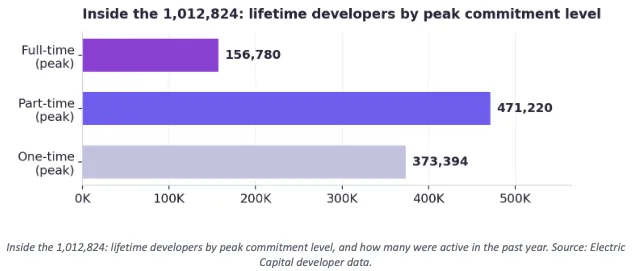
In an X article on June 15, SharpLink CEO Joseph Chalom noted that Ethereum has reached over 1 million distinct lifetime developers, citing data from Electric Capital.
Approximately 232,000 developers are actively working in this ecosystem within the last 12 months, according to Chalom.
Despite the challenges associated with the emerging L1 rivals, Chalom sees the problem irrelevant since, according to him, the only thing that matters at this stage is where developers are going to build.
Read also: Zcash Developers Finalize Ironwood Upgrade Plan. How Is ZEC Price Reacting?
Chalom explains that the advantage of Ethereum network in the eyes of developers isn’t limited to technology. Instead, it refers to institutional aspects as well as cultural ones:
“The advantage is not simply technological. It is institutional, cultural, economic, and compositional — the result of a decade-long accumulation of developers, infrastructure, standards, tooling, liquidity, research, applications, and social coordination that no other ecosystem has replicated.”
Electric Capital, a crypto venture firm that tracks open-source developer activity, lists Ethereum with about 8,000 monthly active developers, 3,000 full-time developers, more than 230,000 repositories and 32 million commits.
Upgrades and Updates
Chalom said Ethereum developers are working on several areas that could boost the network’s position. These include core protocol scaling, privacy, quantum resistance and systems built around AI agents.
One example he cited was the Glamsterdam, an upgrade scheduled for 2026 that could enhance the network’s transaction processing capacity in a way that doesn’t require a change to the basic architecture of the Ethereum network.
As for quantum resistance, Chalom says that Ethereum has an even more organized approach compared to other ecosystems, referring to such documents as Lean Ethereum Roadmap and a specific post-quantum security team at Ethereum Foundation. Chalam explained:
“Ethereum has become the default operating system for programmable finance and internet-native capital formation.”
At the same time, the number of developers alone doesn’t determine the strength of Ethereum’s position among institutional players. Chalom also highlighted standards, liquidity, rollups, EVM support, and “platform neutrality” as factors that add to it.
Read more: Two More Key Developers Leave Ethereum Foundation