Grayscale says Bitcoin price weakness looks more tied to tech-risk selling than fears that quantum computers could break crypto.
Bitcoin‘s latest pullback has put quantum fears back in focus, but Grayscale says they are probably not what is driving Bitcoin price lower now.
Grayscale’s head of research, Zach Pandl, wrote in a May 4 blog post that quantum computers could eventually become a real security issue for Bitcoin and other blockchains, because advanced machines may one day threaten the cryptography used to protect wallets and transactions.
But Pandl argues quantum fear is probably not what has been keeping Bitcoin’s price lower.
Pandl said the pullback in both Bitcoin and quantum-computing stocks since October “reflects a broad de-risking of growth-oriented portfolios, largely triggered by concerns over AI disruption.”
Read also: Bitcoin on May 5: BTC Price Hits New Local High Above $81K
Quantum Stocks Didn’t Behave Like Winners
The chart in Grayscale’s note cuts against the quantum-panic argument. If traders were selling Bitcoin because quantum computers looked closer to breaking it, quantum-computing stocks would likely be moving higher.
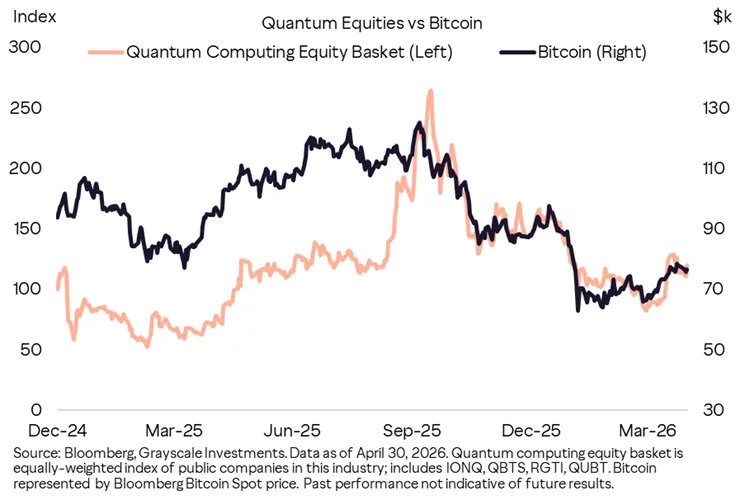
Instead, Pandl wrote that “the share prices of public companies focused on quantum computing have moved in lockstep with Bitcoin over the last few months.”
He added that if quantum breakthroughs were weighing on Bitcoin, “one might expect to see the share prices of companies in that industry rising as a result.”
Quantum stocks have not broken out cleanly either.
- Quantum-computing company IonQ recently traded around $45.7, giving it a market value near $13.5 billion.
- Other public quantum-computing names were also mixed. Rigetti Computing traded around $17.7. D-Wave Quantum, another company focused on quantum-computing systems and services, changed hands near $20.9.
As Grayscale argues, if quantum breakthroughs were the main thing hurting Bitcoin, the companies closest to that trade wouldn’t normally be falling into the same risk-off pile.
But Grayscale hasn’t dismissed quantum risks at all. In an April 6 note, the company noted that Bitcoin’s challenge is “more social than technical,” because the code can be upgraded, but the community would still need to agree on what should happen.
The harder issue is old coins. As Pandl explained earlier, the Bitcoin community needs to decide what to do with coins whose private keys have been lost. Possible options include burning them, leaving them untouched or deliberately slowing their release.
Read more: Google Warns Quantum Risk to Bitcoin and Ethereum Is Closer Than Thought