Crypto market maker disclosure is almost non-existent across leading tokens despite growing institutional activity, a new research finds.
Crypto protocols have figured out how to make a lot of money, but explaining appears to be another story.
Revenue is now widely visible on-chain and, in some cases, flows back to token holders. Yet, most projects still fall short when it comes to packaging those numbers into anything resembling a standard investor update.
A new study from crypto research firm Novora, which reviewed more than 150 protocols, finds that the gap isn’t about data availability but about how little of it is formally communicated.
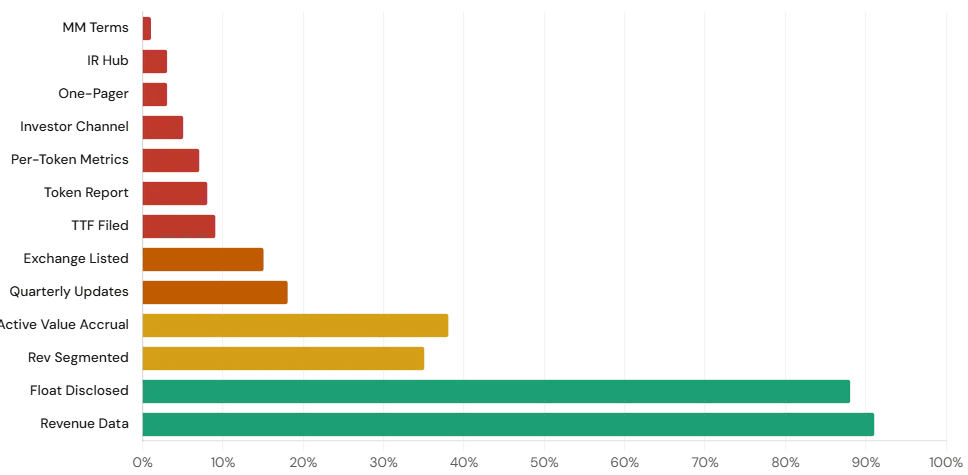
“Revenue exists onchain. Reporting doesn’t exist anywhere,” the report said, noting that nearly 91% of protocols now produce trackable revenue, but only 18% publish quarterly updates. On top of that, just 8% release a token holder report, leaving most investors to rely on dashboards.
Contents
Investor Relations Remain Thin
The imbalance shows up across almost every category. Just 3% of protocols maintain a dedicated investor relations hub. Meanwhile, only about 5% operate any investor-focused communication channel at all beyond social platforms like X or Discord.
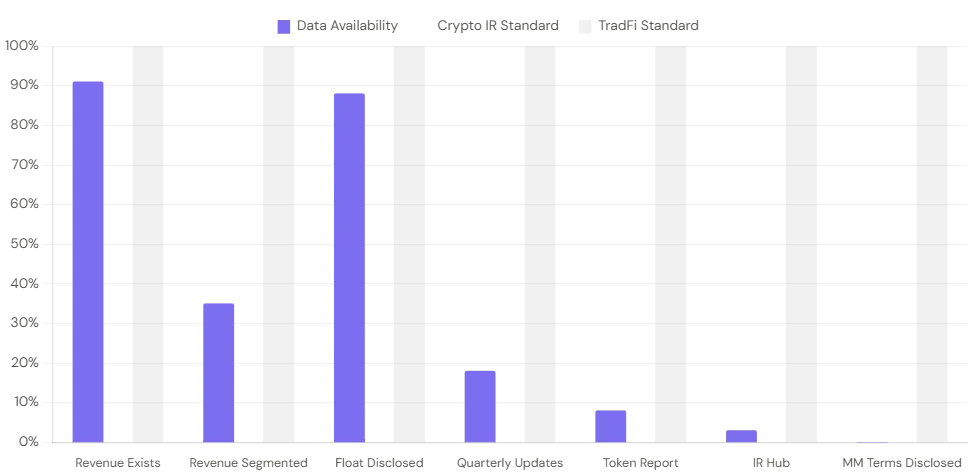
At the same time, the underlying data layer has matured quickly. Coverage reaches about 95% on crypto analytics platform Dune Analytics and 93% on Token Terminal, meaning most protocols already have detailed metrics publicly available. The report reads:
“The data is there. It’s onchain, it’s indexed by third-party platforms, it’s publicly verifiable. But fewer than 1 in 10 protocols package this data into a format that institutional investors can consume. This is the IR gap that defines the industry.”
Crypto Market Maker Deals Almost Entirely Hidden
One of the biggest blind spots sits around liquidity. Less than 1% of protocols disclose their market maker agreements, even though those firms often play a key role in how tokens trade day to day.
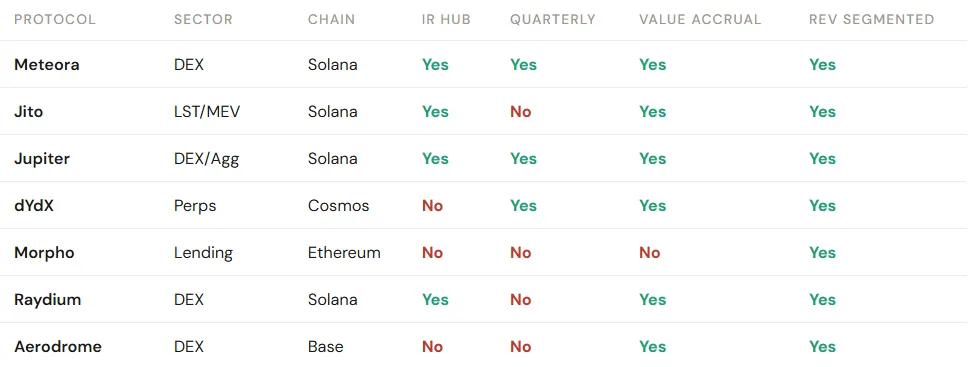
Only Solana-based decentralized crypto excange Meteora was found to have publicly shared details on its arrangements, via a 2025 token holder report. Novora described the opacity as systemic, noting that “market maker opacity is universal” across the sector.
Tokens With Revenue Sharing Tend to Perform Better
Roughly 38% of protocols now include some form of value accrual, meaning token holders receive a share of revenue through mechanisms like fee distribution or buybacks.
Those structures appear to make a difference. Governance-only tokens, which offer no direct economic return, posted average declines of about 51% over a one-year period, compared with roughly 32% for tokens with active value accrual.
The report suggests the exact mechanism matters less than whether one exists at all. “Any active accrual model outperforms governance-only tokens,” Novora wrote, pointing to revenue itself as the key driver.
DeFi Leads While Chains Fall Behind
Disclosure practices vary sharply by sector. DeFi protocols, particularly decentralized crypto exchanges and derivatives platforms, tend to lead, often tying token value directly to fee generation.
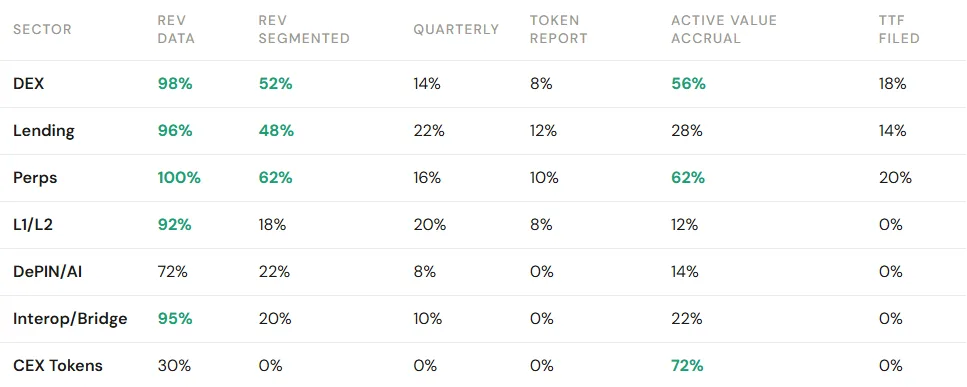
Perpetual futures platforms such as dYdX stand out, with about 62% implementing value accrual models. That compares with just 12% among Layer-1 and Layer-2 networks, despite their larger market capitalizations.
Novora attributes part of the gap to governance structures. Foundation-led ecosystems often lack a clear owner of investor communication, creating what the research firm describes as an IR vacuum.”