The document establishes clear rules for issuers and aims to increase transparency while protecting investor interests.
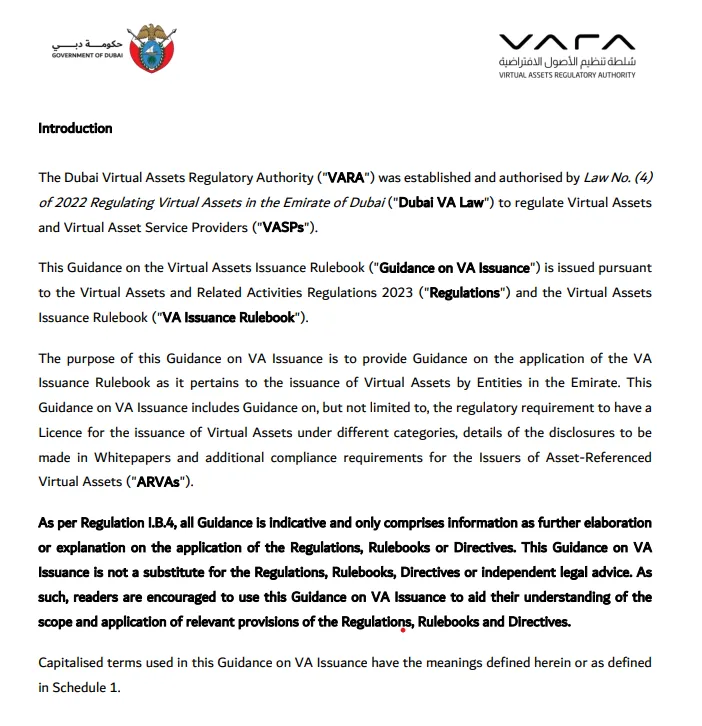
Dubai’s Virtual Assets Regulatory Authority (VARA) published the first global guidance on creating, disclosing, and distributing crypto assets, including tokenized real-world assets (RWA) and stablecoins.
Related: South Korea Plans to Regulate RWA and Stablecoins Under Existing Financial Laws
VARA divided all issuable assets into three categories with different requirements.
Asset Classification
Category 1 includes fiat-referenced stablecoins (FRVA) and assets backed by real resources or their income (ARVA/RWA). Issuers of such tokens must obtain a full VARA license and maintain adequate reserve levels.
Category 2 includes other virtual assets. Issuers do not need a license to issue them. However, sales must occur through VARA-licensed distributors.
Category 3 (Exempt VAs) includes non-transferable tokens and closed-loop assets (such as loyalty points) not intended for secondary market formation.
Related: SEC Nears Launch of Reg Crypto—Proposal Already at White House for Review
Transparency and Stablecoin Requirements
All commercial issuers must publish a white paper in plain language with clear risk descriptions. The document must be available in a machine-readable format. Any material changes must be updated promptly.
Stablecoins face additional requirements. Holders must have the right to redeem the asset for fiat currency. The guidance also prohibits paying yield on idle stablecoin balances.
Additionally, VARA plans to develop technical standards for stablecoin interoperability and a unified digital asset disclosure system.
The Basic Digital Assets Law will be Dubai’s second major regulatory act in this sector. The guidance aims to create a transparent and predictable environment for token issuance while minimizing investor risks.
Related: Chainalysis—Stablecoin Transaction Volume Could Reach $1.5 Quadrillion by 2035