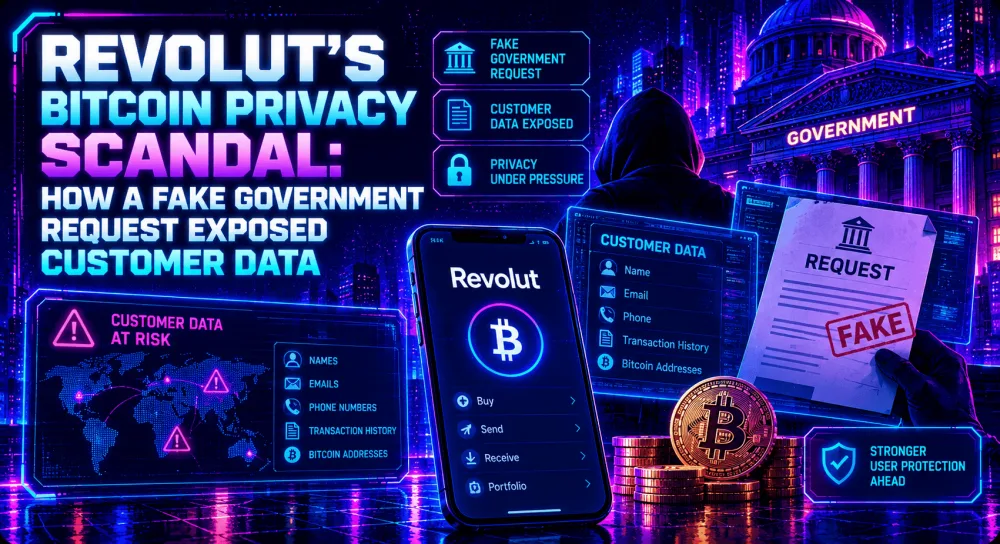
Revolut revealed sensitive customer records after accepting a fraudulent government request. Identity, banking, and Bitcoin data were exposed, raising serious privacy concerns.
Contents
- Revolut’s Bitcoin Privacy Scandal: What Happened?
- What Customer Data Did Revolut Expose?
- How the Fake Government Request Worked
- Was Revolut Actually Hacked?
- Why Bitcoin Transaction Data Makes the Incident Different
- Who Was Affected by the Revolut Data Leak?
- Revolut’s Response to the Data Breach
- The Privacy Risks of Exposing Bitcoin Customer Data
- What Revolut’s Privacy Policy Says About Government Requests
- What the Revolut Incident Means for Crypto Privacy
- How Revolut Customers Can Protect Themselves
- What This Means for Fintech and Crypto Security
- The Bigger Problem With Centralized Crypto Data
- FAQ
- Was Revolut Hacked?
Revolut’s Bitcoin Privacy Scandal: What Happened?
How a Fake Government Request Tricked Revolut
An unauthorized account inside a real government domain sent the request. The authenticity of the email domain made the message appear much more trustworthy than standard phishing.
Read more: $320M Bitcoin Hack: What Really Happened to Liquid Network?
Why the Request Appeared to Be Legitimate
The email contained valid domain authentication signals and infrastructure. This verification only confirms the domain; however, not the sender’s legal authority over the request.
How Revolut Discovered the Fraud
Revolut later contacted the relevant government body to verify the request. This step exposed the unauthorized account and confirmed the fraud.
What Customer Data Did Revolut Expose?
Bitcoin Transaction Histories
Some exposed records contained full transaction histories, including Bitcoin data. These records can reveal wallet links, transfer amounts, timing, and behavior.
Passports, IDs and Verification Selfies
The Revolut data leak includes identity documents for some affected customers. Verification selfies also formed part of the potentially exposed material.
Names, Addresses and Contact Information
The exposed Revolut customer data included names, addresses, emails, and phone numbers. This information can help criminals create highly personalized scams.
IBANs, Account Statements and Withdrawal Records
Some Revolut data leak records include IBANs, account statements, and withdrawal histories. This data can show banking connections and links between accounts and wallets.
What Data Was Not Compromised?
Revolut states that attackers did not compromise its core systems or funds. There is also no evidence that private keys or passwords leaked.
| Exposed Data | What It Could Reveal | Main Risk |
|---|---|---|
| Bitcoin Transaction Histories | Wallet links, transfer amounts, timing, and activity patterns | Crypto targeting, wallet surveillance, phishing |
| Passports and IDs | Full identity details and document information | Identity theft and fraudulent verification |
| Verification Selfies | Facial identity linked to KYC records | Impersonation and social-engineering attacks |
| Names and Addresses | Real identity and physical location | Targeted scams and physical security risks |
| Email Addresses and Phone Numbers | Direct communication channels | Phishing, SIM-swap attempts, account takeover |
| IBANs | Banking relationships and account information | Financial fraud and targeted impersonation |
| Account Statements | Balances, transfers, spending, and financial behavior | Profiling and financial targeting |
| Withdrawal Records | Links between Revolut accounts and external wallets | Identification of crypto holdings and wallet ownership |
| Passwords and Private Keys | No confirmed exposure | Revolut says these were not compromised |
| Customer Funds | No confirmed direct access | Revolut says customer funds remained safe |
How the Fake Government Request Worked
The Unauthorized Account Inside a Real Government Domain
The fraudulent request came from an account inside a legitimate government domain. Security systems therefore saw genuine infrastructure rather than a spoofed domain.
Why SPF, DKIM and DMARC Did Not Stop the Attack
SPF, DKIM, and DMARC verify domain-level email authenticity. They cannot confirm whether the sender actually has authority to request customer data.
Social Engineering Instead of a Traditional Hack
The attacker targeted Revolut’s trust process rather than breaking its software. This Revolut security incident therefore exploits social engineering.
Why Revolut Treated the Request as Authentic
Financial institutions receive requests from government and law-enforcement bodies. Revolut saw trusted infrastructure and valid authentication, treating the demand as legitimate.
Was Revolut Actually Hacked?
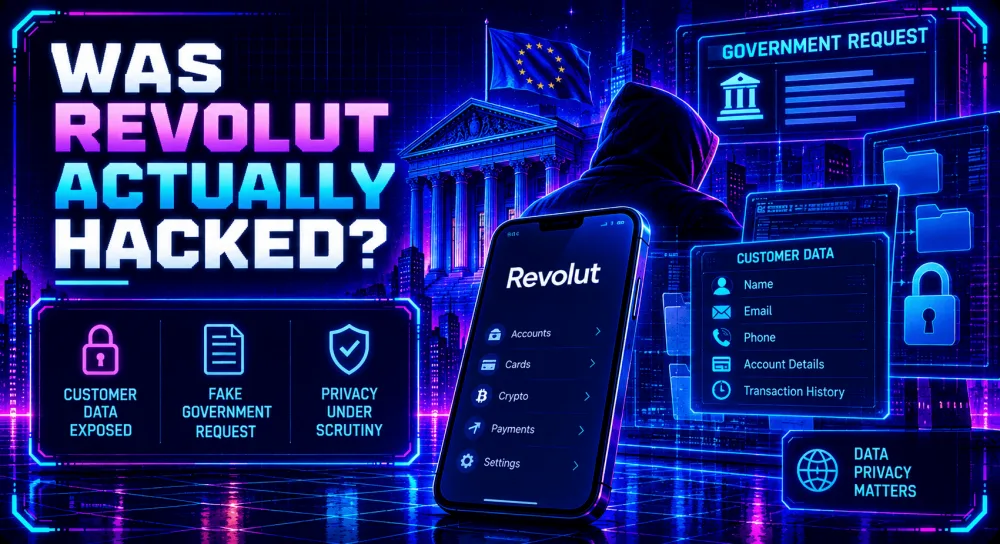
Data Disclosure vs System Breach
A traditional hack involves unauthorized access to internal systems or databases. Here, Revolut itself disclosed data after accepting a fraudulent request.
Why Customer Funds Were Not Stolen
The attacker obtained information rather than direct account control. Revolut states the incident does not affect customer funds or banking systems.
What the Incident Says About Fintech Security
Strong encryption cannot protect data when the staff release it to the wrong recipient. Fintech security therefore needs controls around legal and government information requests.
Related: Polymarket Hit by $2.9M Hack — Prediction Markets Platform Will Compensate Affected Users
Why Bitcoin Transaction Data Makes the Incident Different
What a Bitcoin Transaction History Can Reveal
Bitcoin transaction histories can reveal amounts, timing, wallet relationships, and repeated activity. Large transfers may also provide clues about the user’s financial position.
KYC Data Combined With Onchain Activity
KYC records connect real identities with regulated financial accounts. Combined with onchain data, they can link named individuals to public Bitcoin activity.
Why Bitcoin Privacy Goes Beyond Wallet Addresses
Bitcoin addresses do not contain legal names by themselves. Privacy weakens when centralized platforms connect those addresses with verified customer identities.
Could Exposed Data Put Crypto Users at Risk?
Yes, because criminals can use transaction data to identify valuable targets. Home addresses and identity records can make phishing or physical targeting more dangerous.
Who Was Affected by the Revolut Data Leak?
What Revolut Says About the Number of Affected Customers
Revolut described the affected group as limited. However, the company has not released an exact total for the Revolut customer data breach.
Were High-Net-Worth Crypto Users Targeted?
Some observers suspect wealthy crypto users may have received special attention. Revolut has not confirmed that theory or a targeted customer profile.
What Is Still Unknown About the Victims
The company does not publicly name the government agency linked to the request. It also does not reveal a detailed breakdown by country or customer type.
Revolut’s Response to the Data Breach
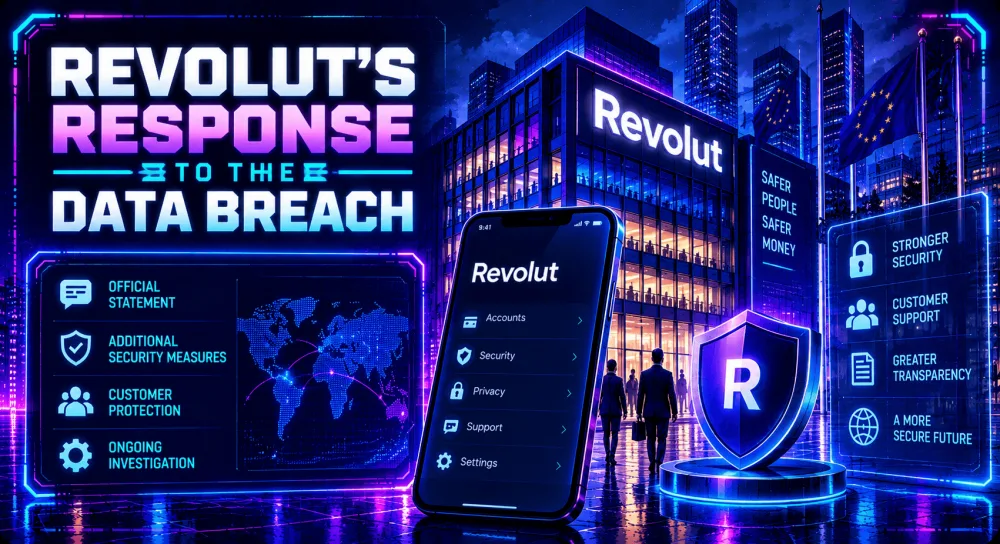
How Revolut Blocked the Unauthorized Account
Revolut blocked the unauthorized email address after discovering the fraud. The company alerted the government body connected with the compromised domain.
Customer Notifications and Precautionary Measures
Revolut contacted affected customers and warned them about the exposure. It also applied precautionary protections to accounts connected with the Revolut data breach.
Regulators and Law Enforcement Investigations
Revolut notified relevant regulators, privacy authorities, and law-enforcement bodies. Investigators can now examine both the fake request and compromised government infrastructure.
What Revolut Says About Customer Funds
Revolut says customer funds remained safe throughout the incident. The company also says attackers did not access its core systems.
The Privacy Risks of Exposing Bitcoin Customer Data
Identity Theft and Financial Fraud
Passports, addresses, birth dates, and banking records can support identity fraud. Criminals can combine several leaked fields to defeat weaker verification procedures.
Phishing and Account Takeover Risks
Detailed customer information can make phishing messages unusually convincing. Attackers may mention genuine account details to trick victims into revealing new credentials.
Crypto Targeting After a KYC Leak
Public blockchain records can remain visible long after a data leak. Criminals may monitor linked addresses and target users after large future transfers.
Why KYC Data Can Be More Dangerous Than a Password
Users can replace a password after an exposure. They cannot easily replace a face, birth date, or historical transaction record.
Related: Mexico Seizes Hidden Crypto Mine With 300 GPUs Amid Cartel Money Laundering Probe
What Revolut’s Privacy Policy Says About Government Requests
When Revolut Can Share Customer Data With Authorities
Revolut can share customer data when legal or regulatory duties require disclosure. Legitimate requests may support investigations, taxation, sanctions enforcement, or other lawful purposes.
Law Enforcement and Regulatory Requests
Banks need procedures for handling valid government and law-enforcement demands. Strong tools should verify identity, authority, scope, and legal basis before disclosure.
The Difference Between a Legal Request and a Fraudulent Request
A legal request comes from an authorized body exercising lawful powers. Fraudulent requests only imitate those signals without genuine authority.
What the Revolut Incident Means for Crypto Privacy
Bitcoin Is Pseudonymous, Not Fully Anonymous
Bitcoin records transactions publicly but does not attach names to addresses. Centralized KYC records can provide the missing identity layer.
The Problem With Centralized Crypto Platforms
Such services collect extensive identity and transaction information for compliance. It creates valuable databases that criminals may exploit.
Why KYC Creates a Single Point of Privacy Risk
KYC systems concentrate passports, selfies, addresses, and transaction records in one place. External requests, insiders, suppliers, or mistakes can expose that information.
Can Crypto Users Protect Their Transaction History?
Users can reduce address reuse and separate different transaction purposes. However, they cannot erase records retained by regulated platforms.
How Revolut Customers Can Protect Themselves
Watch for Phishing After the Data Exposure
Affected customers should distrust urgent messages mentioning Revolut, Bitcoin, taxes, or investigations. Leaked personal details can make fraudulent messages appear authentic.
Secure Your Revolut Account
Customers should secure their email, phone, and Revolut account. They should also review recent activity for unfamiliar cards, logins, or transfers.
Monitor Crypto Wallet Activity
Users should watch wallet addresses connected with exposed withdrawal histories. Unexpected transfers or activity should prompt investigation.
Be Careful With Unexpected Government or Revolut Messages
Official-looking messages can be fraudulent, as this case shows. Customers should verify unusual requests through independently sourced official contact channels.
What This Means for Fintech and Crypto Security
Why Government-Request Verification Needs Stronger Controls
Sensitive disclosures should require more than a trusted email domain. Independent verification, case identifiers, or portals can reduce impersonation risk.
The Risks of Trusting Email Authentication Alone
Email authentication proves narrow technical facts about a message. It does not prove the sender has legal authority to obtain customer records.
Why Human Verification Still Matters
Automated checks can stop obvious fraud, but they cannot judge every legal context. Staff need escalation rules and independent confirmation for sensitive requests.
Could Other Banks and Crypto Exchanges Face the Same Attack?
Yes, because other institutions also process government requests. Crypto exchanges face added risk as KYC records can map identities to blockchains.
The Bigger Problem With Centralized Crypto Data
Exchanges Know More About Users Than Their Wallets Reveal
A wallet shows transactions but usually not the legal identity. Exchanges may hold names, addresses, bank details, documents, and withdrawal destinations.
KYC Databases as High-Value Targets
KYC databases contain information criminals can reuse across fraud schemes. Bitcoin data helps attackers estimate wealth and identify targets.
The Trade-Off Between Compliance and Privacy
Financial rules require companies to identify customers and preserve certain records. It creates privacy risk through centralized storage.
What the Revolut Case Reveals About Crypto Banking
Crypto banking combines traditional identity checks with transparent blockchain activity. The Revolut Bitcoin data breach reveals the dangers of the combination after wrongful disclosure.
FAQ
What Happened to Revolut Customers In September 2026?
A fake government request caused Revolut to disclose sensitive customer records. Revolut later discovered that the sender lacked authorization.
Did Revolut Leak Bitcoin Transaction History?
Yes, some exposed records contained full transaction histories, including Bitcoin data. This information can link known identities with public blockchain behavior.
Was Revolut Hacked?
Revolut says attackers did not breach its core systems. The company disclosed data after accepting a fraudulent government request.
What Customer Data Was Exposed?
Potentially exposed data includes identity documents, selfies, contact details, IBANs, statements, and transaction histories. The information differs between customers.
Were Revolut Customers’ Funds Stolen?
Revolut says customer funds remained unaffected. The main risks involve privacy, identity fraud, phishing, and future targeting.
How Many Revolut Customers Were Affected?
Revolut describes the number as limited but has not released an exact figure. It leaves the full scale of the Revolut data leak unclear.
Was The Government Request Fake?
Yes, the request lacked genuine authority, despite using a legitimate government domain. Revolut identified the fraud during verification.
Can Bitcoin Transactions Be Traced to a Person?
Yes, when a platform links wallet activity with KYC information. Public blockchain data can reveal additional transaction relationships.
What Should Revolut Customers Do Now?
Affected users should watch for phishing and secure their accounts. They must also verify unusual Revolut or government messages via independent channels.