Polymarket is adding Pyth-backed markets tied to stocks, commodities, and indexes, giving retail traders a new way to bet on price moves.
Pyth Network’s native token rose about 9% following the latest developments around its integration with Polymarket. According to CoinGecko data, PYTH is now trading at $0.042, bringing its market capitalization to $240.7 million.
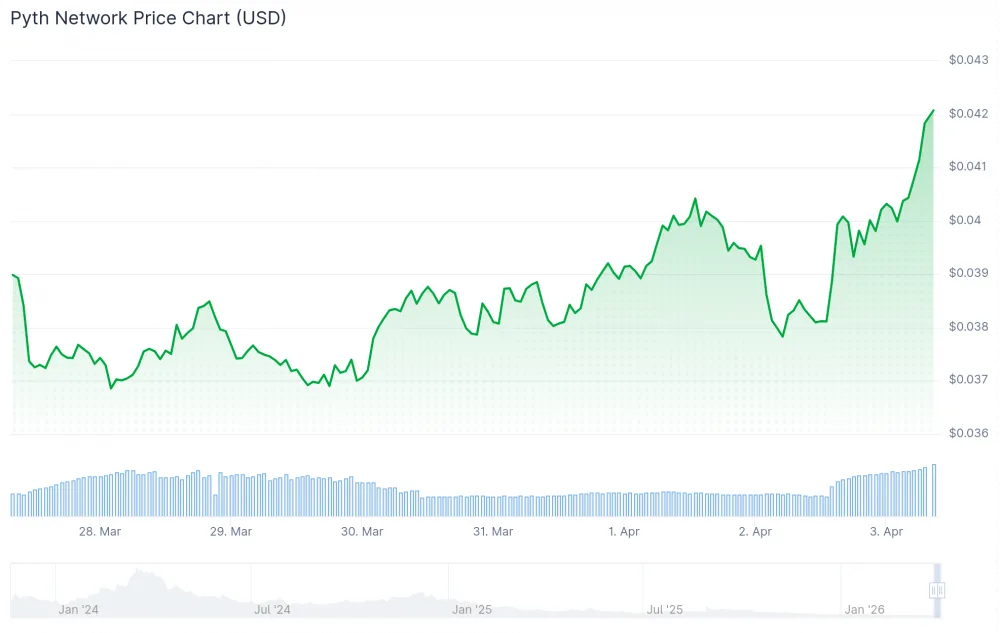
However, even with the price surge, PYTH remains down roughly 96.5% from its all-time high of $1.20 reached in March 2024.
The price reaction comes as Polymarket rolls out Pyth-backed markets tied to real-world assets, giving retail traders a new way to bet on price moves. The new markets include daily up-or-down and daily close bets on gold, silver, oil, and more than a dozen U.S. stocks, including Tesla (TSLA), Coinbase (COIN), and Nvidia (NVDA).
In a press release on Thursday, April 2, Pyth Network said Polymarket has integrated its data as the resolution source for a new suite of traditional asset markets. Alongside the collaboration, Pyth also announced the launch of Pyth Terminal, a data interface where traders and developers can verify price feeds in real time.
How Big Polymarket Is
The collaboration comes as prediction markets are getting more mainstream, fast. As Reuters reported earlier, Intercontinental Exchange, the parent of the New York Stock Exchange, put $600 million into Polymarket as part of a plan to invest up to $2 billion.
This brings ICE’s total commitment to roughly $1.64 billion, following a previous $1 billion investment in October 2025, and putting Polymarket’s valuation at approximately $9 billion to $11.6 billion.
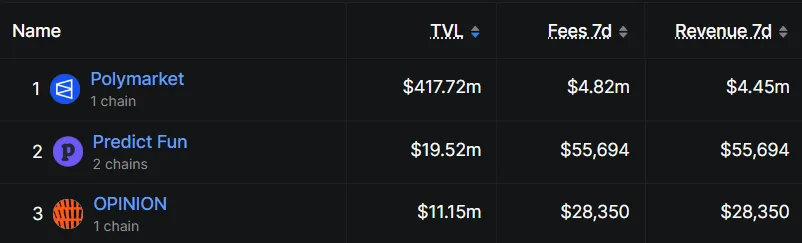
Polymarket remains the largest prediction market by total value locked (TVL). According to DefiLlama, it holds more than $417 million, accounting for roughly 89% of the sector’s $467 million TVL.
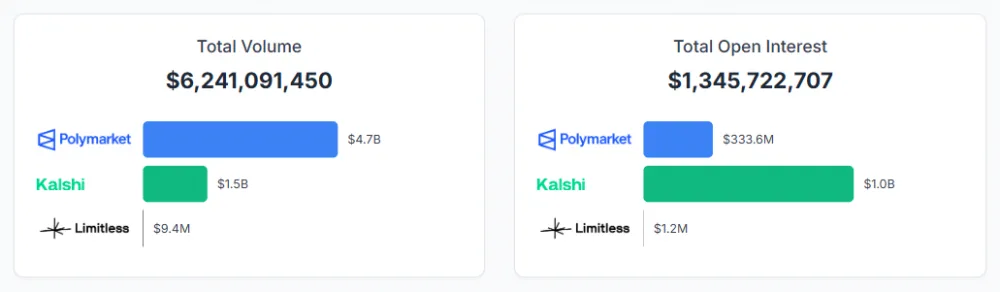
By contrast, in terms of open interest, which is the total value of active bets, Kalshi, another prediction market, is ahead. As of press time, the platform has over $1 billion in open interest, compared with about $333 million on Polymarket, according to data from Polymarket Analytics.
Regulation of Prediction Markets in the US
Despite the influx of capital, the regulatory landscape around prediction markets in the U.S. remains unsettled. On Thursday, April 2, the U.S. Department of Justice and the Commodity Futures Trading Commission filed a lawsuit against the State of Illinois, seeking to block it from applying its gambling laws to federally licensed Designated Contract Market operators.
The CFTC argues that under the Commodity Exchange Act, it has exclusive jurisdiction over swaps and futures traded on federally regulated exchanges. States, it says, have no authority to intervene or apply gambling laws to such platforms.
The lawsuit follows cease-and-desist letters sent by the Illinois Gaming Board to Kalshi, Crypto.com, Robinhood, and Polymarket.