The most important XRP▲$1.13 blockchain updates in 2026 are moving the XRP Ledger beyond payments: into institution-friendly tokenization, credit, and programmable finance. Some upgrades are already live, while others remain under validator voting or development. Still, the roadmap targets several weaknesses that previously limited institutional DeFi and real-world asset adoption of the XRP blockchain.
Contents
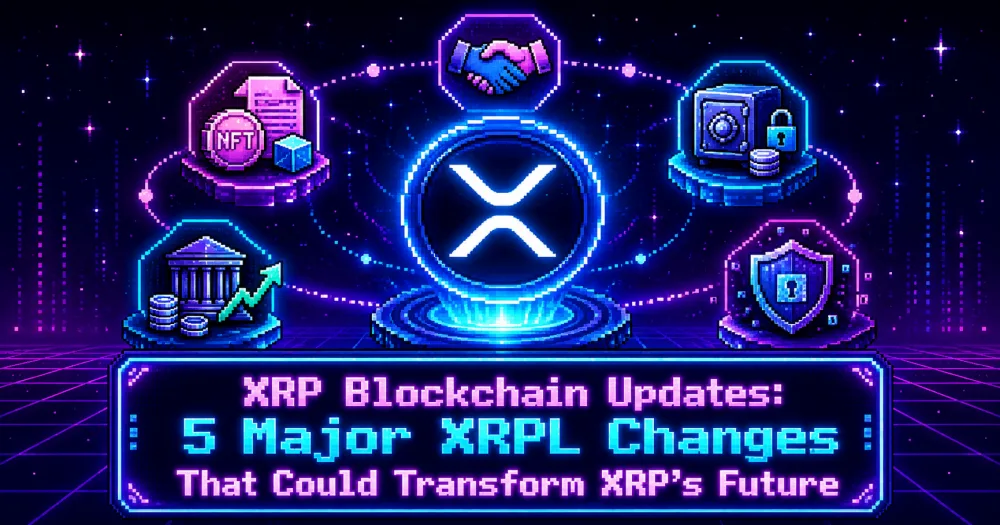
- Why XRP Blockchain Updates Matter in 2026
- 1. Multi-Purpose Tokens Could Expand XRPL Tokenization
- 2. Permissioned Domains and DEXes Open Regulated Markets
- 3. Token Escrow and Smart Escrows Add Programmable Settlement
- 4. Single Asset Vaults and Native Lending Could Create Credit Markets
- 5. Confidential MPTs and Zero-Knowledge Privacy Target Institutions
- How Could These XRPL Changes Affect XRP?
- What Investors Should Watch Next
- Final Verdict
- FAQ
Why XRP Blockchain Updates Matter in 2026
XRPL already offers fast settlement, low costs, a native decentralized exchange, and XRP auto-bridging. However, it lacked several tools institutions expect, such as native lending and programmable settlement.
Read more: Why Is XRP Underperforming? 3 Reasons Ripple Still Can’t Catch Up With the Crypto Market
The latest XRP blockchain updates add these functions directly to the ledger as standardized primitives rather than unrestricted smart contracts. This can reduce contract risk and simplify development.
According to the recent reporting by Ripple, tokenized real-world assets (RWS) on XRPL exceeded $474 million and daily transactions reached three million on March 15, 2026. Sustaining that growth will depend on whether the upgrades attract more liquidity.
1. Multi-Purpose Tokens Could Expand XRPL Tokenization
Multi-Purpose Tokens, or MPTs, are XRPL’s second-generation fungible token standard. MPTokensV1 became active in October 2025, but its importance is growing as other upgrades integrate MPTs into escrows, permissioned domains, vaults, and lending.
An MPT issuance can define maximum supply, transfer fees, authorization requirements, transferability, clawback permissions, and metadata. Issuers can create fixed-supply assets, restrict who may hold them, or make tokens non-transferable.
Potential uses include stablecoins, tokenized deposits, bonds, fund shares, loyalty points, commodities, and regulated real-world assets. MPTs also store immutable metadata on the ledger and can connect to permissioned domains.
The limitation is that MPTs still lack full parity with older XRPL tokens. MPTokensV2 is intended to integrate them more fully with the DEX, AMMs, payments, and checks.
For XRP, more issued assets could increase fees, reserve usage, and demand for XRP as an auto-bridge. But the standard only matters if institutions issue actively traded assets rather than experimental tokens with little volume.
2. Permissioned Domains and DEXes Open Regulated Markets
Permissioned Domains went live on February 4, 2026, followed by Permissioned DEX functionality on February 18. Together, they create controlled trading environments inside the public XRP Ledger.
A permissioned domain defines which credentials grant access. Credentials can represent KYC completion, jurisdiction, accreditation, sanctions screening, or another eligibility standard. A permissioned DEX then restricts trading to accounts that hold accepted credentials.
Transactions remain on the public ledger. What changes is who may participate in a specific market. Permissioned offers trade within one domain, while hybrid offers can access both a permissioned order book and the open DEX.
Among all XRP blockchain updates, this may have the clearest institutional use case. Banks, stablecoin issuers, and asset managers often cannot trade anonymously against unknown counterparties. Permissioned markets give them on-chain settlement with access controls.
The tradeoff is fragmented liquidity. Separate domains may be too shallow to offer competitive pricing. XRP could benefit as an auto-bridge in compliant FX and stablecoin markets, but institutions can also trade token pairs directly.
Read more: XRP Whales Keep Buying While Ethereum Signals Deeper Capitulation, On-Chain Data Reveals
3. Token Escrow and Smart Escrows Add Programmable Settlement
The TokenEscrow amendment became active on February 12, 2026. Before this change, XRPL escrow primarily locked XRP. The ledger can now place trust line tokens and eligible MPTs into escrow.
This supports delayed payments, vesting schedules, settlement guarantees, milestone releases, and controlled asset distribution for stablecoins and tokenized securities.
The more ambitious Smart Escrows proposal introduces a WebAssembly execution layer. Developers could write custom functions controlling when escrowed assets are released, enabling oracle-based payouts, delivery-versus-payment settlement, insurance claims, compliance checks, and treasury rules.
This is narrower than Ethereum-style smart contracts because code controls an escrow rather than running as an unrestricted application. That may reduce attack surfaces while covering practical financial workflows.
The risks remain substantial. WASM execution adds complexity, external data can be manipulated, and faulty logic can lock assets. Smart Escrows are still in development rather than live on mainnet.
If implemented safely, this branch of XRP blockchain updates could make XRPL far more useful for enterprise settlement while keeping XRP central to fees, reserves, and bridge liquidity.
4. Single Asset Vaults and Native Lending Could Create Credit Markets
XRPL’s proposed Lending Protocol enables fixed-term, uncollateralized loans funded through Single Asset Vaults. The code and documentation exist, but the amendments must complete validator activation before the system becomes fully available on mainnet.
Single Asset Vaults pool one asset from multiple depositors. A vault can hold XRP, a traditional XRPL token, or an MPT. Depositors receive vault shares, while private vaults can restrict participation through credentials and permissioned domains.
The Lending Protocol adds loan brokers, borrowers, repayment schedules, interest, and first-loss capital. Underwriting remains off-chain, while loan creation, funding, repayments, impairment, and defaults are recorded on XRPL.
This differs from overcollateralized DeFi lending. It targets institutional credit, where borrowers may receive loans after underwriting rather than depositing more collateral than they borrow.
Possible uses include trade finance, corporate working capital, private credit, stablecoin lending, and institutional XRP liquidity. The system also introduces real default risk: transparent accounting does not guarantee good underwriting.
Native lending could be the most economically significant of the five XRP blockchain updates. It may create demand for XRP as a vault asset, loan currency, reserve asset, or bridge. Yet stablecoins may dominate lending because institutions prefer predictable units of account.
5. Confidential MPTs and Zero-Knowledge Privacy Target Institutions
Public blockchains expose balances and transaction histories. That transparency helps auditing but can reveal trading strategies, client positions, collateral movements, and commercial relationships.
Ripple’s roadmap places zero-knowledge proofs at the center of XRPL’s privacy strategy. Confidential MPTs are intended to let institutions transact with tokenized assets while hiding sensitive amounts or details and still proving compliance.
The goal is selective disclosure rather than uncontrolled anonymity. Participants could prove that a transaction follows required rules without exposing every underlying fact publicly.
Potential uses include private tokenized collateral, confidential institutional transfers, regulated trading with hidden order information, and proof of eligibility without full identity disclosure.
Privacy may determine whether large institutions move meaningful activity on-chain. However, confidential MPTs remain in development. Zero-knowledge systems are technically demanding, and regulators may disagree over what must remain visible.
If successful, these XRP blockchain updates could strengthen XRPL’s position in institutional tokenization. If privacy remains delayed or too restrictive, institutions may choose private ledgers or competing networks.
Read more: XRP Price Explosion Ahead? Analyst Says the Next Major Repricing Could Start Within Months
How Could These XRPL Changes Affect XRP?
None of the five upgrades guarantees a higher XRP price. XRPL can host stablecoins and tokenized assets without requiring every transaction to use XRP as the principal asset.
The bullish case rests on several channels:
- Every transaction pays and burns a small XRP fee.
- Accounts and ledger objects require XRP reserves.
- XRP can auto-bridge trades between assets.
- Vaults and loans may use XRP directly.
- More applications can increase liquidity and development.
The bearish argument is that stablecoins could capture most payments and lending demand, permissioned markets could remain fragmented, and institutions may use XRP only for negligible fees.
The decisive metric is not the number of amendments. It is the durable economic activity they produce.
What Investors Should Watch Next
The most useful indicators are amendment activation, MPT issuance, permissioned DEX volume, vault deposits, lending activity, tokenized asset value, stablecoin settlement, and XRP’s share of bridge routes.
Investors should also separate live features from proposals. Permissioned Domains, Permissioned DEXes, MPTokensV1, and token escrow are active. Native lending is moving through the amendment process, while Smart Escrows and confidential MPTs remain in development.
Final Verdict
The current XRP blockchain updates represent one of XRPL’s largest expansions in years. The network is adding modern tokenization, regulated trading, token escrow, institutional credit, and privacy without abandoning efficient financial settlement.
The strongest near-term opportunity is permissioned tokenized finance. The most important longer-term opportunities are lending and privacy. Both could create substantial activity, but both depend on technical activation, adoption, and usable liquidity.
XRPL is becoming more capable. XRP’s future depends on whether those capabilities make XRP essential liquidity and settlement infrastructure rather than merely the token used to pay tiny network fees.
FAQ
What Are the Biggest XRP Blockchain Updates in 2026?
The major changes include expanded MPT functionality, Permissioned Domains and DEXes, token escrow, proposed Single Asset Vaults and native lending, and privacy development using zero-knowledge proofs.
Is the XRPL Lending Protocol Live?
Not fully. The lending code and documentation exist, but the Lending Protocol and Single Asset Vault amendments must complete validator activation before unrestricted mainnet use.
What Is a Permissioned DEX on XRPL?
It is an order-book market limited to accounts holding accepted credentials. It allows regulated participants to trade on a public blockchain while controlling counterparty access.
Will XRPL Smart Escrows Support Smart Contracts?
Smart Escrows are designed to run custom WebAssembly functions that control escrow release conditions. They provide focused programmability rather than unrestricted general-purpose smart contracts.
Will These Updates Increase the XRP Price?
They could increase XRP utility through fees, reserves, lending, and auto-bridging. Price impact depends on adoption, liquidity, and whether institutions use XRP rather than only stablecoins and tokenized assets.