XRP▲$1.13 continues to be one of the market’s largest crypto assets by volume. However, the token’s 2026 performance has lagged considerably versus the best performers. XRP can have strong surges, but they tend to fizzle out soon after takeoff.
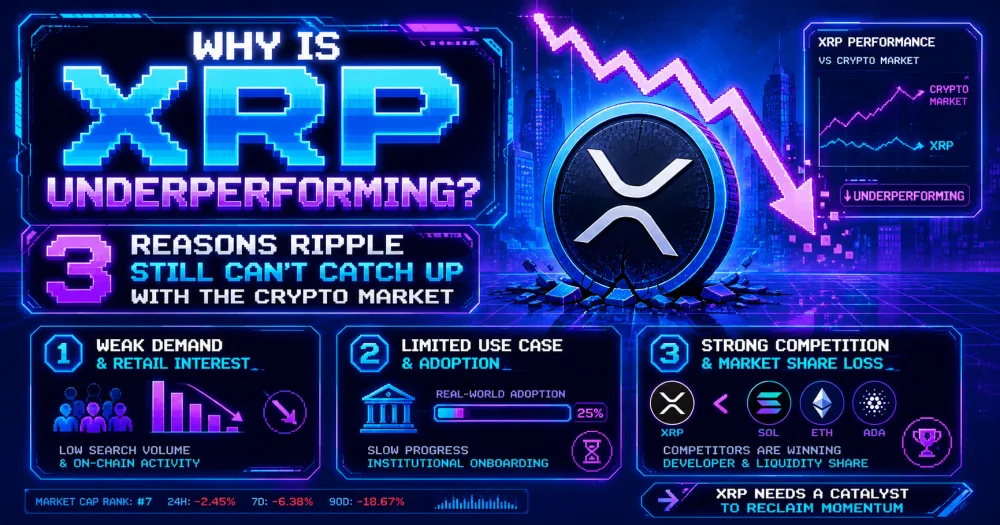
This pattern is part of the why is XRP underperforming hot discussions that dominate the community this year. The reason why XRP is down more than many competitors has little to do with one specific factor. Rather, it is down to capital rotation, competition from similar assets, and technical challenges all contributing to the mix, with investors demanding more concrete evidence of utility.
Related: XRP Price Prediction 2026: Is a Major Drop Coming for Ripple?
Contents
XRP Performance in 2026: Why Has Ripple Fallen Behind?
How XRP Has Performed Compared With Bitcoin, Ethereum, and Solana
XRP was expected to perform better in 2026 after a strong 2025 that saw the token gain regulatory and institutional credibility. The rally that followed was impressive, but the momentum failed to translate into lasting strength. Bitcoin and Ethereum continued to draw heavy institutional investment, with the latter posting renewed attention as the preferred smart-contract platform.
In turn, Solana remains one of the key rivals vying for XRP’s share of the market, particularly among DeFi-focused traders. The token’s on-chain activity is consistently strong, with periodic spikes that drive impressive price gains. However, XRP has struggled to maintain its upward trajectory.
Key Metrics Showing XRP’s Relative Weakness
One of the most obvious factors pointing to XRP’s underperformance in 2026 is relative strength. A less obvious sign is the lack of value realization following positive news flow. XRP needs stronger catalysts to post significant gains, while other tokens appreciate with every minor positive development. Another challenge is traders’ skepticism following several failed attempts to break key levels, with demand evaporating at critical junctures.
As a result, the price action can be misleading, particularly when it comes to analyzing why XRP is hardly growing in price. One reason why XRP is lower than expected in 2026 is the confluence of events that take place when the token posts gains. XRP volume tends to surge during upswing waves, but buying pressure dissipates at key points of resistance.
Is XRP Still Following the Broader Crypto Market?
XRP is partially following the general market direction, as is evident by its frequent moves in tandem with Bitcoin or macroeconomic forces. However, there are periods when the token is quick to sell off when the broader crypto space is lower.
One of the key reasons why XRP is lagging is evident by its reaction to Bitcoin’s precipitous decline. The token is seldom able to remain stable for long when Bitcoin is lower. By contrast, a similar correction in the broader market rarely triggers an equally sizeable selloff in XRP.
Meanwhile, a general market uptick seldom results in immediate gains for XRP. In this scenario, capital is first funneled into Bitcoin, Ethereum, and Solana before any appreciable move higher in XRP takes place. As such, any discussion about XRP’s underperformance should consider the context of institutional demand and overall liquidity in the market.
Institutional Capital Is Flowing Elsewhere
Why Bitcoin ETFs and Ethereum Products Continue to Lead Inflows
Bitcoin and Ethereum continue to draw institutional investment at a steady rate in 2026, with both tokens benefiting from growing trust among traditional asset allocators. Their appeal is further enhanced by deep liquidity, extensive experience, and existing infrastructure across derivatives, spot, and other markets. Bitcoin is regarded as the premier digital-asset destination, while Ethereum offers exposure to smart contracts and other innovations.
XRP-related investment vehicles have value and draw demand, but they lack the critical mass of their primary rivals. As such, any institutional allocation to crypto tends to favor Bitcoin and Ethereum first. This dynamic is even more pertinent for large institutions that seek to minimize risk by dealing with assets that possess well-established custodial and settlement infrastructure.
Has Institutional Demand for XRP Slowed?
Institutional investors continue to express interest in XRP, although their demand has been lower than in previous years. One reason why XRP is lower than anticipated in 2026 is that relevant investment vehicles have failed to gather significant momentum. Institutional investors may buy XRP spot or through futures while taking advantage of long-term bullish trends.
The combination of sustained inflows and growing demand is vital to moving the price higher. As such, any discussion about why XRP is down must recognize the importance of institutional buying. However, a gradual increase in demand may leave the price stagnant for extended periods, with the token failing to appreciate even as investors grow increasingly bullish.
What This Means for XRP Price
Inflows have been vital to most of XRP’s recent moves higher, but they seldom result in immediate price gains. A larger increase in institutional buying power is necessary to overcome technical hurdles and spark a strong rally. As such, any analysis attempting to explain why XRP is down should note that investment vehicles are not always reliable predictors of price action.
A more informative exercise would involve identifying conditions that facilitate XRP price prediction, such as sustained demand, rising spot volumes, and a break higher after key technical levels.
Read more: Best Web3 Wallets 2026: Secure Picks for DeFi, XRP and Beginners
Ripple’s Ecosystem Growth Isn’t Matching Competitors
XRP Ledger vs Solana, Ethereum, and Other Layer-1 Networks
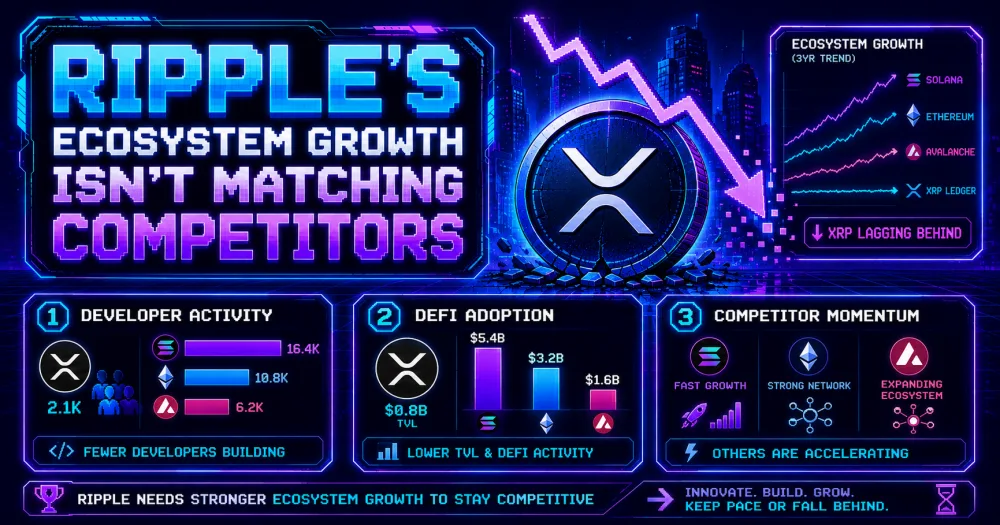
XRP Ledger was designed to enable rapid settlement while minimizing fees, but the token faces heightened competition from rivals that offer additional features. One reason why XRP is down more than other tokens this year is that its advantage over competitors has diminished in 2026. Solana, for example, has seen increased activity across DeFi applications, tokenization, trading venues, and other platforms.
Developer Activity and DeFi Adoption
Meanwhile, Ethereum’s appeal as a developer platform continues to grow, with the network seeing an influx of wallets and protocols. Such developments reduce XRP’s appeal as an alternative, particularly considering how its own DeFi space has stagnated in recent months. To reiterate, the question of why XRP is down is linked to the broader context of why investors choose to allocate capital elsewhere.
Can New Ripple Partnerships Change the Trend?
New ecosystem partnerships can provide much-needed credence to XRP and Ripple price forecasts in 2026. At the most basic level, such alliances serve as an indication that demand for the token’s services is rising, with businesses choosing to utilize XRP Ledger’s advantages. In reality, the most useful partnerships would involve significant shifts in liquidity, stablecoins, custodianship, and other areas.
If these areas continue to see a steady increase in adoption, why XRP is down in 2026 ceases to be the most pertinent question. Ripple’s partnerships would need to accelerate the token’s usage across the board to improve its appeal.
Technical Resistance Keeps Limiting Momentum
Major Resistance Levels Traders Are Watching
One reason why XRP is lower in 2026 is the technical challenges that prevent the price from moving higher. Traders are constantly encountering obstacles, with the market frequently peaking near the $1.1 level before declining. Higher levels would need to be revisited before the token can resume its uptrend, at which point the price would enter a stronger regime.
The importance of these XRP resistance levels is further emphasized by their impact on conversations about XRP’s feeble price growth. The token’s value can rise quickly following a bullish development, but the gains are often short-lived. Breaking higher requires more than a brief increase, especially one that sees buying pressure dissipate quickly following an intraday surge.
Whale Activity and Exchange Flows
Large-scale XRP transactions tend to be significant for price action, with whales regularly selling off large amounts of the asset. Deposits into exchanges have also declined in recent months, with some analysts linking the development to reduced selling pressure. In truth, both developments are useful in understanding why XRP has been dropping, but they need to be placed within a broader context.
As discussed throughout this article, any analysis concerning XRP price prediction must account for several factors. One of the most important indicators involves observing large deposits and withdrawals, as they tend to impact the supply-demand equation considerably.
Futures Open Interest and Market Sentiment
Derivatives traders play a critical role in the fortunes of most crypto assets, with their actions sometimes impacting the spot price considerably. Why XRP is down this year is due to the open interest and short positions data, which can highlight key trends. For example, open interest tends to rise alongside the price during an uptrend, peaking before the reversal takes place.
A similar situation usually plays out during downtrends, with the open interest typically contracting at a faster rate than the price. One reason why XRP is down compared to other tokens is that shorts may benefit disproportionately from a market downturn. The most useful datapoint in this scenario would involve assessing funding rates, which are indicative of the level of optimism among longs and shorts.
What Could Finally Trigger an XRP Breakout?
Regulatory Developments
Regulatory clarity has already contributed to a significant uptick in both XRP price and overall market capitalization several times this year. The fact that XRP is down has much to do with the fact that further regulatory progress has yet to occur. Regulatory developments concerning digital assets, stablecoins, token offerings, and institutional settlement can propel the price higher.
With that said, further regulatory victories for the XRP token may not be sufficient for another large-scale price increase. Investors would want several months of increased adoption, product offerings, liquidity, and transaction volumes for the token to see a substantial increase in value.
Institutional Adoption Catalysts
Institutional adoption is one of the most important drivers of price discovery for XRP in 2026. One potential catalyst would involve an increase in institutional demand for XRP investment vehicles or participation in the XRP Ledger. A rise in XRPL usage would further enhance the appeal, with the token’s utility driving more adoption. Institutional trading would be critical in this scenario, with funds and whales fueling the price surge necessary to propel the token higher.
Such a development would be vital to most discussions about why XRP is down. In short, demand for the asset in different capacities is the most pertinent question when it comes to xrp price prediction. The buying would need to be widespread and long-term to provide the sustained upward momentum that has eluded the asset.
Technical Signals That Would Confirm a Trend Reversal
As mentioned previously in this article, potential catalysts for an XRP breakout usually go beyond one bullish development. In most cases, traders need to see a confluence of positive factors, including a strong price move, increased adoption and transaction volumes, and growing institutional investment. Breaking higher following resistance would also be an important sign, with the price needing to close strongly following the breakout.
Related: XRP Price Outlook July 2026: Will XRP Rebound or Crash Below $1?
Is XRP Still Worth Watching in 2026?
Bullish Scenario
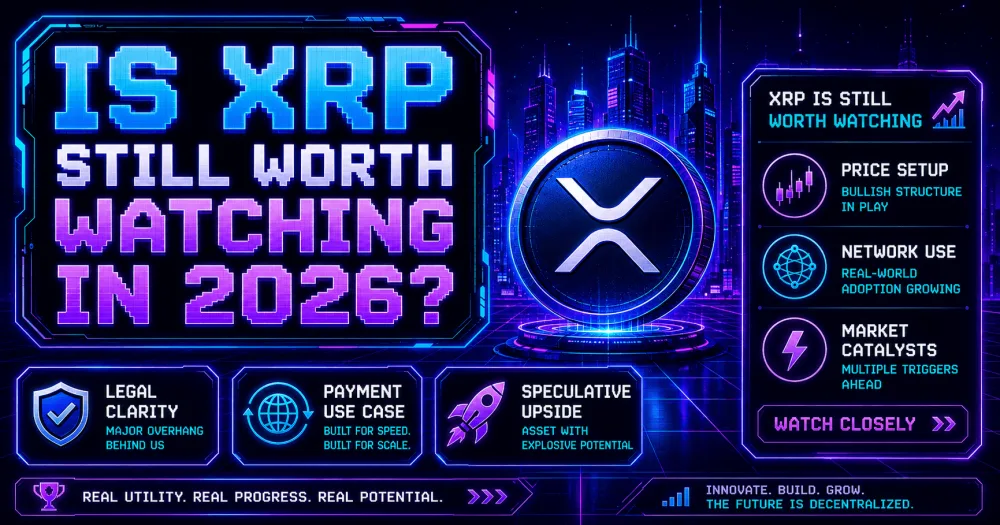
Why is XRP down in 2026 is a reasonable question, but it fails to account for the bullish arguments about the token. XRP benefits from deep liquidity, widespread adoption, and strong institutional infrastructure, with the token set to see increased adoption in the years to come. A rise in adoption should improve the token’s chances at outperforming its rivals, with liquidity providing the crucial support necessary for further gains.
A bullish XRP forecast would be strengthened by a break higher, increased institutional investment, and rising adoption in line with the token’s potential.
Bearish Risks
One reason why XRP is down more than most in 2026 has to do with the opportunity-cost dynamics. The token seldom appreciates at the same rate as other major digital assets, with Bitcoin and Ethereum set to benefit from growing institutional adoption. Bears would point to the crowded nature of institutional investing and the likelihood of capital shifting towards other assets.
At the same time, the bears would note that repeated failures to move higher create value-destructive volatility. The question of why XRP is down would be predicated on the loss of crucial support and the next wave of selling pressure that would offset prior buying streaks.
What Investors Should Monitor Next
One of the most pertinent questions about the future of XRP revolves around why XRP is down. Analysts must consider multiple factors that point to the asset’s future, including liquidity, adoption, and price trends. As discussed in this guide, these issues are best approached from three angles, namely capital flow, activity within the ecosystem, and price movement.
Investment vehicles play an essential role in the former category, with institutional interest providing crucial context for assessing the value of XRP. Exchange balances and whale movements are also useful in this regard, with the data concerning supply-demand dynamics about the token. The latter two areas provide the much-needed context for evaluating liquidity and adoption, which, in turn, are critical to price discovery.
The importance of price structure in assessing the future of XRP cannot be overstated. Support and resistance, trading volume, and short positions should be analyzed carefully when attempting to determine price direction. Why is XRP down? Bears would note the danger of relying on singular developments when assessing an asset’s prospects, with the price often being the most reliable indicator.
FAQ
Why Is XRP Underperforming in 2026?
XRP trails many other assets owing to reduced capital flows, sluggish adoption, and technical challenges.
Why Is XRP Down When Bitcoin Is Up?
The price of Bitcoin does not always correlate with the price of other crypto assets, with institutional capital often flowing to one asset at the expense of others.
What Are the Most Important XRP Resistance Levels?
One of the most important XRP resistance levels in the short term is likely to be found around the $1.1 price level, with higher barriers set to the token’s advantage.
Can XRP Still Break Out in 2026?
There is no reason for why is XRP down bears to believe that the token will be unable to break out and move higher in the coming months.
What will cause the XRP price prediction to change? Institutional adoption, increased transaction volumes, and a strong price breakout will be crucial to moving the price higher and changing the outlook.