Euro stablecoins could bring more risk than reward if Europe uses them to answer dollar-backed tokens, Lagarde warned.
European Central Bank President Christine Lagarde pushed back against calls for Europe to promote euro stablecoins, saying in a May 8 speech published by the ECB that the case for such tokens is “far weaker than it appears.”
Stablecoins have grown from less than $10 billion six years ago to more than $300 billion today, Lagarde said. Despite that growth, close to 98% of them are still tied to the U.S. dollar, while almost 90% of the market is controlled by Tether and Circle, the two largest stablecoin issuers.
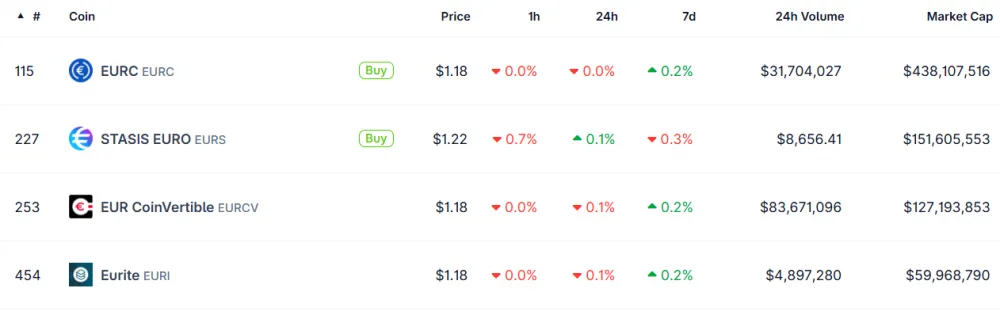
Euro stablecoins remain marginal by comparison. CoinGecko’s euro stablecoin category shows about $910 million in market capitalization, with EURC and STASIS EURO among the largest tokens, while the broader stablecoin market is about $318 billion.
Read also: Kraken Parent Payward Buys Stablecoin Provider Reap for $600M
Lagarde pushed back against calls for Europe to answer dollar stablecoins with more euro-denominated tokens:
“The argument I want to develop today is that once we disentangle those two functions, the case for promoting euro-denominated stablecoins is far weaker than it appears. And a more fundamental question comes into view: do we actually need stablecoins to obtain the benefits they are said to provide?”
Her argument was that policymakers are mixing up two separate things. Stablecoins can act as digital money, especially in countries where “access to a stable currency has historically been constrained.” They can also act as on-chain settlement tools for tokenised markets.
ECB Sees Risk in Stablecoin Pegs
The ECB sees value in the second use case. Lagarde noted that tokenised assets can settle faster and reduce the need for separate ledgers and long settlement windows.
But the ECB head pointed out the money function still carries clear risks.
- When Silicon Valley Bank collapsed in March 2023, Circle disclosed that $3.3 billion of USDC▲$0.9999 reserves were held there.
- USDC briefly fell to $0.877, breaking from its intended $1 peg.
That episode showed that stablecoins can come under pressure when confidence in their reserves weakens, the ECB head emphasized, adding that large redemptions could also feed stress back into the markets holding those reserves.
Lagarde also warned that stablecoins could pull deposits out of banks and weaken monetary policy transmission in the euro area, where banks “remain the dominant source of credit to the real economy.”
The ECB’s preferred answer is public settlement infrastructure, not a euro stablecoin race, Lagarde said, adding that the Eurosystem will launch wholesale settlement through its Pontes project in September.