The CLARITY Act delay is set to become a defining crypto regulation development for the U.S. in 2026. Markets had expected the Senate crypto bill to clear the immediate hurdle ahead of the July 4 recess and provide much-needed regulatory clarity to crypto markets. Instead, the CLARITY deferral sees the same debates about the future of token markets, digital assets classification, and the prospects for institutional adoption continue.
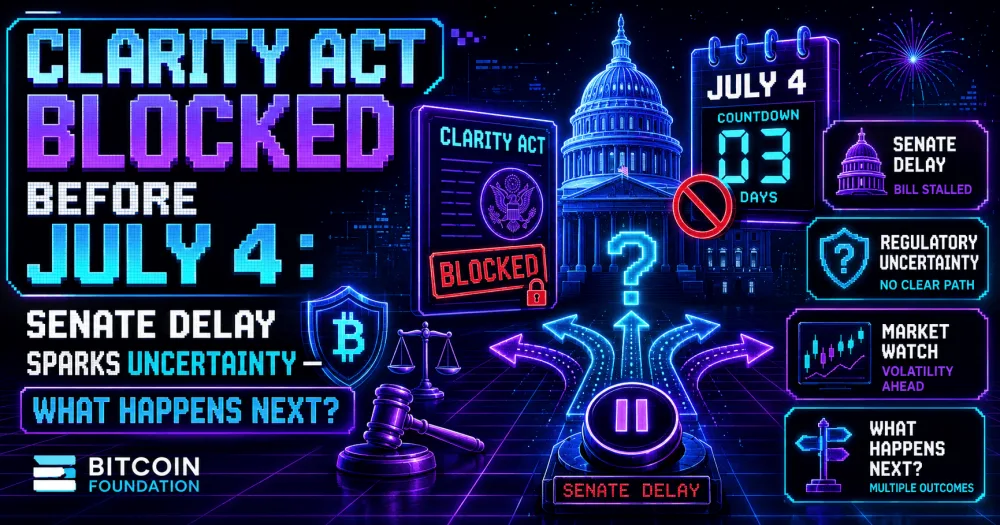
While the status of the bill is not dead, the postponement affects Bitcoin, Ether, altcoins, exchanges, DeFi protocols, stablecoins, and ETF issuers in ways that go beyond just theory. It impacts their listing strategies, custody options, disclosures to regulators, budgets for compliance, and the overall appeal to institutional investors. What comes next in the Senate will dictate whether these questions will be resolved soon or dragged out for years.
But how exactly does this CLARITY development affect crypto markets? The most important consideration is the reaction of traders who do not care to follow every law change but rather rely on the probability of new regulation being passed. As the passage of the Senate crypto bill became more likely, traders used this as a reason to buy more digital assets. Following the delay, the same investors are now lowering their risk exposure and taking profits.
Read more: How the CLARITY Act Could Reshape US Crypto Trading
It is not the passage that drives markets but the likelihood of it happening. That is why the same law can drive prices higher when voters are confident in its outcome and depress them when it becomes clear that nothing will happen anytime soon.
At the same time, this CLARITY deferral does not derail all crypto development. Only the most urgent cases are impacted. For example, a blockchain project considering a U.S. launch, a derivatives exchange debating the merits of listing tokenized deposits, or a venture fund trying to increase exposure to altcoins will all be affected by regulation changes. But if the Senate cannot pass any law in the next couple of months, these businesses will have to postpone their plans. That is the opportunity cost of the CLARITY delay and a reason why it matters to crypto markets beyond theory.
Contents
- 1.What Is the CLARITY Act and Why It Matters for Crypto Regulation
- 2.Why the CLARITY Act Vote Was Blocked Before July 4
- 3.What the “Senate Delay” Really Means for the CLARITY Act
- 4.Immediate Market Reaction to the CLARITY Act Delay
- 5.How the Delay Affects the U.S. Crypto Regulatory Landscape
- 6.Political Factors Behind the CLARITY Act Standoff
- 7.What Happens Next For The CLARITY Act
- 8.Expert Predictions And Market Outlook
- 9.Is Regulatory Clarity Still Coming In 2026?
- 10.FAQ
What Is the CLARITY Act and Why It Matters for Crypto Regulation
The Core Purpose of the CLARITY Act in U.S. Crypto Policy
The CLARITY Act aims to establish a federal market structure for digital assets. It is supposed to bring order to the chaos by ending jurisdictional disputes in courts and among regulators and establishing a clear set of rules.
How the Bill Aims to Divide SEC and CFTC Authority
The CLARITY draft makes it clear that the SEC and CFTC jurisdiction over digital assets will be divided. The SEC would retain jurisdiction over securities and investment contracts, while the CFTC would regulate digital commodities and associated spot markets.
Why This Legislation Is Critical for Bitcoin, Ethereum, and Altcoins
Bitcoin has the broadest regulatory acceptance, while Ethereum and altcoins remain subject to varying degrees of scrutiny. The Clarity Act promotes Bitcoin adoption while also addressing the concerns for other digital assets. This can improve liquidity in token markets and reduce listing risks.
Market Expectations Before The July 4 Vote
Before the July 4 vote, traders and investors were betting that this catalyst would finally enable a Senate resolution. While this did not happen, a crypto regulation vote in the upper chamber would have been a positive sign for the markets.
Why the CLARITY Act Vote Was Blocked Before July 4
Internal Senate Disagreements and Political Deadlock
The CLARITY vote was blocked due to internal disagreements. The bipartisan Senate crypto caucus is not unified on how to approach this issue. Pro-crypto senators want to impose stricter consumer protections, while others believe it will kill innovation.
Key Regulatory Conflicts Slowing Down the Bill
The key reasons why this Senate vote on crypto regulations was postponed involve stablecoins, DeFi, AML reporting, custody, disclosures, and token classifications. Each of these topics involves a heated debate about how to balance innovation and consumer protection.
Lobbying Pressure From Crypto Industry vs Traditional Finance
Crypto proponents want clearer rules so that builders and capital can flow into the U.S. Traditional finance lobbying groups want stablecoin issuers and payment processors to be subjected to the same banking regulations as financial institutions.
Procedural Delays And Scheduling Breakdown In Congress
Beyond the substance of the debate, crypto regulation is being delayed by how much procedural attention it can receive in a busy Senate.
Related: Unions and Democrats Push Back Against CLARITY Act: Who Else Is Slowing Down the US Crypto Bill?
What the “Senate Delay” Really Means for the CLARITY Act
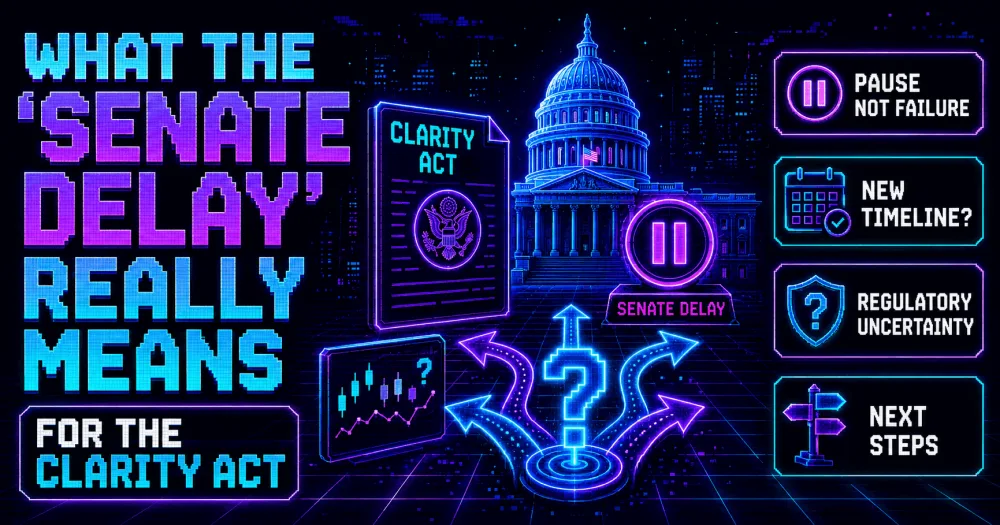
Difference Between Postponement And Legislative Failure
A Senate delay is not the same as a legislative defeat. Had this voting procedure failed, the failure would have been obvious, which is not the case with the CLARITY deferral. Essentially, the bill is still alive but with less time to clear the chamber.
Possible New Voting Timeline Scenarios
The bulls want a CLARITY re-vote in July. The bears want to kill the bill by pushing it to the end of the calendar year. A neutral scenario involves another crypto regulation vote in late summer.
What Conditions Must Be Met For the Vote to Resume
The vote can resume if senators reach an agreement on stablecoins, DeFi, AML language, and the division of jurisdiction. The leadership needs to be convinced that the new wording will not result in a floor fight.
Historical Examples Of Similar Crypto Bill Delays
Most crypto regulation initiatives are born, die, and resurface in fits and starts. Stablecoin and market structure bills are expected to have similar trajectories and procedural hurdles before a final outcome.
Immediate Market Reaction to the CLARITY Act Delay
Bitcoin and Ethereum Price Sensitivity to U.S. Regulation News
Bitcoin and Ethereum tend to lead the pack in terms of price sensitivity to any U.S. regulation news. However, such events rarely trigger sharp price movements, especially in Bitcoin’s case. They do contribute to increased volatility.
Impact On Altcoins’ And Memecoins’ Volatility
Compared to Bitcoin, other cryptocurrencies are more sensitive to regulatory news, particularly memecoins. The reason is their dependence on liquidity and speculative positioning. Altcoins are even more precarious due to their uncertain regulatory status.
Institutional Investor Sentiment After The Delay
Institutional investors may continue to buy the dip in Bitcoin and Ethereum but be hesitant to increase exposure to other asset classes.
Derivatives And ETF Expectations Shift
Derivatives traders are the first to realize when a pivotal event has failed to occur, which makes them the first to adjust their positions. The CLARITY Act delay will likely result in reduced long positions and decreased expectations for altcoin ETF listings.
Related: CLARITY Act Passes Key Senate Committee: Now Everything Depends on Democrats
How the Delay Affects the U.S. Crypto Regulatory Landscape
SEC Vs CFTC Jurisdiction Confusion Continues
Without the bill, SEC vs CFTC crypto confusion continues. Companies still must guess whether their assets, services, or platforms fit securities rules, commodities rules, or both.
H3: Stablecoin And DeFi Uncertainty Increases
The stablecoin-related concerns involve the treatment of redemption risks, rewards, and competition with traditional finance. The DeFi-related issues center around governance, decentralization, and interfaces with traditional finance.
Potential Regulatory Vacuum in 2026
Even if a formal crypto regulatory vacuum occurs, businesses affected by it will take regulatory actions to fill this void.
Global Competitors (EU, Asia) Gaining Advantage
The regulatory uncertainty makes the U.S. less attractive to crypto entrepreneurs, giving other jurisdictions an edge.
Political Factors Behind the CLARITY Act Standoff
Divisions Inside the U.S. Senate
The Senate is split between innovation, consumer protection, banking concerns, and enforcement priorities. The final text must be clear enough for builders and strict enough for skeptics.
Upcoming Elections And Political Timing Pressure
With the elections approaching, members of the Senate are aware of the risks associated with contentious votes. The fact that crypto regulation has become a partisan issue hurts its prospects in the short term.
The Role Of Bipartisan Crypto Support And Resistance
The bill has bipartisan interest, but support is conditional. Some lawmakers want stronger AML rules. Others want wider developer protections and a lighter path for decentralized networks.
The Influence of Financial Regulators And Watchdogs
Regulators and watchdogs continue to warn about fraud, illicit finance, market manipulation, and conflicts of interest. Their pressure can force amendments and slow down the bill’s progress.
What Happens Next For The CLARITY Act
Possible Revised Voting Dates After July 4
The earliest possible voting date would be after the July 4 recess. If the negotiators can finalize the language before the break, a July vote is possible. Otherwise, the Senate may have to wait until September.
Amendments Likely to Be Introduced
Expected amendments concern stablecoin rewards, DeFi definitions, AML reporting, custody, disclosures, and ethics oversight.
Scenarios: Approval, Delay, or Dilution of the Bill
The best case is approval with a workable SEC-CFTC split. The middle case is another delay. The worst case is a diluted bill that passes but fails to deliver real clarity.
Signals to Watch From Congress in the Coming Weeks
Most signals emanate from the text of the amended bill, including the likelihood of a Senate vote, comments from pivotal lawmakers, and industry lobbying efforts.
Expert Predictions And Market Outlook

Short-Term Crypto Volatility Forecast
With the short-term outlook clouded by the CLARITY postponement, Bitcoin may continue to serve as the best hedge against economic uncertainty. Ether’s volatility will be driven by the prospects for ETF approval, while altcoins and memecoins are likely to see increased price swings.
Long-Term Regulatory Clarity Scenario (Bull vs Bear Case)
The bull case concerns the ability of the CLARITY Act to usher in an era of institutional adoption. The bear case involves prolonged regulatory uncertainty and the shift of innovation to other jurisdictions.
Institutional Adoption Under Delayed Regulation
Institutional crypto adoption regulation will continue, but it may become more selective. Large investors can expand Bitcoin exposure while waiting on altcoins and DeFi.
Impact On U.S. Crypto Dominance
U.S. crypto dominance depends on capital markets, legal certainty, developers, banking access, and exchange liquidity. Delayed rules weaken that advantage even if demand remains strong.
Is Regulatory Clarity Still Coming In 2026?
Key Takeaway From The Senate Delay
The key takeaway is simple: the CLARITY Act delay is a warning, not a final verdict. The bill still has a path, but the fast-track story is weaker.
What Investors Should Watch Next
Investors should watch the Senate vote timing and language, stablecoin-related amendments, DeFi-related amendments, and statements from influential lawmakers.
Final Outlook on U.S. Crypto Legislation
Regulatory clarity is still possible in 2026, but it is no longer guaranteed. Until the Senate resolves the bill, crypto will trade between optimism, caution, and political risk. Eventually, the future of U.S. crypto regulation will depend on whether the Senate can deliver on its promises in the next few months.
FAQ
What Is the CLARITY Act Delay About?
The CLARITY Act delay is the postponement of the Senate crypto vote, which was expected to take place before July 4.
Is The Senate Crypto Bill Dead?
The Senate crypto bill is not dead but rather delayed due to disagreements over DeFi regulation, stablecoin oversight, AML reporting, and jurisdiction.
Why Does the Bill Matter for Bitcoin Regulation News?
This bill matters for Bitcoin regulation news because it will define the way Bitcoin is to be treated in the future.
What Is the Main SEC vs CFTC Crypto Issue?
The main SEC vs CFTC crypto issue concerns the division of jurisdiction over digital assets.
How Could the Delay Affect Crypto Prices?
This delay can increase market volatility, especially for altcoins, reduce risk appetites, and put downward pressure on prices, especially in the short term.
Can Regulatory Clarity Still Arrive in 2026?
Yes, it can arrive in 2026 but only if the Senate manages to agree on the bill before the end of the year.