The best prediction markets APIs for builders depend on product scope, legal access, latency needs, and data depth. This review compares trading APIs, analytics APIs, and aggregation layers for dashboards, bots, research tools, and API-first products.
Prediction market infrastructure now includes three tracks. Some prediction markets APIs support trading. Others expose analytics, market metadata, or aggregated feeds across platforms. Builders use them for live dashboards, probability alerts, event-contract research, and automated order workflows.
This guide helps developers compare the best prediction markets APIs without treating one stack as universal. The right api for prediction markets depends on compliance, documentation, WebSocket coverage, data history, and endpoint stability. These prediction markets APIs also carry regulatory, technical, and financial risks. This page is not financial, legal, or tax advice.
Disclaimer: Affiliate and data accuracy note
Some relationships may be affiliate-based, but the review uses test criteria. Prediction markets APIs can change access, limits, pricing, and geography after publication. Updated on June 18, 2026, It is not investment advice.
Contents
- How we ranked prediction markets APIs for developers
- Best prediction markets APIs compared by use case
- Review notes for the leading prediction markets APIs
- API for prediction markets by product category
- Integration checklist for API prediction workflows
- APIs we would not rank without extra verification
- FAQ about best prediction markets APIs
- Bio: Author, review date, and testing scope
How we ranked prediction markets APIs for developers
We ranked prediction markets APIs by matching technical evidence to developer use cases. The score uses a 10-point scale, not brand size. Market coverage, documentation, SDK quality, WebSocket support, latency checks, sandbox access, and legal clarity all mattered.
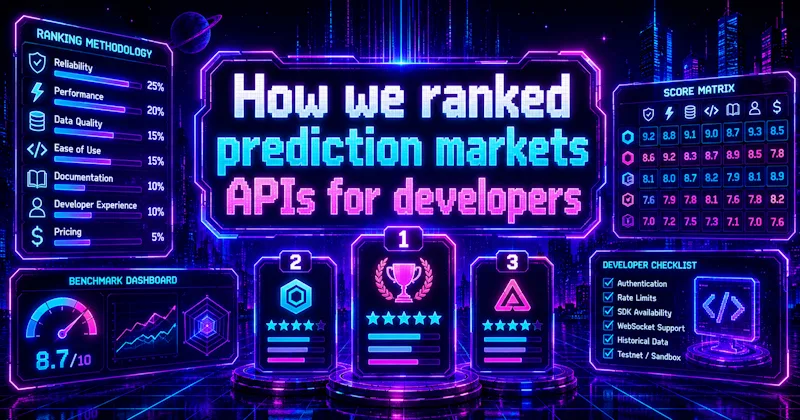
The formula is simple enough to audit:
- Documentation and examples: 20%
- Market data depth: 20%
- Trading workflow and auth: 15%
- WebSocket or streaming support: 15%
- Sandbox and safe testing: 10%
- SDK, language support, and samples: 10%
- Compliance and access clarity: 10%
In our test, the best prediction markets APIs were not always the most visible products. Some prediction markets APIs looked useful for data but weak for execution. Public data limits also affected scoring, especially where docs were incomplete or product pages lacked developer endpoints.
Testing criteria, data sources, and scoring formula
We treated each api prediction score as a weighted result, not a general opinion. Closed data was marked as a limitation. Prediction markets APIs with public docs, stable samples, and visible auth rules scored higher.
| Criterion | Weight | What We Checked | Pass Signal | Limitation |
| Docs | 20% | Endpoint pages | Current examples | Docs may lag |
| Data | 20% | Markets, prices, history | JSON samples | Closed history |
| Auth | 15% | Keys, scopes, terms | Clear permissions | Account gating |
| Streaming | 15% | WebSocket, reconnect | Live feed docs | Paid tiers |
| Compliance | 10% | US access notes | Official terms | Legal change |
This method keeps prediction markets APIs comparable across trading, research, and aggregation use cases.
Proof of testing and verification workflow
Our verification workflow records what was stated, what was opened, and what worked in test. A prediction api should not be described as production-ready until endpoints answer as documented.
Checklist used in our test:
- API key request available or blocked
- Public endpoint returned a valid payload
- Auth error was understandable
- Sandbox or demo path was documented
- WebSocket page showed channel logic
- Latency was recorded with timestamp
- Screenshot endpoint was saved without secrets
For each api prediction check, we marked status as stated, verified, blocked, or unavailable. We never publish tokens, private keys, account IDs, or sensitive api predictions payloads.
Best prediction markets APIs compared by use case
The best prediction markets APIs are easier to compare when grouped by job. A trading bot needs execution, auth, order status, and reconnection logic. A research dashboard needs market metadata, history, settlement status, and exportable data. An aggregator product needs normalization across platforms.
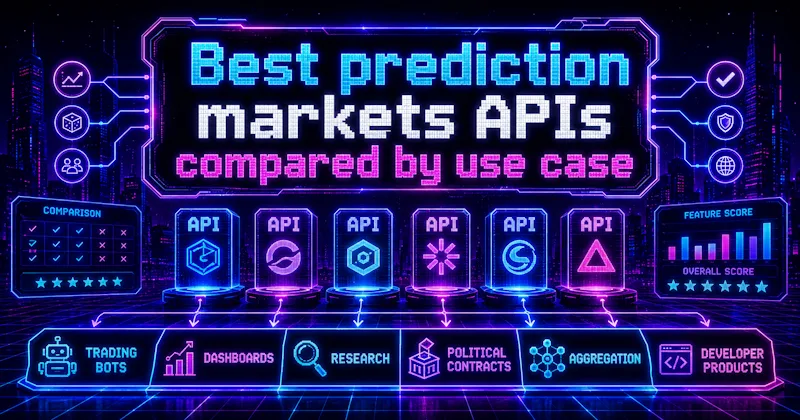
This comparison separates prediction markets APIs by practical fit:
Trading bots need direct exchange access and order events. Dashboards need stable public data. Research tools need historical samples. Political contract tools need eligibility checks and official rules. Aggregation products need coverage, schema consistency, and vendor resilience.
That is why prediction markets APIs should not be selected by price alone. Legal access, data freshness, and endpoint proof matter more for US builders.
Top 9 prediction markets API scorecard
The table compares prediction markets APIs by visible developer value, not by trading appeal. The best prediction markets APIs still require endpoint checks before integration.
| API | Use Case | Access Model | Data Type | SDK | Risk | Verification Status | Notes |
| Polymarket | Crypto-native markets | Docs and auth | Order book, trades | TS, Python, Rust | US restrictions | Verified docs | WebSocket useful |
| Kalshi | US event contracts | Regulated account | Markets, orders | API examples | Eligibility | Verified docs | REST, WS, FIX |
| Gemini | REST and WS flows | Account permissions | Events, terms, orders | Docs | Terms required | Verified docs | Prediction REST added |
| Dome | Aggregation | API key | Cross-platform data | TS, Python | API end of life | Limited | Acquired by Polymarket |
| Manifold | Prototypes | Public API | Social markets | REST | Alpha changes | Verified docs | Not cash trading |
| Robinhood | Consumer product | Product access | App markets | No public PM API found | API gap | Limited | Product page only |
| Coinbase | Regulated product | Product access | Markets | No PM API found | API gap | Limited | Exchange API separate |
| Bitquery | Analytics | API key | Lifecycle, trades | GraphQL | Chain coverage | Verified docs | Polygon focus |
| PredictIt or Metaculus | Research | Public or partner data | Market or forecast data | Mixed | Maintenance or access | Limited | Verify before use |
A political prediction markets api needs more review than a general api for prediction markets, because trading permission can be narrower than data access.
Review notes for the leading prediction markets APIs
Each review uses the same format so prediction markets APIs are compared fairly. The card checks API purpose, supported data, auth, SDK or examples, limits, two positives, and two drawbacks.
We separate public facts from our test notes. Public docs can show an endpoint, while our test only confirms access from our environment. That distinction matters because prediction markets APIs may restrict regions, trading actions, or account permissions.
The review format also avoids marketing claims. A platform can have deep markets but weak developer access. Another can have clean endpoints but limited coverage. US builders should treat every card as a starting point for endpoint testing, not as final approval.
Polymarket API prediction markets for crypto-native trading
Polymarket api prediction markets fit crypto-native builders who need market metadata, order book data, and live price updates. In our test, the docs showed order book access and a WebSocket market channel for changes, prices, and trades.
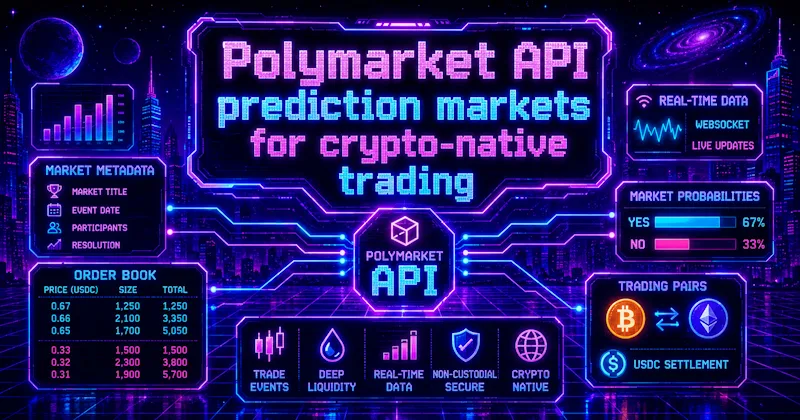
| Parameter | Polymarket API Notes |
| Primary use case | Crypto-native prediction market data and trading workflows |
| Access model | Public docs, account-based trading access, regional restrictions |
| Data available | Market metadata, order book, last trade price, trades, live updates |
| WebSocket support | Yes, market and user channels are documented |
| SDK or examples | TypeScript, Python, and Rust examples appear in docs |
| Sandbox status | No general public sandbox confirmed in reviewed docs |
| Main limitation | US access and trading availability require regional verification |
| Best fit | Crypto-native dashboards, order book tools, and market monitors |
Key checks:
- Data: market metadata, order book, last trade, and live stream options
- Execution: auth and trading depend on account and regional access
- Risk: Polymarket lists geographic restrictions, including the United States
Pros: strong real-time data model and useful SDK examples.
Cons: region limits and crypto transaction risk.
These prediction markets APIs should not be used to bypass any geographic restriction.
Kalshi API prediction markets for US event contracts
Kalshi api prediction markets fit US event-contract workflows where regulated access, sandbox testing, and order handling matter. Kalshi documentation covers REST, WebSocket, FIX, demo environment, API keys, and rate limits.
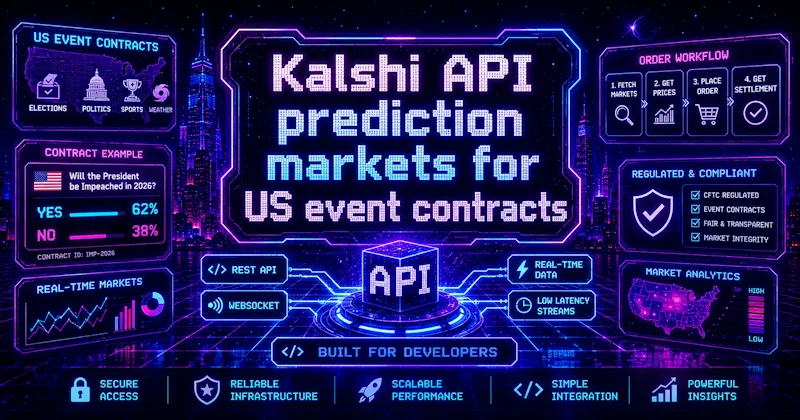
| Parameter | Kalshi API Notes |
| Primary use case | US event-contract market data and trade execution |
| Access model | Account-based access with developer agreement |
| Data available | Events, markets, order book data, orders, fills, positions |
| WebSocket support | Yes, WebSocket specs are documented |
| FIX support | Yes, FIX is listed for event-contract workflows |
| Sandbox status | Demo environment is documented |
| Rate-limit model | Token-based limits by tier and request cost |
| Main limitation | Eligibility, contract rules, and account approval still apply |
| Best fit | US event-contract apps, dashboards, and trading systems |
Key checks:
- Auth: API credentials are part of the documented setup
- Market data: REST and WebSocket support event-contract workflows
- Compliance: Kalshi states it is CFTC-regulated as a Designated Contract Market
Pros: regulated exchange context and documented demo testing.
Cons: eligibility checks and contract-specific restrictions still apply.
A political prediction markets api in this category requires official rule review before any trading workflow.
Gemini prediction markets API for REST and WebSocket workflows
The gemini prediction markets api fits builders who need event discovery through REST and live trading workflows through WebSocket. Gemini docs state that REST endpoints cover event-based contract discovery, terms acceptance, and recovery snapshots. WebSocket is used for active prediction market trading.
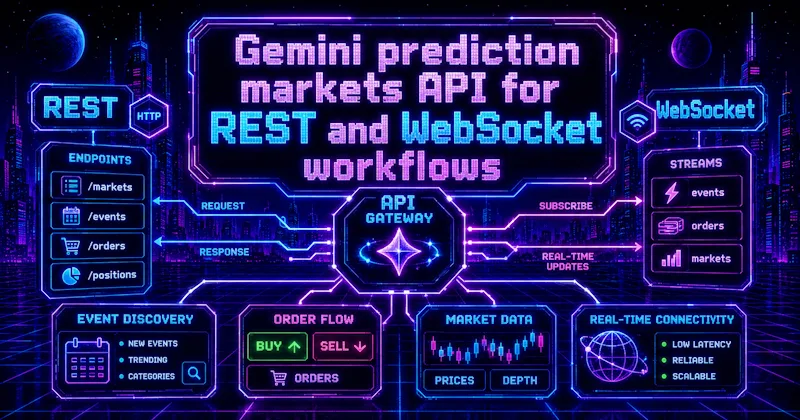
| Parameter | Gemini Prediction Markets API Notes |
| Primary use case | Event discovery, live market streaming, and order placement |
| Access model | Public REST discovery plus authenticated trading permissions |
| Data available | Events, categories, instrument symbols, order data, positions |
| WebSocket support | Yes, active trading and streams use WebSocket |
| Sandbox status | Sandbox environment is documented |
| Terms flow | Terms acceptance is required before live prediction orders |
| Identifier rule | instrumentSymbol must be used for streams and orders |
| Main limitation | Trading functions require account permissions and accepted terms |
| Best fit | Builders who need REST discovery with WebSocket execution |
Key checks:
- Public data: events and instrument symbols can be discovered through REST
- Permissioned data: terms and order actions may require authenticated access
- Streaming: Gemini lists WebSocket order and market streams
Pros: clear separation between REST discovery and WebSocket execution.
Cons: terms flow and permissions add integration steps.
Api predictions must be validated against settlement rules and not treated as guaranteed outcomes.
Dome API prediction markets for aggregated market data
Dome api prediction markets originally fit builders who wanted unified access, historical candles, real-time prices, wallet analytics, and cross-platform market matching. Dome docs list Polymarket and Kalshi coverage, API key setup, and SDK examples.
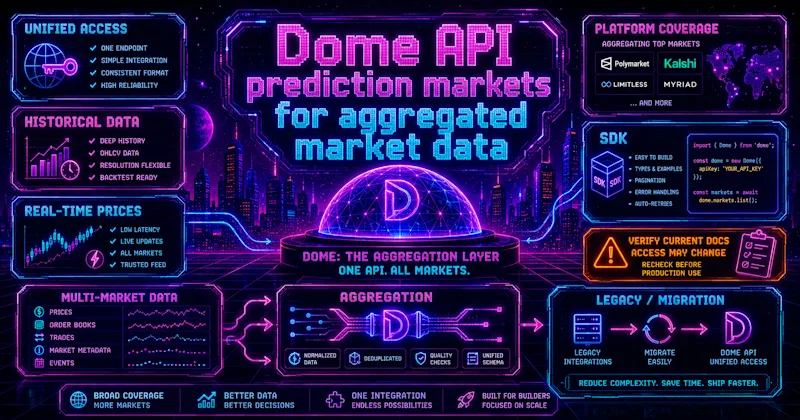
| Parameter | Dome API Notes |
| Primary use case | Aggregated prediction market data across platforms |
| Access model | API key and unified integration model |
| Data available | Real-time prices, historical data, order books, market coverage |
| WebSocket support | WebSocket and webhook positioning is described |
| SDK or examples | Unified SDK model is described |
| Platform coverage | Polymarket, Kalshi, and other venues were presented as coverage targets |
| Current status | Treat as limited or legacy until current docs and access are rechecked |
| Main limitation | Aggregator dependency, possible migration risk, and coverage uncertainty |
| Best fit | Dashboards, research tools, and multi-market data prototypes |
The current limitation is material. Dome documentation says Dome was acquired by Polymarket and that all Dome APIs would reach end of life on April 28, 2026. That means this api for prediction markets should be reviewed as legacy, transition, or migration context.
Pros: useful aggregation concept and SDK model.
Cons: access uncertainty and third-party dependency.
Aggregators can reduce schema work but add latency and vendor risk.
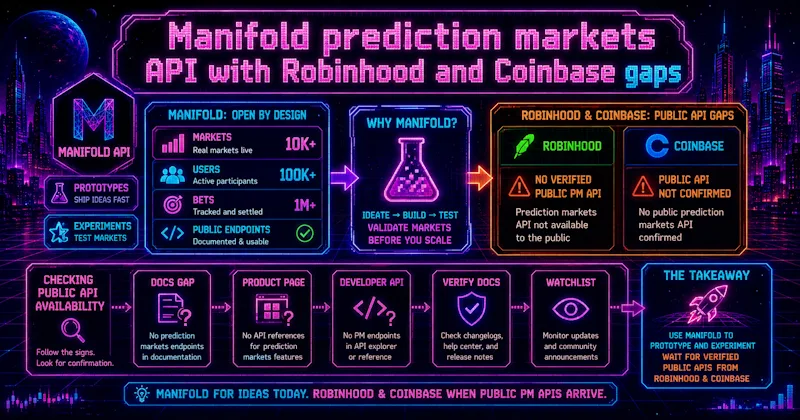
Manifold prediction markets API with Robinhood and Coinbase gaps
The manifold prediction markets api is useful for prototypes, experiments, and social prediction interfaces. Manifold docs provide programmatic access and show the moved API domain. They also warn that the API is still alpha.
| Parameter | Manifold API Notes |
| Primary use case | Prototypes, bots, social prediction tools, and research interfaces |
| Access model | Public GET endpoints plus authenticated actions where required |
| Data available | Markets, users, bets, portfolios, comments, groups, and related objects |
| WebSocket support | Not the main documented workflow in the reviewed API page |
| Auth model | Authorization header with API key for protected actions |
| Rate limit | 500 requests per minute per IP in reviewed docs |
| API status | Alpha, with possible changes or breakage |
| Main limitation | Not a cash event-contract exchange like Kalshi or Gemini |
| Best fit | Non-cash prediction prototypes and social forecasting experiments |
Robinhood and Coinbase need different treatment. The robinhood prediction markets api could not be verified as a public prediction-market developer API from official docs. Robinhood has a prediction markets product page, but that is not the same as developer API access.
The coinbase prediction markets api also needs caution. Coinbase has prediction markets and separate Exchange APIs, but public prediction-market API availability was not confirmed from the reviewed pages.
API for prediction markets by product category
An api for prediction markets should be chosen by category before vendor choice. Native exchange APIs work for execution. Aggregation APIs work for normalized data. Analytics APIs work for historical research. SDK layers reduce setup. Research data feeds help model validation.
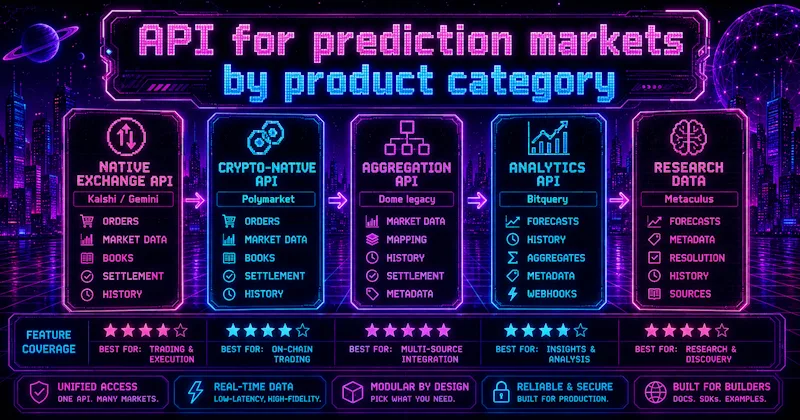
| Category | Main Task | Needed Endpoints | Dependency Risk | Example |
| Native exchange API | Orders and market data | Markets, orders, positions | Platform access | Kalshi, Gemini |
| Crypto-native API | Order book and wallet flow | Books, trades, auth | Region and chain risk | Polymarket |
| Aggregation API | Normalized data | Prices, history, mapping | Vendor layer | Dome legacy |
| Analytics API | Research and lifecycle | Trades, settlement, metadata | Coverage gaps | Bitquery |
| Research data | Forecast analysis | Questions, forecasts, history | Access model | Metaculus |
This category map keeps prediction markets APIs from being compared as if every product supports the same workflow.
Native and unified prediction markets APIs compared
Direct prediction markets APIs give more schema control, lower dependency risk, and clearer trading state. They can also require more engineering work. Unified APIs reduce setup across venues but add normalization choices, vendor latency, and migration risk.
| Model | Latency | Schema Control | Resilience | Cost Risk | Best Fit | Main Caveat |
| Direct API | Lower | Higher | Platform-specific | Variable | Trading workflows | More integration work |
| Unified API | Depends | Lower | Vendor-dependent | Subscription risk | Dashboards | Added dependency |
Direct api prediction work fits order execution. Aggregation helps when one dashboard must compare several markets.
Political prediction markets API coverage for US builders
A political prediction markets api can expose market metadata, prices, order book snapshots, settlement status, and sometimes trading access. The sensitive part is not only technical. US builders must check eligibility, contract rules, account status, and official platform terms.
A political prediction markets api may allow data access while restricting orders. That difference matters for election contracts, public-office markets, and event categories under review. These prediction markets APIs should be verified against official disclosures, not competitor summaries. This text is not legal advice, and access can change.
Integration checklist for API prediction workflows
A reliable api prediction workflow starts with small tests, not production traffic. Create the account, request the API key, review permissions, confirm sandbox access, and run one public endpoint first.
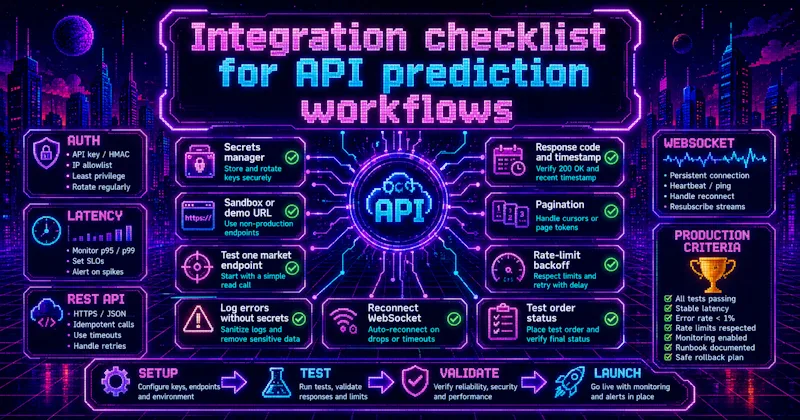
Use this checklist:
- Store keys in a secrets manager
- Confirm sandbox or demo URL
- Test one market endpoint
- Capture response code and timestamp
- Add pagination handling
- Add rate-limit backoff
- Log errors without secrets
- Reconnect WebSocket sessions safely
- Test order status on low volume
The minimum production criteria are clear. The prediction api must handle auth failures, retries, stale data, disconnects, and permission errors before launch.
Prediction API setup, auth, and sandbox checks
A prediction api setup should be documented before any trading test. The goal is to prove access without exposing credentials or private account data.
Five setup checks:
- Create API key and record scope.
- Confirm account permissions.
- Run sandbox or demo request.
- Test pagination and error responses.
- Mark status as working, blocked, or pending.
For each api for prediction markets, save the endpoint name, response time, environment, and test date. Do not store private keys, tokens, or credentials in article notes, screenshots, or shared spreadsheets.
API predictions, historical data, and latency risks
Api predictions require context. A market price can imply probability, but it can also reflect liquidity, spread, fees, stale data, or resolution risk. Historical data helps with backtesting, alert thresholds, and dashboard validation.
A practical flow looks like this:
Market metadata → historical prices → order book depth → live stream → latency log → settlement check.
In our test, prediction markets APIs were most useful when historical samples and live data could be compared. Latency should be measured by endpoint, region, and time. Market probability is not a guaranteed forecast or investment result.
APIs we would not rank without extra verification
Some prediction markets APIs should stay outside a final ranking until more evidence is checked. This is not a negative claim about a brand. It is a verification rule for builders who need stable access.
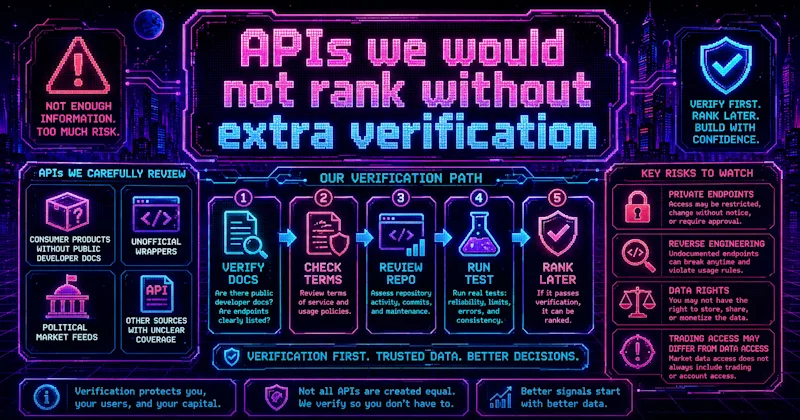
We would hold back three groups:
- Consumer products with no public developer documentation for prediction markets.
- Unofficial wrappers that may rely on private endpoints or fragile reverse engineering.
- Political market feeds without clear eligibility, terms, and settlement documentation.
A political prediction markets api needs extra care because data access and trading access can differ. Some prediction markets APIs may expose prices, while order entry remains restricted. We require public docs, terms, repository activity, and a working test before ranking.
Robinhood prediction markets API, Coinbase prediction markets API, and wrapper caveats
Robinhood has official prediction markets pages and event-contract support through Robinhood Derivatives, but its public developer docs reviewed here describe crypto trading API access, not a verified public prediction-market API.
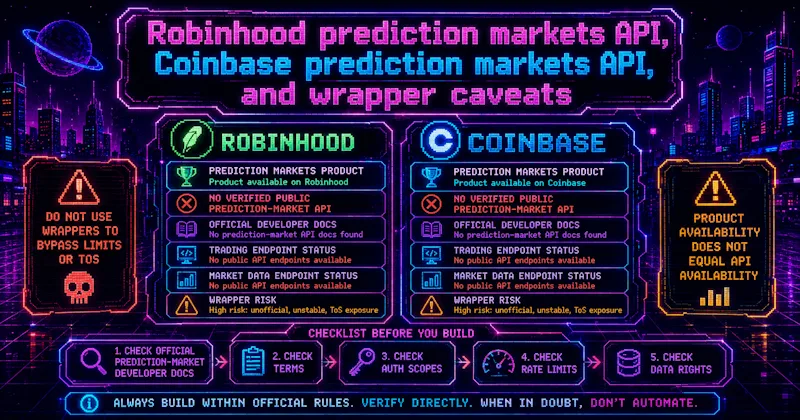
Coinbase also has prediction markets pages and separate Exchange APIs for trading and market data. The reviewed Coinbase Exchange docs describe crypto exchange APIs, not a confirmed public prediction-market API.
Before adding these prediction markets APIs to a ranking, check:
- Official prediction-market developer docs
- Terms that allow programmatic use
- Auth scopes for event contracts
- Rate limits and data rights
- Repository activity if a wrapper is used
Do not use wrappers to bypass platform limits or ToS.
FAQ about best prediction markets APIs
This FAQ summarizes common developer decisions around the best prediction markets APIs. Answers are short by design. They cover regulation, WebSocket support, political markets, historical data, and setup checks.
The same rule applies throughout. Prediction markets APIs should be tested against official documentation before production use. FAQ answers do not replace platform docs, legal review, tax review, or internal risk controls.
Which are the best prediction markets APIs for US developers?
The best prediction markets APIs for US developers depend on use case, eligibility, and required data. Kalshi fits regulated event-contract workflows. Polymarket fits crypto-native data checks where access is allowed. Gemini fits REST and WebSocket testing. Aggregators or analytics APIs fit dashboards and research after endpoint verification.
What is the difference between a prediction API and a market API?
A prediction api returns forecast-like values, probabilities, or prediction-focused data. An api prediction workflow may also use a market API, which provides prices, order books, settlement status, and trading actions. For example, a dashboard may read implied probabilities, while a bot needs order endpoints.
Can a political prediction markets API be used for trading?
A political prediction markets api can be used for trading only when the platform, jurisdiction, account status, and permissions allow it. US builders must verify official rules before use. Political contracts may have extra limits, and data access does not always mean trading access.
Do API predictions require historical data?
Api predictions do not always require historical data, but history is important for backtesting, validation, alerts, and dashboards. An api for prediction markets can monitor current prices without history. It cannot prove a strategy works unless past market data and resolution rules are checked.
Is there an API for prediction markets with WebSockets?
An api for prediction markets may include WebSockets, but support depends on the platform and permissions. WebSockets help with live prices, order updates, and latency control. If streaming is unavailable, REST polling can work, but rate limits and delayed data must be handled.
Which API for prediction markets fits your build?
The right api for prediction markets starts with the product, not the logo. A trading bot needs auth, order status, WebSocket recovery, and legal access. A dashboard needs stable market data and history. A research tool needs settlement data and exportable samples.
For US builders, the best prediction markets APIs should pass three checks before launch:
- Compliance check for geography, eligibility, and terms
- Technical check for endpoints, auth, limits, and latency
- Data check for history, liquidity, resolution, and timestamps
These prediction markets APIs can support useful products, but every api prediction workflow needs legal and technical review before production.
Bio: Author, review date, and testing scope
Reviewed by the editorial API research team. Updated June 18, 2026. Testing covered public docs, endpoint availability, sandbox notes, and access limits for prediction markets APIs. Data should be reviewed again when documentation, terms, or market access changes.
References: References and sources to verify
Official API references:
- Kalshi API documentation
- Kalshi WebSocket documentation
- Polymarket API documentation
- Polymarket order book API reference
- Gemini prediction markets documentation
- Gemini prediction markets events API
- Manifold API documentation
- Dome API documentation
- Bitquery Polymarket API documentation
- Coinbase Exchange API product page
- Coinbase Exchange API documentation
- Robinhood API documentation
- Robinhood Crypto Trading API support page