The current NFT marketplaces comparison table shows that, while OpenSea remains one of the best-known NFT marketplaces due to its support for many assets and multiple chains, Blur has a large lead over competing marketplaces among professional Ethereum NFT traders, with Tensor dominant on Solana and Magic Eden on Bitcoin Ordinals NFT marketplaces.
Read More: What Is UNNF Crypto? Can the United Nations Nuclear Fund Token Explode 100x or Is It Too Risky?
Contents
- 1.Top NFT Marketplaces 2026: Comparison Table
- 2.How We Ranked the Best NFT Marketplaces in 2026
- 3.Best NFT Marketplaces 2026: Reviews by Use Case
- 4.Primary vs Secondary NFT Marketplaces Explained
- 5.Solana NFT Marketplaces vs Bitcoin NFT Marketplaces Compared
- 6.List of NFT Marketplaces by Type and Buyer Goal
- 7.Biggest NFT Marketplaces, Popular NFT Marketplaces, and Liquidity Risks
- 8.Decision Tree for Choosing an NFT Marketplace
- 9.NFT Marketplaces We Do Not Recommend
- 10.FAQ
Top NFT Marketplaces 2026: Comparison Table
The NFT buyer should choose an NFT marketplace based on liquidity, the supported blockchains, the fees, and the intended use of the NFT for a specific use case, instead of popularity. The top NFT marketplace for trading quickly may not be the best for discovering digital art, while an NFT marketplace that curates NFTs may have poorer liquidity than other NFT marketplaces.
*Fees and creator royalties vary by collection, blockchain, and platform or marketplace. Users should check each platform for the specific details before trading.
| Marketplace | Best For | Supported Ecosystems | Marketplace Fee* | Key Strength |
| OpenSea | General users and collectors | Ethereum, Solana, Base, Polygon and others | ~0.5% | Broad asset selection and mainstream adoption |
| Blur | Active traders | Ethereum-focused | ~0.5% | Advanced trading tools and liquidity aggregation |
| Tensor | Solana traders | Solana | Collection-dependent | Deep Solana NFT liquidity and professional trading features |
| Magic Eden | Bitcoin Ordinals and multi-chain NFTs | Bitcoin, Solana, Ethereum and others | Collection-dependent | Strong Ordinals ecosystem and cross-chain reach |
| SuperRare | Curated digital art | Ethereum | Varies by transaction type | High-end artist discovery and curated collections |
| Foundation | Creators and collectors | Ethereum | Varies by sale type | Artist-focused marketplace with selective onboarding |
How We Ranked the Best NFT Marketplaces in 2026
In our review of the current NFT market, we considered liquidity, trading volume, supported blockchains, marketplace fees, security practices, creator tools, and user experience.
As the NFT ecosystem has expanded to Ethereum, Solana, Bitcoin Ordinals, Base, and others, specialization and differentiating by quality have become more important than brand.
Of these factors, liquidity was the most heavily weighted, since it affects execution quality, price discovery, and whether an asset can be bought or sold.
On the other hand, a lower-fee marketplace will not provide much for users if their listings, bids, and active buyers are on another marketplace, especially if the top NFT marketplaces are generally aimed at different groups, such as collectors and professional NFT traders.
We also looked at trading features across leading NFT trading platforms, including bulk trading tools, analytics dashboards, aggregation tools, collection bidding, and cross-chain trading.
Other platforms, such as Blur and Tensor, have differentiated themselves by developing more advanced trading infrastructure, while OpenSea and Magic Eden have focused on overall accessibility and covering the ecosystem.
Creator decisions include minting options, launchpad functionality, royalty settings, and creator and collection visibility within the marketplace. This is particularly true when assessing an NFT marketplace for artists, where audience quality and discoverability may be as important as transaction fees.
Finally, we looked at security and reputation, including wallet integrations, transaction signing workflows, contract verification standards, and marketplace track records.
Though no platform is completely risk-free, stronger operational protections will be a key criterion when identifying the safest NFT marketplaces in 2026.
Best NFT Marketplaces 2026: Reviews by Use Case
OpenSea: Biggest NFT Marketplace by Reach
OpenSea remains the broadest general-purpose option in this best NFT marketplaces list and is widely used as an NFT marketplace for collectors.
According to OpenSea’s help center, it currently supports Ethereum, Polygon, Arbitrum, Optimism, Avalanche, Base, Solana, Flow, Ronin, Monad, and other chains. It remains one of the best NFT marketplaces for collectors looking for broad discovery rather than a targeted single-chain trading terminal.
OpenSea’s fees page notes that they take 1% on secondary sales and 10% for primary-drop minting, and pass through no fees for swaps. This makes it the best NFT marketplace for beginners. As always, check a project’s verification status, ensure royalties are enabled for your primary sale, and check for gas fees before signing transactions.
Blur: Most Popular NFT Marketplace Among Traders
Unlike most NFT marketplaces, Blur is not designed for people to browse for NFTs. Rather, the marketplace is for pro Ethereum NFT traders. The project is as described, an NFT marketplace for traders, featuring fast sweeping, marketplace aggregation, bidding tools, and 0% marketplace fees. This helps account for its trader orientation.
Read More: Top Solana DEXs: Jupiter, Raydium, Orca Compared
The focus on traders is both the strength and weakness of Blur, because it is a perfect NFT marketplace for flipping NFTs, bulk purchase, and bidding. However, it is not as beginner-friendly as storefront-style marketplaces and has historically faced backlash from creators because of how trader incentives affect royalties.
Tensor: Best Solana NFT Marketplace
Tensor is one of the leading Solana marketplace aggregators optimized for active trading. According to the Tensor website, the Solana NFT marketplace is the “Solana’s #1 NFT Marketplace”. According to Delphi Digital, Tensor is a Solana platform combining a marketplace aggregator as well as an AMM-style trading infrastructure, including collection bids and sell-side liquidity.
Tensor is likely going to be a better fit for users traversing the Solana ecosystem who prioritize speed, depth, and trading tools to support high-throughput activity than it would be for a user asking which NFT marketplace is best across all chains.
Magic Eden: Best Bitcoin NFT Marketplace for Ordinals
Magic Eden’s Bitcoin Ordinals division was subject to an important change in 2026. Magic Eden’s help center states that its Bitcoin API and backends would sunset after March 27, 2026. However, Binance Academy states that Magic Eden shut down its Ethereum, Polygon, and Bitcoin marketplaces to refocus on its Solana marketplace.
This means that while Magic Eden can’t be the default Ordinals marketplace in 2026 without knowing which marketplaces are available, it makes more sense to contextualize Magic Eden, which was a high-volume Ordinals marketplace, in an OpenSea vs Blur vs Magic Eden comparison of current Solana-based marketplaces in 2026 rather than the safest default for Bitcoin NFTs.
SuperRare & Foundation: Best NFT Marketplaces for Artists
SuperRare maintains a connection with high-end digital artwork by positioning itself as an art gallery and auction house of original digital art. Editorial materials for SuperRare Marketplace stress focus on curated 1/1 NFT artwork, whereas general NFT trading venues are less suited to digital artists’ needs.
Foundation is no longer an active auction platform. Foundation’s homepage now mentions as of 27 April 2026 that the platform is offline, will not resume operations, and will remain offline indefinitely. NFTs and smart contracts created on the platform remain on-chain and under the control of their respective wallets.
| User Goal | Recommended Marketplace | Why It Fits |
| Buy NFTs for the first time | OpenSea | Large selection and beginner-friendly interface |
| Trade NFTs actively | Blur | Built specifically for high-volume NFT trading |
| Trade Solana NFTs | Tensor | Optimized for Solana liquidity and execution |
| Collect Bitcoin Ordinals | Magic Eden | Established presence in the Ordinals ecosystem |
| Discover digital art | SuperRare | Curated marketplace focused on original artwork |
| Find new NFT collections | OpenSea | Extensive multi-chain collection coverage |
| Flip NFTs | Blur | Advanced bidding and portfolio management tools |
| Buy rare curated pieces | SuperRare | Emphasis on scarcity and artist quality |
Primary vs Secondary NFT Marketplaces Explained
The primary market for NFTs is where the NFT is minted for the first time, such as a mint, drop, or launchpad. OpenSea describes a drop as a launch in which collectors can mint an NFT from a new collection. Magic Eden runs the Launchpad, a launch platform for new NFT projects on Magic Eden.
This, of course, is the simplest NFT minting platforms vs marketplaces difference: an NFT is offered to buyers rather than being resold by an existing owner.
Secondary NFT marketplaces allow NFTs to be resold and traded after the initial sale. OpenSea defines secondary sales as purchases and resales after the first sale, with on-chain transaction history.
In its FAQ, Coinbase states that a creator can receive royalty payments if an NFT is transferred in a secondary marketplace, and the amount varies based on the marketplace and its settings.
Read Also: What Is GDNR Crypto? Global Digital Nuclear Reserve Explained — Can It Really 100x in 2026?
Buyers, when choosing between a primary vs secondary NFT marketplace, trade time for risk. Primary NFT mints offer early access to newly minted NFTs. However, secondary markets provide listing and bidding prices, floor prices, and historical sales data.
Whereas these largest platforms serve both as primary and secondary markets, the primary market is where NFTs are launched, and the secondary market is where they are traded by collectors.
Solana NFT Marketplaces vs Bitcoin NFT Marketplaces Compared
Due to the differences above, Solana NFT marketplaces follow a different model from that of Bitcoin NFT marketplaces: Solana marketplaces such as Tensor and Magic Eden prioritize attributes such as high transactions per second (TPS), low fees, live bidding, and trading statistics.
Starting in 2026, there has been competition between Tensor and Magic Eden for users and trading volume within the Solana ecosystem.
Users who prefer low latency and frequent portfolio updates are attracted to Solana marketplaces, which have a trading-centric approach, incorporating collection bids, sweeping capabilities, and advanced statistical tools as part of the Solana NFT ecosystem.
Since Ordinals, Bitcoin NFT marketplaces (most recently, increasingly Runes) are oriented around Bitcoin-native ownership and inscription tooling, as opposed to a high-throughput marketplace that many of the Solana marketplaces represent. These marketplaces are centered around Taproot-compatible wallets, use Ordinals, and settle on-chain in native Bitcoin.
Finally, Solana users utilize Tensor or Magic Eden, and Bitcoin users consider Ordinals liquidity, support for inscriptions, and marketplace depth when assessing the benefits of a given Bitcoin marketplace.
As of 2026, Ordinals trading venues tend to compete more on additional Bitcoin-native features than on the speed of trades.
When comparing NFT marketplaces 2026, a user’s choice generally depends on what they wish to accomplish.
Solana marketplaces are favored for high-volume trading or quick transactions, while those seeking exposure to Ordinals and Bitcoin-native digital collectibles tend to use Bitcoin marketplaces.
Thus, NFT marketplace comparison should include the underlying blockchain ecosystem, in addition to the marketplace capabilities and associated transaction fees.
| Buyer Goal | Recommended Ecosystem | Typical Marketplace Choice |
| High-frequency trading | Solana | Tensor |
| Fast NFT execution | Solana | Tensor, Magic Eden |
| Low transaction costs | Solana | Tensor, Magic Eden |
| Ordinals collecting | Bitcoin | Bitcoin-native marketplaces |
| Bitcoin-native ownership | Bitcoin | Ordinals marketplaces |
| Long-term collectible exposure | Bitcoin | Ordinals-focused platforms |
| Advanced trading tools | Solana | Tensor |
| NFT portfolio management | Solana | Tensor, Magic Eden |
List of NFT Marketplaces by Type and Buyer Goal
One way to choose the best NFT marketplaces is by anticipating what your goal is. As the NFT market has developed, many platforms have diversified their core purpose and are either best at trading efficiency, digital art, discovering assets across different blockchains, or serve a mix of these purposes.
Those wanting the largest selection of assets, as it supports many different blockchain networks and is still one of the biggest names in the space, will also likely go to OpenSea. The site is also the most user-friendly for those looking for discovery, established collections, and a familiar interface.
Blur is a platform targeted at professional traders, with features such as an aggregated view across marketplaces, portfolio management, and bidding tools, and Tensor, with similar features, is now targeted to traders in the Solana ecosystem.
As a result, they are mainly focused on speed of execution and liquidity rather than being made more user-friendly for first-time buyers.
Since then, Magic Eden has become the leading marketplace for Bitcoin Ordinals and multi-chain collectors, evolving from its footing as a Solana marketplace to become one of the go-to platforms for NFT trading on Bitcoin.
Read Also: What Is a16z Crypto and Why It Is Becoming One of the Most Influential Forces in the Crypto Market
Artists and high-end digital art collectors tend to favor a curated marketplace, which selects creators and original art pieces. This is because highly curated platforms, like SuperRare, focus more on the artworks and less on the volume of sales. They are therefore more suitable for artists and collectors who value scarcity.
There is currently no one NFT marketplace that everyone agrees is the best. The most common are OpenSea for amateurs, Blur or Tensor for professional traders, Magic Eden for cross-chain and Bitcoin users, and SuperRare for curated art collections. Choosing the best catering marketplace depends mostly, once again, on whether users want to collect, trade, mint, or find artists.
Biggest NFT Marketplaces, Popular NFT Marketplaces, and Liquidity Risks
While the largest NFT marketplaces by volume are OpenSea, Blur, Tensor, and Magic Eden, not all collections will find the best revenue through the biggest volume marketplace. The best liquidity for selling an NFT may relate to an ecosystem, collection, or a niche of the market, rather than the biggest volume marketplace.
Industry market-share data indicate that trading volume can quickly shift from exchange to exchange with changing incentives and blockchain usage.
While the data reported by popular NFT marketplaces can imply high aggregate trading volume, buyers should consider collection-level liquidity, as a marketplace may host thousands of collections, of which only a small percentage trade consistently and reliably price discover.
Low liquidity carries other risks. Bid-ask spreads can be wide, and there may not be enough buyers or sellers, or an order book may be sparsely populated, making it difficult to sell an NFT at market value. This is especially true for short-term traders, for whom it may be more important to have good execution than a large market.
As such, the popularity of an asset platform and the liquidity of the assets traded on it often matter more than the general marketplace rankings.
Decision Tree for Choosing an NFT Marketplace
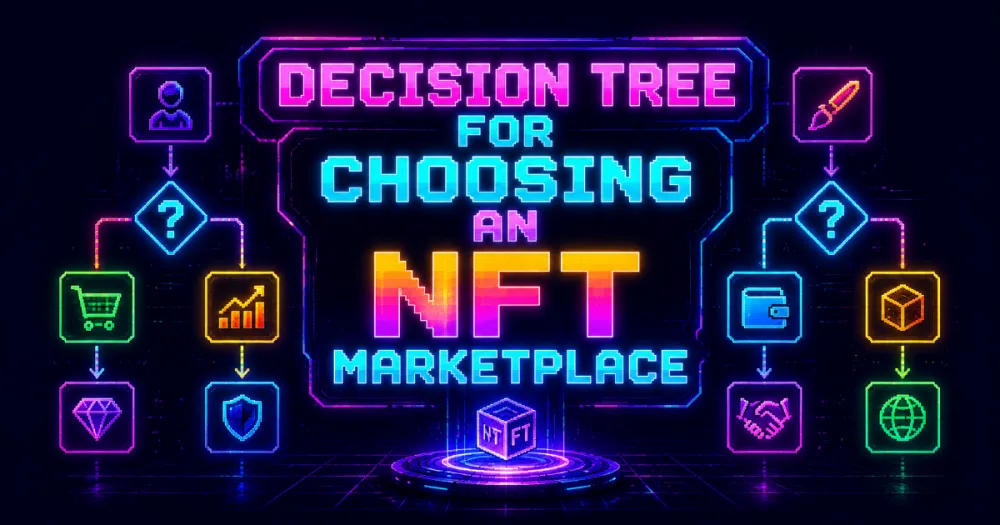
It can help to narrow your search for the top NFT marketplaces by choosing what types of NFTs you are looking to buy. If you’re looking for a general multi-chain marketplace with lots of collections, OpenSea is one of the largest NFT marketplaces. Tensor and Magic Eden remain the main marketplaces for Solana NFTs in general.
These include Blur and Tensor, which offer advanced bidding, portfolio management, and liquidity features that are more suited to active traders and those who do not prefer to hold an NFT for an extended period of time.
Collectors looking for curated quality NFT marketplaces for artists that prioritize creator quality and discovery rather than quantity. One of the best-known NFT marketplaces for artists is SuperRare, a curated platform that features limited runs of quality digital artworks.
So, which NFT marketplace is the best to start with? It’s always safest to choose one with the highest number of collections, a clear verification process, and greater liquidity in the marketplace. In either case, confirm these collection details and carefully validate the transaction details. Only connect your wallets through the official marketplace websites.
NFT Marketplaces We Do Not Recommend
Some NFT marketplaces may no longer be available to new users because they have shut down or otherwise become nonfunctional.
Foundation is the clearest case. In April 2026, the company announced that the Foundation marketplace had gone offline and would not return. Although users retained ownership of their NFTs through their on-chain smart contracts, the marketplace itself was no longer active.
X2Y2 is another site we would not recommend. Once one of the largest Ethereum NFT marketplaces, X2Y2 announced in 2025 that it was shutting down its NFT marketplace after a prolonged decline in trading activity across the sector. The team said they would repurpose funds to other cryptocurrency projects.
Kraken NFT also shut down; Kraken had previously shut down its NFT marketplace, migrating its users to an asset-withdrawal process before shutting down. As such, it is not even included in the comparison of the best NFT marketplaces.
Buyers should prefer established marketplaces with active trading, clear policies, and frequent updates to the products offered rather than focusing exclusively on the cheapest NFT marketplace fees.
An NFT marketplace’s operational status and liquidity are as important as the fees and number of collections when determining the safest NFT marketplaces.
FAQ
What is the biggest NFT marketplace in 2026?
OpenSea is one of the largest NFT marketplaces by total user reach/visits, supported blockchains, and number of collections, although the NFT marketplace leader in terms of trading volume can vary based on market conditions.
Which NFT marketplace has the lowest fees?
Blur advertises 0% marketplace fees on all blockchain-based NFT transactions; users may still be charged network fees for blockchain transactions and royalties on certain collections. Fee structures may change and fee information is available directly through the Blur platform.
What are the best Solana NFT marketplaces?
The leading Solana NFT marketplaces in 2026 are Tensor and Magic Eden, which have a strong ecosystem and community support, including a large number of collections to trade.
What are the top Bitcoin NFT marketplaces for Ordinals?
Magic Eden has become one of the most visibly branded marketplaces for trading Ordinals, several Bitcoin-native competitors and new Ordinals infrastructure have launched.
Which NFT marketplaces are best for artists?
SuperRare is frequently considered to be among the best works from a selection of curated digital art marketplaces, and is sometimes used by artists with a goal of being included in larger marketplaces.
What is the difference between primary and secondary marketplaces?
Primary marketplaces ease initial sales or minting of NFTs directly from the creators or projects, while secondary marketplaces ease transfers between collectors after an initial sale or minting.
Are NFT marketplaces safe to use?
Marketplaces provide verification and security/wallet protections, but are still at risk. Users are encouraged to verify the collections, check the URL of claimed websites, and double-check the transaction prior to signing.
Which NFT marketplace is best for beginners?
OpenSea is often cited as one of the most beginner-friendly of all NFT marketplaces due to its large number of available collections, multi-chain support, and user-friendly interface, which is designed to allow less experienced collectors to access a wide variety of NFTs without the need for dedicated trading tools.