Restaking risks are easy to underestimate because the basic idea sounds simple: use already-staked crypto to secure additional networks and earn extra rewards. In practice, restaking adds new layers of exposure on top of ordinary staking. A user is no longer only trusting one blockchain, one validator, or one staking contract. They may also be relying on operators, smart contracts, liquid restaking tokens, bridges, and external services.
The appeal is obvious. Restaking can make staked assets more productive and help new crypto networks borrow economic security instead of building it from scratch. For Ethereum users, Ethereum restaking has become one of the most watched DeFi sectors because it connects ETH▲$1,761.17 staking to new middleware, data, rollup, oracle, and infrastructure systems.
The risk is that extra yield rarely comes free. Slashing, bugs, centralization, liquidity stress, and complex dependencies can turn restaking from a passive income strategy into a chain of hidden assumptions. Before using any restaking protocol, users need to understand where the yield comes from and what can go wrong.
Contents
What Is Restaking?
Restaking lets users take assets already used for staking and commit them to secure additional services. Instead of securing only a base blockchain, restaked assets can help secure other systems that need validators, operators, or cryptoeconomic guarantees. In return, users may receive additional rewards.
EigenLayer made the idea popular on Ethereum by allowing ETH stakers and liquid staking token holders to opt into extra validation work. These external networks are often called AVS, or Actively Validated Services. They can include data availability layers, bridges, oracle networks, rollup services, and other crypto infrastructure.
The core idea is shared security. New protocols get access to existing staked capital, while restakers seek extra income. That sounds efficient, but it also means that one asset may now carry several risk layers at once.
Why Restaking Became Popular
Restaking became popular because it promises better capital efficiency. ETH stakers already lock capital to secure Ethereum. Restaking asks whether that same capital can do more. For users, the answer looks attractive when extra rewards appear without needing to buy a new token.
Protocols also like restaking because it can reduce bootstrapping problems. A young network may struggle to build its own validator set or attract security capital. By borrowing security from a larger ecosystem, it can launch faster and focus on its actual service.
The restaking boom also grew from points programs, airdrop speculation, and liquid restaking tokens. These incentives pulled users into the market before all long-term risks became clear. That is why restaking needs careful analysis: the marketing often sounds simpler than the structure underneath.
Main Restaking Risks
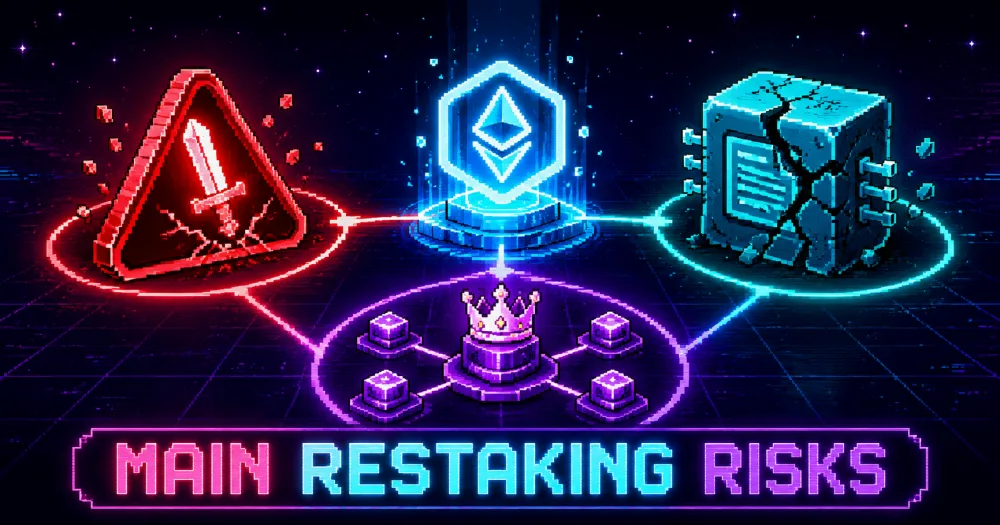
Restaking risks usually fall into three major buckets: slashing, smart contracts, and centralization. These are not separate in practice. A bad operator decision can trigger slashing. A smart contract bug can affect withdrawals. A centralized operator set can turn one mistake into a wider problem.
| Risk Type | What It Means | Why It Matters |
|---|---|---|
| Slashing risk | Restaked assets may be penalized for validator or AVS failures | Users can lose principal, not just rewards |
| Smart contract risk | Bugs, upgrade keys, or logic flaws can affect funds | Restaking depends on complex contracts |
| Centralization risk | Too much control may sit with a few operators or protocols | One failure can spread across many users |
| Liquidity risk | Exiting may be slower or costlier than expected | LRTs can trade below underlying asset value |
| Complexity risk | Users may not understand all dependencies | Hidden assumptions can appear during stress |
The danger grows when users chase yield without checking what secures it. If a protocol cannot explain slashing conditions, operator selection, withdrawals, audits, and governance, the rewards may not justify the risk.
Slashing Risk: The Most Direct Threat
Slashing risk is the most direct restaking danger. In normal proof-of-stake systems, validators can lose part of their stake if they violate rules or behave incorrectly. Restaking extends this idea by adding new services with their own conditions.
A restaker may be exposed not only to Ethereum validator penalties, but also to rules imposed by additional services. If an operator fails to perform a required duty, signs conflicting messages, runs faulty software, or violates an AVS condition, restaked assets may face penalties. The user may not have personally made the mistake, but their capital can still be exposed.
This makes operator selection important. Restakers often delegate to operators who run the infrastructure. If that operator accepts too many services, runs weak systems, or mismanages keys, users may inherit the consequences. Extra rewards can quickly look small compared with a serious slash.
Why Slashing Is Hard to Evaluate
Slashing is difficult because every service may define failure differently. Some systems may have clear rules. Others may still be evolving. A user needs to understand which services the operator supports, what penalties exist, and whether slashing is live, delayed, capped, or still being phased in.
Users should avoid treating restaking yield like ordinary staking yield. The extra return comes from accepting additional obligations. If those obligations are unclear, the risk is unclear too.
Smart Contract Risk in Restaking
Smart contract risk matters because restaking relies on code. Deposits, delegation, withdrawals, reward accounting, liquid tokens, operator registries, and AVS interactions may all pass through contracts. If that code fails, users can lose funds or get stuck.
Restaking contracts may be audited, but audits do not remove all risk. Bugs can remain hidden. Upgradeable contracts may depend on admin keys or governance decisions. External dependencies can break. A mistake in one integration can affect users who thought they were only taking simple staking exposure.
Liquid restaking adds even more contract layers. A user may deposit ETH or an LST, receive an LRT, use that LRT in DeFi, and then rely on several protocols at once. If one contract has a logic failure, the effect can spread through lending markets, liquidity pools, bridges, and vaults.
Related: Best Crypto Staking Platforms 2026: A Tested U.S. Review of Rewards, Fees, Security, and Risks
Why Contract Dependencies Matter
Restaking often depends on several systems working at the same time. A liquid restaking token may rely on a restaking protocol, a staking provider, a price oracle, a bridge, a redemption queue, and one or more DeFi pools. These systems may look separate on a website, but they can be connected financially.
This creates dependency risk. If one component fails, the damage may not stay isolated.
Centralization Risk and Operator Power
Centralization risk appears when too much power sits with a small number of operators, protocols, or governance groups. Restaking may look decentralized because many users participate, but actual control can still cluster around a few infrastructure providers.
If several AVS networks rely on the same operator set, a single technical failure can affect multiple systems. If one liquid restaking protocol controls a large share of deposits, its governance and smart contracts become major points of failure.
Centralization can also appear through upgrade keys, multisigs, whitelists, oracle providers, and front-end access. Users may think they are using decentralized infrastructure, while key decisions remain concentrated in a small group.
Why Centralization Makes Restaking More Fragile
The promise of restaking is shared security, but shared security can create shared failure. During stress, everyone may run toward the exit at the same time.
Centralization also affects governance. If a few large players influence operator selection, AVS adoption, reward distribution, or upgrade decisions, smaller users may have little practical control. That does not always mean the system is unsafe, but it does mean users should understand who can change the rules.
The healthiest restaking ecosystems need operator diversity, transparent slashing rules, open monitoring, and limited reliance on single points of failure.
Liquid Restaking Token Risks
Liquid restaking tokens, or LRTs, make restaking easier to use in DeFi. A user deposits ETH or a liquid staking token and receives a tradable token representing a restaked position. That token can then be used in lending markets, liquidity pools, or yield strategies.
The benefit is liquidity. Users are not always locked into a slow unstaking process. The risk is that the LRT can trade away from the value of the underlying asset.
LRT risks include smart contract bugs, oracle issues, withdrawal delays, bridge exposure, and leverage loops. If users borrow against an LRT and the token depegs, liquidations can follow.
Restaking Yield: Where Returns Come From
Restaking yield may come from AVS payments, protocol incentives, token rewards, airdrop expectations, points programs, or DeFi strategies around LRTs. Not all yield is equal. Some returns come from real demand for security. Others come from temporary incentives.
Users should ask what they are being paid for. Are they securing a live service with real revenue? Are rewards coming from token emissions? Is the yield based on points that may or may not convert into value? Is the return boosted by leverage elsewhere in DeFi?
A high restaking yield can be attractive, but it may also indicate higher risk. If the market does not understand the source of rewards, it may misprice the danger. Sustainable yield should be easier to explain than speculative yield.
Restaking vs Liquid Staking
Restaking and liquid staking are related, but they are not the same. Liquid staking lets users stake assets while receiving a liquid token in return. Restaking takes staked assets and commits them to additional services for extra rewards and extra risk.
| Feature | Liquid Staking | Restaking |
|---|---|---|
| Main purpose | Keep staking position liquid | Use staked capital for extra security roles |
| Main token type | LST | LRT |
| Main reward source | Base staking rewards | Staking rewards plus extra protocol rewards |
| Main added risk | Depeg, validator, smart contract risk | Slashing, AVS, operator, smart contract risk |
| Complexity | Medium | Higher |
The key difference is obligation. Liquid staking mainly represents a staked position. Restaking adds new commitments. Those commitments can increase returns, but they also expand the ways something can fail.
How to Evaluate a Restaking Protocol
Before using a restaking protocol, users should slow down and review the structure. The best projects explain risk clearly instead of hiding behind high yield. Strong documentation does not guarantee safety, but weak documentation is a warning sign.
Check these points first:
- Which assets can be restaked?
- Which operators control the work?
- Which AVS networks are involved?
- Are slashing rules live, clear, capped, or still changing?
- What audits and bug bounties exist?
- How do withdrawals and redemption queues work?
- Does the LRT trade with deep liquidity?
- Who controls upgrades, parameters, and emergency actions?
These questions help separate real infrastructure from risky yield marketing. If users cannot identify who runs the system and what can trigger losses, they should not treat the strategy as passive.
Related: Best Crypto Staking Platforms 2026: A Tested U.S. Review of Rewards, Fees, Security, and Risks
How Users Can Reduce Restaking Risk
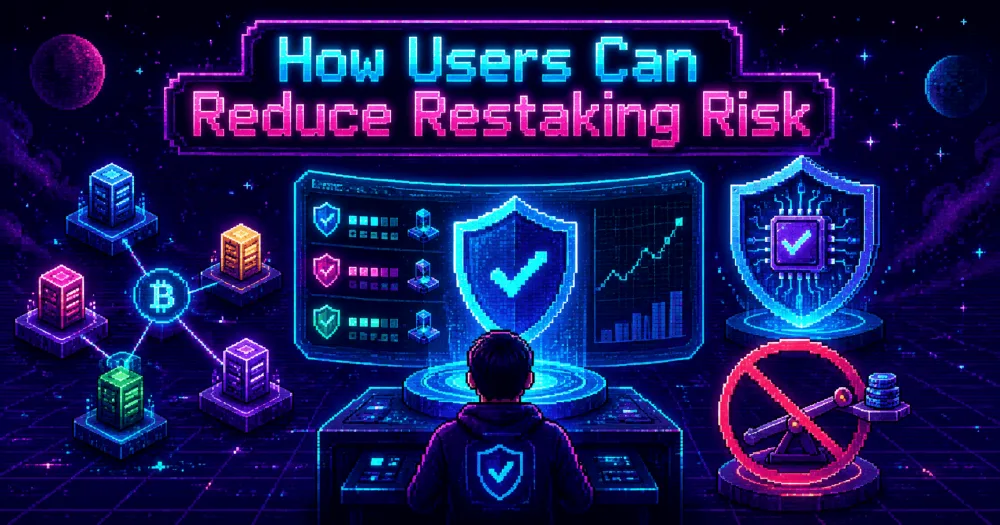
Restaking cannot be made risk-free, but users can reduce exposure. The first step is position sizing. Do not commit capital just because rewards look attractive. Restaking should be treated as a higher-risk DeFi strategy, not a savings account.
The second step is diversification. Avoid relying on one operator, one LRT, one DeFi pool, or one protocol interface. Diversity does not remove risk, but it can reduce dependence on a single failure point.
The third step is avoiding excessive leverage. Borrowing against LRTs can magnify returns, but it can also turn a depeg or withdrawal delay into forced liquidation.
Is Restaking Worth the Risk?
Restaking may be worth the risk for users who understand the structure, accept possible losses, and choose operators carefully. It may also make sense for institutions or advanced DeFi users who can monitor positions, contracts, liquidity, and governance changes.
For beginners, restaking is harder to justify. The product may look like ordinary staking, but the risk stack is much deeper. Slashing rules, contract dependencies, LRT liquidity, operator performance, and AVS design all matter.
The best approach is cautious. Restaking is an important crypto innovation, but it is not free yield. It turns staked assets into security for additional systems. That can create value, but it can also create new failure paths.
Conclusion
Restaking risks come from the same thing that makes restaking powerful: shared security. By reusing staked capital, protocols can launch faster and users can seek extra rewards. But that same reuse exposes capital to slashing, smart contract failures, operator mistakes, centralization, liquidity stress, and DeFi contagion.
The biggest mistake is treating restaking like simple staking. It is not. Restaking adds new obligations, new dependencies, and new ways for losses to appear. Liquid restaking tokens can make the experience feel easy, but they can also hide the complexity underneath.
For users, the rule is simple: understand the full chain of risk before chasing extra yield. If the reward is small and the downside is unclear, the trade may not be worth taking.
FAQ
What are restaking risks?
Restaking risks are the extra dangers users accept when staked assets secure additional networks or services. These include slashing, smart contract bugs, operator failure, centralization, liquidity stress, and LRT depegs.
What is slashing in restaking?
Slashing in restaking means restaked assets can be penalized if an operator or external service violates required rules. Users may lose part of their stake even if they did not personally make the mistake.
Are liquid restaking tokens safe?
Liquid restaking tokens are not risk-free. They can face smart contract bugs, liquidity problems, depegs, withdrawal delays, and risks tied to the underlying restaking protocol.
Is restaking better than staking?
Restaking may offer higher rewards than normal staking, but it also adds more risk. Staking usually secures one base network, while restaking may expose assets to multiple services and rule sets.
Can restaking cause centralization?
Yes. Restaking can increase centralization if many users delegate to the same operators, use the same LRTs, or rely on a few protocols for shared security.
Should beginners use restaking?
Beginners should be cautious. Restaking is more complex than ordinary staking and requires understanding slashing, operators, smart contracts, liquidity, and protocol dependencies.