Many newcomers ask, what is ethereum, before they try on-chain apps. In simple terms, ethereum is a public network that records transactions and runs program code. A built-in asset covers execution fees and helps prevent spam across the ledger. People also ask, what is eth, because eth pays the fee for each action. For planning, eth works as the unit you spend to publish changes, while the ledger stores outcomes for everyone.
Disclaimer: This guide is for education and product understanding, not investment, legal, or tax advice. Digital assets can lose value fast. Always verify addresses, fees, and app permissions, and use amounts you can afford to lose.

Contents
How we prepared this review
We used the official ethereum protocol specification, the Yellow Paper, as the core reference, and validated key terms through simple transfers and contract calls. The protocol PDF: Yellow Paper protocol.
Ethereum in plain words: the idea and purpose of the network
One way to view ethereum is as a shared computer that anyone can use without an account request. It lets people send value, publish data, and run rules that live as smart contracts. Those rules can move tokens or update records based on conditions the code checks. The point is not speed alone, but a consistent result that many computers verify in the same way.
Expert note (Maya Chen, Blockchain Product Researcher): Treat the network as a shared state machine, not a normal bank ledger. Once you see each transaction as a state change, wallet prompts make more sense, and you click less on autopilot.
Ethereum in 1 minute
A user creates a transaction, signs it, and broadcasts it to the ethereum network. Validators order transactions into blocks, and the chain updates a shared state after execution. A transfer can move funds, while a contract call can update balances, ownership, or app data. Fees are paid in eth, so demand for block space affects what you pay.
- A basic transfer often uses 21,000 gas units in normal conditions.
- Blocks are produced about every 12 seconds, so confirmations can arrive quickly.
- Contracts can consume 100,000 gas or more, depending on the work done.
After you send a small amount, the design of the network feels closer to an app platform than a single-purpose payment system.

How Ethereum differs from Bitcoin, tokens, and the word blockchain
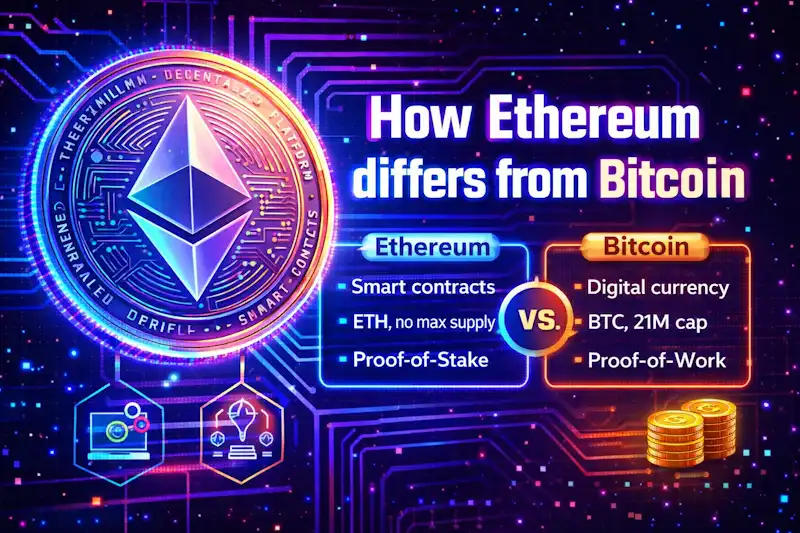
To explain forks, people sometimes ask, what is ethereum classic, after reading older headlines. That chain follows a different history, while the main chain kept most tooling and app activity. When the question becomes ethereum what is it, the key point is that it executes contracts, not only transfers. In contrast, eth is the fee asset that makes those executions possible.
| Item | Main job | Block time | Typical throughput | Programmable rules |
|---|---|---|---|---|
| Main chain | General execution | 12 s | 15-30 tx/s | Yes |
| Bitcoin | Payment focus | 600 s | 3-7 tx/s | Limited |
| Token standard | Asset format | 0 s | 0 tx/s | Depends |
| Blockchain concept | Data ordering | 0-600 s | 0-30 tx/s | Varies |
The numbers give scale, not guarantees, and they show why execution-focused chains and payment-focused chains feel different in practice.
Expert note (Daniel Brooks, Crypto Market Structure Analyst): People compare chains by speed, but design goals matter. One system optimizes transfers, another prioritizes execution. That framing helps you decide when a token, a chain, or a database is enough.
Where Ethereum is used: payments, apps, and tokens
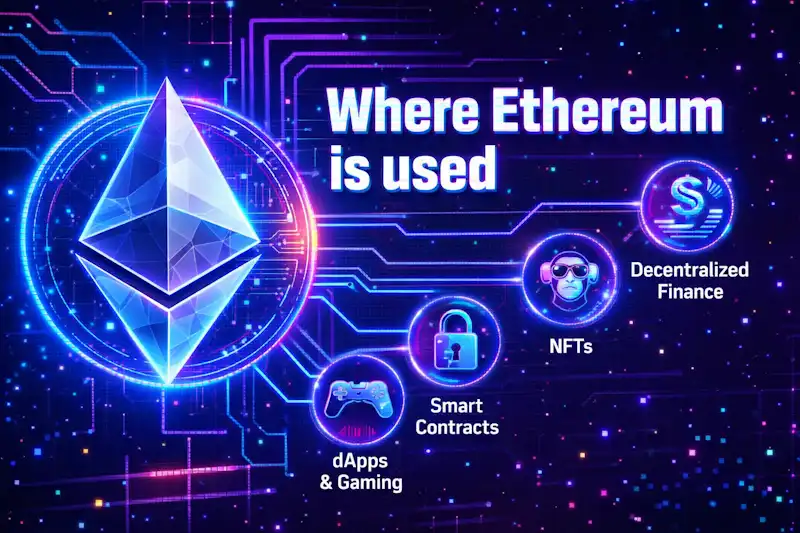
Most activity on ethereum comes from contract interactions that change on-chain state. Users swap assets, borrow, lend, mint tokens, and register ownership in ways that wallets can verify. Many actions still require a small balance of eth, because fees must be paid even when you move other assets. This is why people keep a small buffer for routine use.
- Simple transfers and payroll-style payouts
- Stablecoin settlement for merchants and online services
- DeFi trading, lending, and collateral management
- NFTs and game items with on-chain ownership
- App tokens issued through common standards
Once you try a few workflows, it becomes clear that signing the right message matters more than memorizing every term.
How Ethereum works: the basic network mechanics
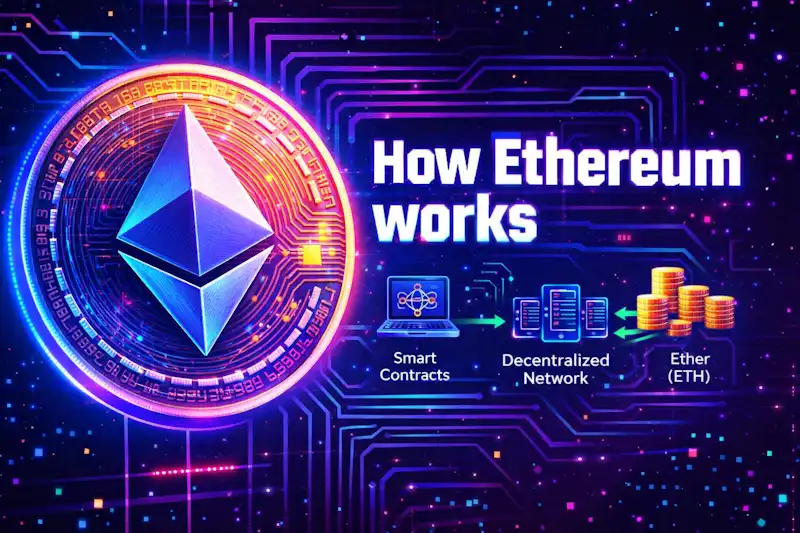
Under the hood, ethereum keeps a shared state that every node can recompute from the same inputs. Each block applies transactions, updates balances, and updates contract storage. The fee is paid in eth, which limits spam and funds validator incentives. The result is a network where anyone can verify what happened, even if they do not trust the sender.
The Ethereum blockchain as a shared data ledger
You can treat the ethereum chain as an append-only log that links each block to the previous one. Because every block depends on earlier state, rewriting history becomes hard without controlling consensus. Addresses are 20 bytes, and a checksum display helps catch some typing mistakes. The log stays accessible, so audits and later reviews can use the same data.
Transfers and fees: what gas is and what affects it
In ethereum, gas measures how much computation and storage a transaction consumes. You pay in eth, and the total fee equals gas used times the effective gas price. A plain transfer has a predictable cost, while a swap can vary with code paths and storage writes. Since EIP-1559, a base fee is burned, and a tip can be added to speed inclusion.
- Gas depends on computation, storage writes, and data size.
- Congestion raises the base fee when blocks fill up.
- Wallets let you set a max fee to cap worst-case cost.
- Contract design can reduce gas by avoiding heavy storage.
After you watch fees in real time, budgeting with eth becomes part of planning, and you learn to wait for calmer blocks.
Expert note (Aisha Rahman, Smart Contract Engineer): Gas is a metering tool, not a random surcharge. If an action writes to storage or touches many contracts, it costs more. Estimate fees before swaps, and keep a buffer for retries.
Seed phrase, private key, and signature: why recovery is hard
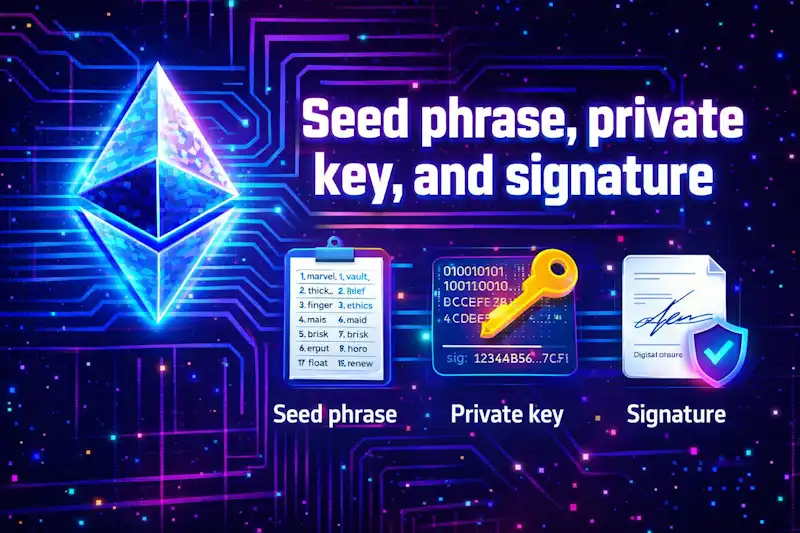
A wallet controls funds by holding a secret that can produce valid signatures. The seed phrase often derives many keys, so one backup can restore multiple accounts. Networks can verify a signature, but they do not know who owns it. If the seed phrase is lost, access to assets on the chain is usually gone for good.
Expert note (Luca Romano, Wallet Security Specialist): The biggest risk is not hacking, but user error under time pressure. Slow down, read the spender address, and confirm the network. A hardware wallet adds friction, and that friction prevents costly approvals.
Network nodes, validators, and Proof of Stake consensus
After the Merge, ethereum relies on Proof of Stake, where validators propose and attest to blocks. If you search what is ethereum staking, you will see rewards come from issuance and fees, while penalties apply for downtime. A full validator bond is 32 units of the base coin, but pools let smaller balances participate. Many also type what is eth staking when they compare pooled options and learn how the staked asset is represented. During validation, the unit remains eth, while derivatives may trade separately.
Expert note (Sofia Patel, Protocol Research Lead): Proof of Stake rewards are tied to participation and correct behavior. Staking is not passive income in a bank sense. Understand lockups, withdrawal queues, and operator risk before delegating funds.
Strengths and weaknesses of Ethereum versus traditional finance
Compared with bank rails, ethereum settles based on shared verification, not on a single operator’s database. A payment in eth can be final within minutes, even outside business hours. The downside is that user errors can be irreversible, and support is not centralized. The table summarizes tradeoffs using typical ranges, not guarantees.
| Topic | Plus for users | Minus for users | Example numbers |
|---|---|---|---|
| Settlement | Predictable finality | No standard chargeback | 2-15 min, 0 reversals |
| Availability | Runs 24/7 | Fee levels vary | 0 downtime goal, 0.20-20.00 |
| Access | No account approval | Key loss risk | 5 min setup, 1-10 days onboarding |
| Audit trail | Shared public data | Lower privacy by default | 1-30 days reviews, 0-200.00 |
Use these ranges as a baseline, then test with small amounts, because real fees and times depend on demand and the tools you pick.

Programmable rules: smart contracts and automation
Smart contracts let ethereum enforce rules as code that executes the same way for every user. A contract can hold funds, check conditions, and move assets without manual processing. Many people first understand what is ethereum when they see a swap settle without a broker. Fees still apply, so automation is constrained by the cost of execution.
Application ecosystem: tokens, DeFi, NFTs, and standard compatibility
The ecosystem around ethereum grew because standards made assets portable across wallets and apps. ERC-20 tokens share a common interface, and ERC-721 NFTs share ownership methods. Some users ask what is eth all time high when they think about cycles, yet most use depends on app demand. Because most actions require fees, people keep some balance for fees.
- Standards reduce custom integrations across apps.
- DeFi composes contracts like building blocks.
- NFTs store ownership pointers and metadata references.
- Layer 2 networks batch transactions and post proofs back.
After you test a few apps, you can reuse the same wallet for many systems, and you start spotting standard prompts faster.

Tradeoffs: fees, network load, and beginner complexity
Even today, ethereum can become expensive when many users compete for block space. Some beginners still ask what is eth when they see fee settings inside a wallet screen. Beginners also face a UI problem – approvals, contract calls, and chain selection are easy to misread. Fee estimates help, but they are not promises, and failures still burn some gas. Starting with small values and repeating steps reduces mistakes.
- Fees rise when blocks fill and users bid for inclusion.
- Some actions need two steps – approve, then execute.
- Bridging to Layer 2 adds steps and new risks.
- Interfaces can hide details like spender permissions.
After a few careful sessions, many users keep a checklist, and they review approvals first, which lowers risk more than chasing speed.
Risks that are worth stating plainly
Using the system removes many gatekeepers, but it also removes built-in reversals. A wrong address, a fake signature request, or a flawed contract can lead to loss. The safest plan is to assume every click is final and verify details before you sign. When value is at stake, slow actions beat fast actions.
Disclaimer: On-chain actions are usually final, and smart contracts can fail or be exploited. We do not custody funds and cannot reverse mistakes. Check local rules on reporting and taxation before using any wallet, exchange, or staking service.
Losing funds due to mistakes: addresses, networks, and wrong actions
Mistakes often come from copy errors, wrong networks, or misunderstood approvals. A transfer to a wrong address is usually unrecoverable, while a wrong-network send can sometimes be fixed with the right wallet view. The table uses example amounts to show scale and recovery odds. Numbers vary by service policies and how fast you act.
| Mistake type | Example loss | Typical recovery chance | Time to detect | Primary fix |
|---|---|---|---|---|
| Wrong address | 0.05 base coin | 0-5% | 1-10 min | Test with small amount |
| Wrong network | 200 stablecoins | 10-60% | 5-60 min | Import token or bridge |
| Unlimited approval | 1.0 token value | 0-20% | 1-7 days | Revoke approvals |
| Phishing signature | 2.5 coin value | 0-5% | 1-30 min | Hardware wallet, review data |
Most fixes rely on acting fast, so using test sends and reviewing approvals can protect larger balances over time.
Smart contract bugs and protocol risks
Code risk is real, because complex contracts can hide edge cases. Audits reduce risk, but they do not remove it, and incentives can fail under stress. If an app is upgradeable, the upgrade key becomes another risk surface. A practical rule is to limit exposure to contracts you cannot explain, and to avoid chasing yields you cannot model.
Scams and phishing: fake sites, wallets, and signatures
Attackers copy interfaces and try to push users into fast signing. The common pattern is urgency, a fake error message, and a request to connect a wallet. A signature can grant permissions, even if it is not a direct transfer. Security improves when you treat every prompt as a contract you are about to authorize.
- Use bookmarks, not search ads, for sites you visit often.
- Check the domain, then re-check before connecting.
- Read requested permissions and the spender address.
- Use a hardware wallet for larger balances.
After one near miss, most people slow down and read screens, then they verify the spender address, and that habit is a strong defense.
Expert note (Henry Nguyen, Incident Response Consultant): Most phishing succeeds through familiar screens that look normal. If a site asks for a signature to fix an error, pause. Close the tab, open a bookmark, and compare the request details again.
Regulation and taxes: what to verify in advance
Even though the network is global, local rules apply to gains, income, and reporting. Some jurisdictions tax swaps, while others focus on realized gains when you convert to fiat. You should also check how staking rewards are categorized, since treatment differs. Keeping records from the first day saves time later.
- Confirm which events count as taxable disposals locally.
- Track timestamps, amounts, and fees for each action.
- Keep records for 3-7 years, based on local requirements.
- If unsure, ask a licensed specialist in your jurisdiction.
After you build a simple spreadsheet log, compliance becomes routine, and you can answer local reporting questions without searching past transactions.
Author note
In my view, the strongest part of ethereum is that it lets strangers coordinate around shared rules. Holding some eth is useful when you use apps, because fees are part of most workflows. The drawback is usability – one bad approval can cost more than a bank error. The learning curve pays off when you stay cautious and keep backups today.
FAQ about Ethereum
Can you buy a small amount, and how do coin fractions really work?
Yes, small buys are normal because the base unit is divisible into tiny parts. Wallets show decimals, so you can hold 0.01 or 0.0001 and still pay fees. Check the decimal places before you copy amounts, and label your balances in value terms, not unit count.
Why can fees jump fast, and how should you plan around them?
Fees rise when many users compete for limited block space in the same minutes. Set a maximum fee, watch the estimate window, and avoid time-sensitive actions during spikes. If your wallet supports it, choose a slower mode and let the transaction wait instead of overpaying.
How long does a transfer take, and why can the time change a lot?
Most transfers confirm within minutes once a block includes them. Time changes with congestion and the fee you set, because validators prefer transactions that pay more. If a transfer stays pending, you may need to speed it up or replace it using the same nonce.
Can you cancel or change a sent transaction after you click send?
A confirmed transaction cannot be undone under normal conditions. If it is still pending, you can often replace it by sending a new transaction with the same nonce and a higher fee. Some wallets do this with a speed up or cancel button, but it only works before inclusion.
What is the difference between the base coin and ERC-20 tokens?
The base coin is used to pay network fees and is required for most actions. ERC-20 tokens are contract-defined balances that follow a common interface for transfers and approvals. Tokens can move only if you also have enough fee balance, even when you are not moving the base coin.
How does a self-custody wallet differ from an exchange account?
A self-custody wallet keeps keys on your device or hardware, so you sign actions yourself. An exchange account is custodial, so the platform signs and controls withdrawals. Self-custody gives control and responsibility, while custody gives support and account recovery options.
What is staking, and what risks matter before you delegate funds?
Staking earns rewards for helping secure consensus, but returns can vary. Key risks include downtime penalties for operators, smart contract risk in staking wrappers, and liquidity limits during withdrawal queues. Prefer clear fee terms, diversify, and avoid locking funds you may need soon.
What are Layer 2 networks, and when should a user choose them?
Layer 2 systems bundle many actions off the main chain and post proofs back. They often cut fees and improve speed for routine transfers and app use. You still need to understand bridges, withdrawal times, and which apps support each layer before moving funds.
What should you check before you approve a transaction request?
First, verify the destination address and the exact asset and amount. Next, check permissions, especially approvals that allow spending later. If a wallet shows decoded data, read it for spender rights and deadlines. When something looks odd, reject and review on a block explorer.
Which network upgrades change rules, and why should users track them?
Upgrades can change fee math, consensus rules, and how transaction data is stored. That can affect wallet behavior, app compatibility, and typical fees. Track major upgrade names, keep your wallet updated, and expect short periods of interface glitches after activation.