Contents
- 1.What Is a Stop-Loss Order in Crypto Trading?
- 2.Why Stop-Loss Orders Are Essential in Crypto Markets
- 3.Types of Stop-Loss Orders in Crypto
- 4.How to Set a Stop-Loss Order Step-by-Step
- 5.How to Calculate the Right Stop-Loss Level
- 6.Common Stop-Loss Strategies Used by Traders
- 7.Stop-Loss Mistakes Traders Should Avoid
- 8.Stop-Loss Orders in Different Market Conditions
- 9.Advanced Stop-Loss Techniques
- 10.Stop-Loss Orders on Major Crypto Exchanges
- 11.FAQ
What Is a Stop-Loss Order in Crypto Trading?
Definition of Stop-Loss in Simple Terms
A stop-loss is an automatic order to close a trade when the price of the asset reaches a certain level, and is used as a way to limit potential losses in the event of an adverse price move.
Stop-losses are typically used as a risk management tool, rather than to earn a profit on fast-paced cryptocurrency markets.
For example, a trader buys Bitcoin at $100,000 and wants to place an order that automatically closes it if the price drops to $95,000, a stop-loss order would help them achieve this. Stop-loss orders also help investors avoid emotional trading and are a basic strategy used in crypto risk management.
How Stop-Loss Orders Work on Crypto Exchanges
Most cryptocurrency exchanges offer the ability to set specific trigger prices for market and limit orders, such that buy or sell orders can be placed automatically at a specific price point. Depending on the exchange and order type, the stop-loss may either execute as a market order or be converted into a limit order.
Read Also: What Is Crypto Arbitrage Trading and How Does It Work? Complete Beginner’s Guide (2026)
When learning how does stop-loss work in crypto trading, you may find your trades are not executed at the stop price. In these cases, slippage (the difference between the stop price and the actual price you receive when your order is executed) is likely to have occurred due to extreme volatility or market illiquidity. This is particularly concerning for small-cap digital assets and leveraged positions.
Most of the exchanges allow stop-losses to be built directly into the spot and derivatives trading interfaces. This allows the trader to state the conditions that will cause them to exit the market before they enter, and helps the trader manage their risk when they are not in front of charts.
Stop-Loss vs Take-Profit Orders
Stop-loss and take-profit orders can set the maximum losses and profits of an open position. A stop-loss order protects against additional losses and risks, while a take-profit order realizes profits when the price reaches a predetermined point. Stop-loss and take-profit orders create a structured exit point for traders.
| Order Type | Primary Purpose | Trigger Condition | Typical Outcome |
| Stop-Loss | Limit potential losses | Price moves against the position | Position is closed automatically |
| Take-Profit | Lock in gains | Price reaches a target level | Profit is realized automatically |
| Trailing Stop | Protect profits during trends | Price reverses by a predefined amount | Position closes while preserving part of gains |
The difference between a stop-loss vs take profit crypto strategy is that the former protects your trading loss in a bearish market, while the latter maintains your trading profits in a bullish market.
To avoid emotion-driven actions, many traders would simultaneously place both types of orders as part of their stop-loss trading strategy.
Why Stop-Loss Orders Are Essential in Crypto Markets

Managing Volatility in Crypto Trading
Cryptocurrency markets are highly volatile, and price changes often depend on liquidity, macroeconomic events, market sentiment, and continuous open-order trading.
Because digital assets are traded 24 hours a day, an unhedged trader can lose money on their position without being aware of the asset’s price fluctuations, so most traders use stop-loss orders during volatile price changes.
A correctly placed stop-loss order crypto allows traders to set their maximum loss as soon as they enter a trade. Instead of relying on emotions during times of volatility, they can exit at a price that is optimal for their trading style and risk tolerance.
Protecting Capital During Market Downturns
In trading, a principle of capital preservation states that it’s easier to avoid losses than to recover from them, and risk management focuses on minimizing losses before maximizing gains.
In a broad market sell-off, stop-loss orders are a way to limit risk when the price of an asset drops below a set level. This is crypto risk management technique intended to limit large portfolio losses from short-term price corrections.
Emotional Discipline and Risk Control
In periods of volatility, fear, hope, and panic may affect the judgment of investors. Undisciplined traders fail to follow their trading plan by exiting unprofitable trade positions as planned and make spontaneous decisions based on their emotions.
As a way to relieve some of the emotional burden, the how to use stop-loss practice, which sets predetermined thresholds for selling to recoup losses, is common. Experienced investors incorporate stop-losses into a stop-loss strategy trading framework, which stresses limiting trading losses to predetermined thresholds.
Types of Stop-Loss Orders in Crypto
Market Stop-Loss Orders
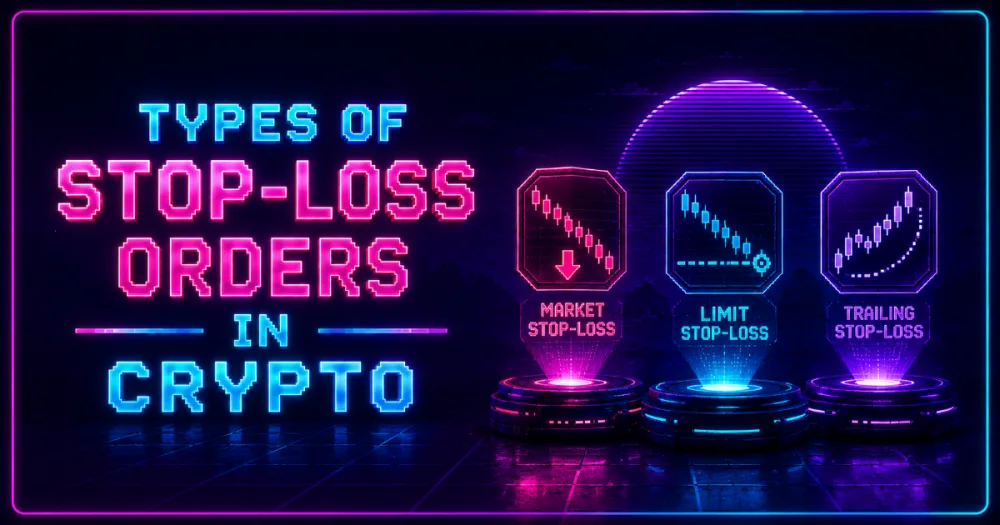
A market stop-loss order is an order to close the position once the stop-loss price has been executed. A market stop-loss order becomes a market order ‘market on stop’ once the stop-loss price has been reached, and will be filled at the best available price in the order book. Because it is focused on execution rather than price, this order type is often used to limit losses.
The downside is that the actual execution price may differ from the trigger level; in volatile and/or illiquid markets, the order may be filled at the next available price rather than the stop price, which would create slippage.
Limit Stop-Loss Orders
A limit stop-loss order is an order type that specifies both a stop price and a limit price. A limit order to sell is sent at the stop price, rather than being executed immediately like a stop order. This gives traders more control over the price at which they can get out of a position.
The main advantage is price control: if the price rapidly moves past the limit price, the order won’t fill and the position will remain open even after the stop triggers.
Trailing Stop-Loss Explained
A trailing stop-loss is a stop-loss order that moves along with the price of an asset in a favorable direction, keeping pace with the position in the market by maintaining a set distance between the market price and the stop level, either as a percentage or amount.
One distinct advantage of trailing stop-loss crypto methods is the protection from the loss of unrealized gains, while not requiring constant monitoring. These orders only trigger if the market moves against the trader by the defined amount.
Trailing stops, because they follow the market trend, work well for trending markets. As such, most advanced types of modern crypto trading tools have trailing-stop functionality by default.
| Stop-Loss Type | Execution Priority | Price Control | Best Used For |
| Market Stop-Loss | High | Low | Fast exits during sharp moves |
| Limit Stop-Loss | Medium | High | Controlled exits at specific prices |
| Trailing Stop-Loss | High | Dynamic | Trend-following strategies |
How to Set a Stop-Loss Order Step-by-Step
Choosing the Right Exchange (Binance, Coinbase, etc.)
Traders must ensure their chosen exchange supports stop-loss orders before placing the order. For instance, exchanges like Binance Academy and Coinbase Advanced Trade accept stop orders for various financial instruments. Stop-loss orders may not necessarily be available for all markets, products, and jurisdictions.
Liquidity is another variable across exchanges, as deeper order books translate into better execution quality and less slippage when the stop order is triggered. In order to learn how to set stop-loss on Binance crypto, traders can check the official order type documentation on the exchange before opening a position.
Selecting a Stop-Loss Price Level
More generally, stop-loss levels are often set before a trade is entered. Binance Academy states that many traders use technical analysis, such as placing stop-loss orders at support and resistance levels. Others use a set percentage of capital at risk.
The exact placement of the stop-loss must be determined based on market conditions and individual risk tolerance levels, as a stop-loss too close to market entry may have the position closed by regular market fluctuations. If the window is too wide, the loss may be high.
Placing Stop-Loss on Spot Trades
In spot markets, participants typically set a stop trigger price and a market or limit order. Once a transaction reaches the stop trigger price, an order will be automatically placed via the market exchange to execute the trade.
Understanding how to set stop-loss crypto process is particularly important because cryptocurrency markets are open 24/7, allowing traders to define how much risk they are willing to take without having to constantly monitor price fluctuations.
Setting Stop-Loss on Futures Positions
Most futures trading systems have stop-loss features that can be attached to an open position and will reduce or liquidate a trader’s exposure to market risk when a predetermined market trigger level is breached.
Because leveraged trading is a common feature of futures trading, a well-placed futures stop-loss can be seen as a basic risk management feature. Many of the derivatives exchanges support the setting of both a stop-loss and a take-profit level on the same position.
How to Calculate the Right Stop-Loss Level
Using Percentage-Based Risk Strategy
The percentage method is based on the trading capital that can be risked on a trade. According to Binance Academy, risk management is a pre-trade exercise, whereby stop-loss levels and position sizing are combined to determine the amount of capital that can be risked on a trade.
You first need to decide how much loss you’re willing to take, then use that information to calculate an appropriate position size, rather than choosing a random stop price level. This is how crypto risk management systems tend to work in very different market conditions.
Support and Resistance Levels Method
Support and resistance are two of the most popular technical-analysis concepts used when setting stop-loss levels. Per Binance Academy, they are levels where price direction has previously been affected by buying or selling pressure, and thus could be likely reversal levels to exit a position.
Stop-loss orders are placed below support for long positions or above resistance for short positions. This is because the price moving past a support/resistance level is taken as confirmation that the condition that created the trade no longer holds.
Read Also: Best Crypto ETF Contracts for 2026: Which ETFs Will Dominate Trading This Year?
For many traders, learning how to use stop-loss is attractive, as it allows them to avoid using static stop-loss percentages and size their risk according to market structure.
Risk-to-Reward Ratio (R:R) Approach
Similarly, a risk-to-reward ratio represents a ratio of a market trader’s maximum potential loss (the risk) to the maximum possible profit (the reward). This ratio can be used to determine whether a trading opportunity offers enough potential to justify the risk, according to Binance Academy and Investopedia.
In practice, stop-loss and take-profit levels can be calculated together. Binance Academy states that many traders may seek setups with a risk-reward ratio that makes the trading strategy profitable even with some losing trades mixed in.
As a result, the R:R model is incorporated into many stop-loss strategy trading plans, as considering both risk and reward before entering a trade can lead to a more systematic method of trading.
Common Stop-Loss Strategies Used by Traders
Fixed Percentage Stop-Loss Strategy
Fixed percentage stop-loss orders are perhaps the simplest type of stop-loss orders, where traders place a stop-loss order to be triggered once the number of losses reaches a predetermined percentage. According to Binance Academy, it is often part of broader risk management systems since it enables traders to consistently plan their trades in advance.
Its most obvious benefit is its simplicity. Many educational resources describe this approach as one of the best stop-loss strategy for crypto beginners because it allows traders to define risk consistently without relying on complex indicators.
ATR (Average True Range) Based Stop-Loss
The Average True Range (ATR), developed by J. Welles Wilder, is a technical analysis volatility indicator used to measure price volatility over a specified period of time, and according to Investopedia, measures market volatility without indicating its direction.
Because volatility is not constant, ATR-based stops can be adjusted to reflect current market conditions. A trader may use a multiple of the ATR value to set stop-loss orders, allowing wider stop-losses during periods of high volatility. Such strategies are typically mentioned in advanced crypto stop-loss guide resources.
Swing Low / Swing High Strategy
Another swing trading risk management technique is placing stop-loss orders at nearby swing lows (for long trades) or swing highs (for short trades), depending on the expected direction of the movement. An effective break of these levels will generally indicate the trade setup is no longer valid.
Read Also: What Is PnL in Crypto Trading? How to Calculate Profit & Loss Guide
Stops based on swings are based on a swing’s price action. Swing-based stops are used by traders to determine how to reduce losses in crypto trading. They’re considered a reliable point of reference.
Stop-Loss Mistakes Traders Should Avoid
Placing Stop-Loss Too Tight
One of the most common trading mistakes is applying a stop-loss too close to the position entry, and according to the Binance Academy, the market can swing both ways with normal volatility before establishing a confirmed trend, causing stops placed in the noise to be triggered.
As a result, traders can be forced out of legitimate trades, which moves some risk management guides to prefer using technical levels or measures of volatility as opposed to fixed distances.
Ignoring Market Volatility
Market volatility also comes into play for where to place stop-losses. According to Investopedia, traders often use volatility indicators such as the Average True Range (ATR) to determine price fluctuation around which to place stop-losses.
In a more volatile environment with more price fluctuations, a stop-loss strategy may be less effective, as the asset will be more likely to hit the stop price. Thus, many experienced traders employ volatility analysis in their crypto risk management.
Ignoring volatility can also cause an imbalance between the risk and reward that is offered. A stop-loss is not set correctly if it does not take volatility into account as a measure of risk.
Moving Stop-Loss Emotionally
Another mistake is moving the SL once a trade starts going in the wrong direction. Binance Academy claims it is one of the biggest pitfalls of risk management and occurs during times of high uncertainty.
If a stop has to be moved to a greater distance in order to avoid a loss, this might eventually have a negative impact on the robustness of a trading system or the process of evaluating performance.
A disciplined stop-loss trading crypto strategy should include pre-determined exit conditions before entering a position, and these should be adhered to regardless of market conditions.
Stop-Loss Orders in Different Market Conditions
Bull Market Strategy Adjustments
In a strongly trending market, traders sometimes use a trailing stop instead of a regular stop, providing better profit potential before closing the position if the market begins to move in the opposite direction. Binance Academy states they are used in trending markets because they will follow the price at a predetermined distance.
If stops are set too close to the price action, a normal pullback might trigger the stop, which is why many traders consider volatility and market structure in position management.
Bear Market Risk Management
Bear markets are characterized by prolonged pessimism and uncertainty. An investor might use a stop-loss order for capital preservation as part of a broader risk management strategy during a downturn. According to Binance Academy, a stop-loss is used to define risk before opening a trade.
In a similar vein, without a formalized crypto risk management framework in place, traders often scale back their exposure in the short term during extended periods of declines.
Sideways Market Considerations
In range-bound markets, where prices may oscillate between periods of support and resistance, placing stop-loss orders above support or below resistance may be a better option than placing them at a midpoint in the range to avoid being triggered by typical market fluctuations.
Read Also: Top 5 Crypto Trading Setups for Quick Gains: Boost Short-Term Performance
When formulating a stop-loss strategy trading, it may be just as important to focus on adjusting the placement of the stop to current market conditions as it is to use different types of orders.
Advanced Stop-Loss Techniques
Trailing Stop Optimization
Trailing stop orders automatically adjust when the market moves in the direction of the trader, to protect profits and remain open with the trend.
According to Binance Support documentation, a trailing stop modifies itself by a predetermined percentage or callback rate as the price changes, and is triggered at the rate corresponding to an inverse price change.
A stark difference in trailing stop-loss crypto trading is the placement of the stop-loss. Stops that are too tight may be triggered through normal trading activity, whereas wider stops may give trends more time to establish prior to being closed out.
Partial Stop-Loss Exit Strategy
Conversely, some traders do not close out a full position but may instead gradually offset risk as the price moves in their favor by closing out a portion of their position once a certain price target is hit. Position scaling is widely discussed in the professional trading literature as a risk management and return enhancement technique.
Traders can participate in this practice to reduce risk exposure on their positions after an initial price move against their wishes, without necessarily abandoning their trading idea, as part of larger flexible crypto risk management and capital preservation practices.
Combining Stop-Loss With Leverage Trading
Since leverage magnifies profits and losses, stop-losses are of increased importance in derivatives markets. The Binance Academy lists leveraged trading as one of the causes of increased market volatility. As a result, risk controls are a key component of futures trading.
A correctly used futures stop-loss can be an efficient way for traders to choose their maximum loss when entering a leveraged trade. Derivatives exchanges often provide options for stop-loss and take-profit to be added to a trade and automatically executed even in fast-moving markets.
| Technique | Main Objective | Key Advantage |
| Trailing Stop | Protect profits during a trend | Automatically follows favorable price movement |
| Partial Exit | Reduce exposure gradually | Preserves part of the position while lowering risk |
| Stop-Loss + Leverage | Limit downside on leveraged trades | Helps control losses in highly volatile markets |
Stop-Loss Orders on Major Crypto Exchanges
How to Set Stop-Loss on Binance
Binance also supports stop-limit and stop-market orders. According to Binance’s documentation, a stop price is the price at which an order will be triggered once the market reaches that level. Depending on the selected order type, Binance will place either a market order or a limit order.
Spot trading stop-loss orders can be found in the order entry panel. If you are wondering how to set stop-loss on Binance crypto, remember to check trigger prices and execution prices before placing the order.
How to Set Stop-Loss on Bybit
Users can set stop-loss parameters when opening a position or in the position management page for that position in Bybit’s spot market and derivatives market. This allows a user to automatically exit a position when certain conditions are met within the trading platform.
For futures trading, these stop-loss orders are conditional orders with respect to the open position, according to the documentation. In such cases, the orders are automatically updated or canceled as the position is exited.
How to Set Stop-Loss on Coinbase Pro
In 2022, Coinbase Pro was taken offline, and the more advanced trading tools were migrated to a program called Coinbase Advanced Trade. The order types requiring triggers are now available on the Advanced Trade program of the Coinbase website, where users define the triggers and order conditions.
As explained in most crypto stop-loss guide literature, the basic steps to place a stop-loss order include selecting the trading pair, choosing the type of stop order, entering a trigger price, and finally confirming the order. After entering the order, the trading platform will automatically execute it once the set conditions are met.
FAQ
Can a stop-loss guarantee that a trade will close at the exact price I set?
No. In fast-moving markets or those with low liquidity, the final execution price may not equal the price at which the order is triggered. It is particularly common during periods of high volatility.
Is a stop-loss necessary for long-term investors?
Not always. Some investors may choose to simply buy and hold for longer, and others may have stop-losses set to avoid further losses or giving back gains.
What is the difference between a stop-market and a stop-limit order?
A stop-market order becomes a market order when the stop price is hit. A stop-limit order turns into a limit order, giving the investor more control over the price but with no guarantee of execution.
Can I change or cancel a stop-loss order after placing it?
Yes. Most cryptocurrency exchanges allow traders to edit or cancel a stop-loss order before it gets activated in the market (unless it has already executed).
Do stop-loss orders work on both spot and futures markets?
Yes. Most major exchanges support stop-loss orders, both for spot and derivatives trading, though the order types and settings at different exchanges may vary.