Discussing the best privacy coins 2026 does not sound like past privacy-coin debates. Once, the big question was simply whether a coin could hide transactions effectively. Today, what counts is whether it can stay on exchanges, keep liquidity, support working wallets, survive regulation, and still have a solid reason to exist beyond “being private.”
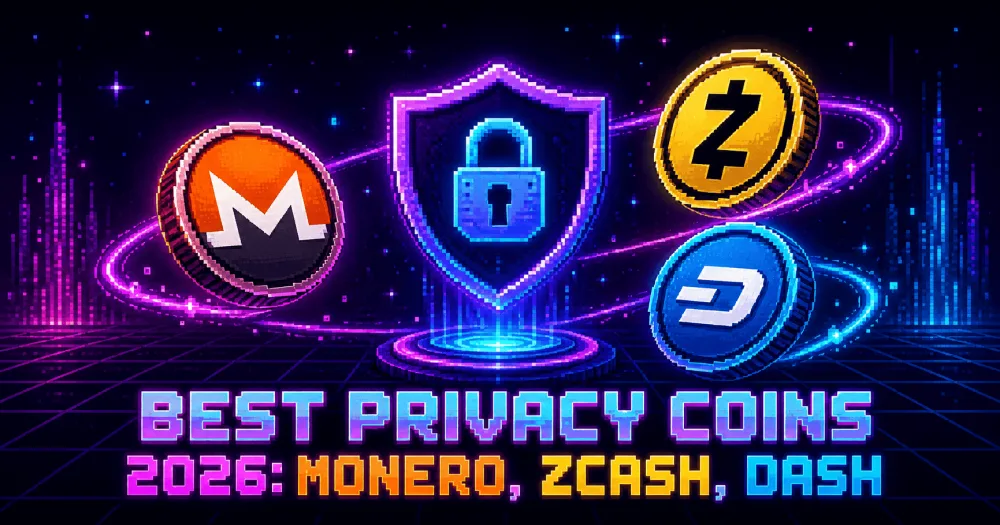
When thinking about private digital money, names like Monero, Zcash, and Dash often come up. Still, what lies under the hood sets them apart. Monero stands firm as a coin built entirely around hiding user details. Zcash uses strong cryptography, but only when people choose shielded transfers. Dash focuses more on fast transactions, with privacy features feeling like add-ons rather than the core of the system.
Contents
- What Are Privacy Coins?
- Why Privacy Coins Still Matter in 2026
- Best Privacy Coins 2026: Comparison Table
- Monero: Designed for Privacy
- Zcash: Good Privacy When Set Up Right
- Dash: Focus on Fast Transactions
- Monero vs Zcash vs Dash: Which Is Best?
- Regulatory Pressure on Privacy Coins
- Are Privacy Coins Good Investments in 2026?
- Privacy Coins Versus Bitcoin Mixers
- What to Watch in 2026
- Final Verdict: Best Privacy Coins 2026
- FAQ
What Are Privacy Coins?
Privacy coins are digital currencies built to obscure where funds move. Bitcoin’s ledger, for example, is pseudonymous rather than truly anonymous. Anyone watching can see wallet IDs, balances, and every transfer made. Link one of those IDs to a real person, and everything opens up fast.
Money sent through privacy coins looks different from regular transactions. Who pays can be hidden in certain systems. In others, the receiver stays unknown instead. Amounts might vanish from view, or trails between transfers can become harder to follow. Every design takes its own path, and protection levels vary sharply.
Related: Zcash vs Bitcoin in 2026: Is Zcash a Better Privacy Coin Than Bitcoin for Investors?
Traces can linger even with a privacy-focused cryptocurrency. Some coins make transactions private automatically. Others leave the choice to the user. A few use strong cryptography, while others rely on mixing-style methods.
Why Privacy Coins Still Matter in 2026
Money secrets are not just for rebels. Some people need hidden transactions to operate lawful ventures, avoid threats, keep earnings private, guard contributors, or stop every purchase from echoing forever.
Meanwhile, coins built for privacy get more attention from authorities than regular digital money. Worries over crime funding, sanctions evasion, and shady online trading drive this tension. Because of those issues, certain privacy-focused tokens have vanished from major exchanges.
Secrecy matters, but so does practicality. Coins that vanish into obscurity fail even if they hide well. The best privacy coins 2026 mix strong privacy with real-world use, exchange access, liquidity, and staying power.
Best Privacy Coins 2026: Comparison Table
| Coin | Privacy model | Privacy strength | Main advantage | Main weakness |
|---|---|---|---|---|
| Monero | Mandatory privacy | Very high | Strong privacy by default | Exchange delistings and regulatory pressure |
| Zcash | Optional shielded privacy | High when used correctly | Zero-knowledge proofs and selective disclosure | Privacy depends on user behavior |
| Dash | Optional mixing-style privacy | Moderate to low | Fast payments and usability | Not a true privacy leader |
Monero locks down privacy like few others. Zcash works better when precise control over what gets revealed matters. Dash remains useful for fast transfers, but calling it top-tier for secrecy pushes things too far.
Monero: Designed for Privacy
Most people wondering which privacy coins lead in 2026 name Monero early. It was born private, with no setup needed. Skipping privacy is not a choice here. Default mode is always locked in.
Monero hides transaction details through several techniques working at once. Ring signatures make the sender unclear. Stealth addresses keep the recipient out of sight. RingCT hides how much moves. Tracing a specific transfer gets difficult when all these pieces combine.
Hidden details come first here. Each transaction wraps secrecy into its core design automatically. When privacy remains optional, mistakes happen. Someone overlooks, ignores, or misses the setting. Monero removes that risk by making privacy standard.
Why Monero Stays Ahead
Someone choosing Monero helps strengthen anonymity for everyone else. There is no checkbox to pick whether you want secrecy. Regular use strengthens the network’s privacy.
Most coins talk about privacy, but few deliver like Monero. Built-in secrecy is not a feature buried in menus. It is how the system runs. Its users value independence from central control and freedom to transact without gatekeepers watching closely.
Monero’s Biggest Problem
Hidden strengths often carry hidden costs. Because privacy is automatic, certain exchanges struggle to include Monero. After delistings, some places no longer offer simple entry points. Mainstream money systems tend to step back when faced with its design.
Monero is not dead, but its investment case changes when exchanges step back. Strong tech loses some edge when access fades, liquidity thins, and rules tighten.
For users who care most about hidden transactions, Monero still leads. For investors, exchange access remains the biggest problem.
Zcash: Good Privacy When Set Up Right
Zcash keeps payment information private through advanced cryptography. Its zero-knowledge proof systems can hide amounts and addresses while still confirming that a transaction is valid.
Unlike Monero, Zcash lets users choose whether to keep things private. Some addresses show everything clearly. Others lock down the information. Depending on setup, a shielded transfer might hide who sent it, who received it, and how much moved.
This flexibility helps in some cases, but it also creates risk. If people use transparent mode, the system acts more like an open ledger. If shielded transactions are used correctly, Zcash becomes much harder to trace.
Zcash and Digital Privacy in 2026
Zcash stands out because zero-knowledge proofs still shape debates about financial privacy. Unlike Monero, it finds more favor with institutions by offering visibility only when required. Full disclosure is not necessary for verification to work.
By 2026, privacy is splitting into two paths. One side wants maximum secrecy. The other wants privacy with possible oversight. Zcash sits closer to the second path, allowing hidden transactions while still permitting selective disclosure when needed.
So Zcash appears in conversations about privacy that follows rules, hidden transactions, and financial tools that protect user details.
Zcash’s Biggest Problem
Most people using Zcash pick different settings. If only a few choose shielded transactions, privacy weakens. Privacy works better when more users join, but choices stay individual.
Many people also struggle to spot the difference between transparent and shielded transactions. A choice appears each time someone sends money. Pick wrong, and privacy falls apart. Crypto users already lose funds by sending tokens to the wrong chain. Expecting everyone to toggle privacy correctly every time is hoping harder than reality allows.
Dash: Focus on Fast Transactions
Dash shows up on privacy coin lists, but it does not truly sit alongside Monero or Zcash. Once tied closely to anonymity, it is now known better for fast transactions and spending ease rather than hidden details.
Dash keeps things private through coin blending. Tracing becomes tougher this way, but it does not match Monero’s deep cryptographic shields or Zcash’s shielded transfers.
Read more: DASH Price Prediction 2026: Will DASH Surge Again or Fade Into Crypto Obscurity?
Why Dash Shows Up in Privacy Coin Rankings
Dash brings speed and recognition. It has been around for years and was built around payments from the start. Privacy appears as an optional extra when needed.
Still, if the goal is top privacy, stronger choices exist. Dash shows up in best privacy coins 2026 searches partly by habit and history. When actual secrecy measures count, Monero takes a sharper lead, with Zcash close behind.
Dash’s Biggest Problem
Some choose Dash for privacy, though that is no longer its strongest point. When real anonymity matters, users often pick Monero or Zcash. Speed seekers also have many other options now, including stablecoins and newer payment rails.
Dash still has value as a payment coin. But its privacy narrative does not stand out like before.
Monero vs Zcash vs Dash: Which Is Best?
What counts as “best” depends on what someone means.
Monero takes the lead if deep privacy by default is the priority. Zcash steps ahead when fine-tuned secrecy using advanced cryptography and selective transparency matters. Dash makes sense for daily spending where hiding transactions is optional rather than central, but it does not lead in true anonymity.
| Use case | Best choice | Why |
|---|---|---|
| Maximum default privacy | Monero | Privacy is mandatory |
| Strong cryptographic privacy | Zcash | Shielded transactions use zero-knowledge proofs |
| Privacy with selective disclosure | Zcash | Better fit for regulated environments |
| Fast payments with some privacy | Dash | Payment-focused and simple |
| Long-term privacy ideology | Monero | Strongest privacy-first culture |
| Mainstream compliance potential | Zcash | More flexible privacy model |
Not every privacy coin fits the same mold. Monero appeals to those who want full secrecy. Zcash matters when solid math meets possible oversight. Dash remains useful when moving money fast matters.
Regulatory Pressure on Privacy Coins
Because of rules, tracking privacy coins gets trickier than analyzing standard digital money. The technology may be clear, yet markets still wobble.
Pressure builds most on Monero because privacy comes by default. When rules tighten, exchanges might walk away instead of defending XMR. With fewer places to trade, liquidity dries up. Access fades when doors keep closing.
Zcash has a smoother path because privacy can be switched on or off. When people need to show payment records, they can. That openness leaves more room to talk with regulators.
Dash tends to slide onto exchanges more easily because its privacy tools are optional and weaker. The odd twist is that easier access may come at the cost of true secrecy.
Privacy coins are not disappearing, but they may become harder to find on mainstream platforms.
Are Privacy Coins Good Investments in 2026?

Privacy coins grab attention, but they are not simple investments. Real needs drive their existence, yet authorities watch closely. Risk comes from markets and from laws shifting underfoot.
Monero handles private transactions better than most, even if some exchanges limit access. Zcash carries weight with institutions, though only if shielded transfers become more common. Dash once stood out for payment speed, but its secrecy no longer looks special.
A practical investor should ask:
- Does the technology really keep personal information safe?
- Is privacy mandatory or optional?
- Does the coin appear across several active exchanges?
- Is development still active?
- Are users actually using the privacy features?
- Could new rules make the coin harder to access?
Top-notch privacy tech might still fail as an investment. Strong code can stumble when markets lose interest, trading slows, or trust fades.
Privacy Coins Versus Bitcoin Mixers
Privacy coins and Bitcoin mixers are not the same thing. Privacy coins build secrecy into the asset or protocol. Mixers operate outside the chain and shuffle transactions to confuse trails.
Most mixers carry serious legal and service risks. Relying on external platforms or smart contract setups means funds might become linked to suspicious activity. Privacy tokens work inside their own network rules, though oversight bodies still watch them closely.
Privacy comes built into each standard Monero transfer. Zcash offers hidden pools when users choose shielded transfers. Dash offers private blending only when someone decides to turn it on.
For most people, privacy built into the system works better than outside apps that mix payments.
What to Watch in 2026
Several forces will shape privacy coins by 2026: government rules, exchange access, actual usage, and privacy tech upgrades.
Watch these signals:
- Exchange delistings or relistings.
- More shielded Zcash activity.
- Monero development progress and wallet adoption.
- Dash merchant adoption and whether its privacy tools still matter.
- Liquidity changes across major markets.
- Regulatory shifts in Europe, the U.S., and Asia.
- Whether users treat privacy as a real need or only a trading narrative.
If privacy matters more to users, Monero and Zcash could gain ground. If regulation tightens, exchange access may shrink. This push and pull shapes much of the best privacy coins 2026 debate.
Final Verdict: Best Privacy Coins 2026
The best privacy coins 2026 ranking is clear when measuring privacy strength.
Most people pick Monero first because privacy comes built into each transfer. For anyone needing truly hidden money moves online, it stands out clearly. Trouble shows up through exchange access and government scrutiny.
Second place goes to Zcash, thanks to strong zero-knowledge features. True anonymity only happens with shielded transfers, but Zcash has a solid case for regulated privacy and selective disclosure.
Third place goes to Dash, mainly because it handles fast transactions smoothly. Its privacy features are weaker and optional, but it remains in the conversation because of legacy appeal and search interest.
Monero stands out when privacy matters most. Zcash offers strong encryption with selective sharing. Dash brings speed with basic privacy. What works depends on what you value.
FAQ
What are the best privacy coins in 2026?
The best privacy coins 2026 are Monero, Zcash, and Dash. Monero leads by protecting every transaction by default. Zcash offers shielded transactions through strong cryptography. Dash supports fast transfers with optional privacy.
Monero versus Zcash: which offers more privacy?
Monero hides most transaction data by default. Zcash can offer strong privacy, but only when users choose shielded transactions correctly.
Does Dash truly count as a privacy coin?
Dash works mostly like a payment-focused cryptocurrency. Privacy appears only when users choose PrivateSend. It is less private than Monero or shielded Zcash.
Are privacy coins legal?
Across much of the world, outright bans on privacy coins remain rare. Still, regulators watch them closely, and some trading platforms restrict or remove them because compliance gets complicated.
Which privacy coin has the strongest privacy?
Monero has the strongest default privacy because every transaction hides details by design, without requiring extra steps.
Are privacy coins good long-term investments?
They can be, but they face tight rules and shaky trading conditions. Strong privacy does not guarantee strong prices or easy market access.