Your online business can welcome customer payments in Bitcoin, Ethereum, or stablecoins via a crypto payment gateway. Whatever coin the customer uses to pay you, it auto-converts to USDC▼$0.9997, USDT▼$0.9990, or fiat. Then you can easily withdraw the funds to your account: no chargebacks, no currency friction.

For many merchants, the first question is which service actually qualifies as the best crypto payment gateway in 2026. This guide compares the best crypto payment solutions available today, explains the crypto payment processing flow, and gives tips on how to select a crypto payment gateway and how to integrate it with your business model.
Contents
Top 5 Best Crypto Payment Gateways in 2026
1. CoinGate
CoinGate is crypto payment gateway adheres to the EU legislation. On top of over 70 cryptocurrencies, it also includes Bitcoin Lightning Network. Many European sellers view it as a strong candidate for best crypto payment gateway for ecommerce.
CoinGate asks for a 1% flat fee and offers fiat settlement through SEPA/SWIFT. It offers plugins for WooCommerce, Shopify, and WHMCS. That makes it especially convenient for European merchants and SMBs.
Rating: 4.7/5
2. BitPay
Bitpay is the pioneer, enterprise-grade crypto payment processor that Microsoft and AMC trust. It supports BTC▲$63,244.00, ETH▲$1,667.10, USDC, USDT, and other major cryptocurrencies. For larger firms, BitPay is often treated as best crypto payment processor option rather than just a simple plugin.
The platform enables daily bank withdrawal in USD, EUR, and GBP. Fees depend on the volume, ranging from 1% to 2% + $0.25. Lower fees apply to larger volumes, which appeals to businesses that receive substantial cryptocurrency payments.
Rating: 4.5/5
3. Stripe (Stablecoins)
Stripe came back to the crypto payment space with USDC-based stablecoin payments on Ethereum, Base, and Polygon networks, charging a transaction fee of 1.5%. This puts Stripe in the conversation around best crypto payment gateways supporting stablecoins 2026.
Funds are settled in USD into your Stripe balance. That makes it a smart choice for USA-based businesses that already use Stripe.
Rating: 4.4/5
4. NOWPayments
NOWPayments is non-custodial crypto payment processor supports over 350 cryptocurrencies. Its broad coin support makes it attractive for any merchant that needs an altcoin payment gateway.
The fees are flat at 0.5% (for same-coin payments) or 1% (for payments with auto-conversion).
The platform boasts a rich plugin library: WooCommerce, Shopify, Magento, PrestaShop, and WHMCS. On top of that, it offers mass payouts, subscriptions, and white-label, making it a good choice for e-commerce and altcoin-friendly stores. That flexibility is why many sellers treat it as their preferred altcoin payment provider.
Rating: 4.6/5
5. CoinRemitter
CoinRemitter is the lowest-fee crypto payment gateway on the market, charing 0.23% per transaction. No KYC is required.
Crypto-only settlement with auto-withdrawal takes around 30 minutes. The platform uses a Gas Station reducing fees on USDC, USDT, ETH, and BNB▲$600.44 transactions. CoinRemitter is often preferred by developers and privacy-first merchants. It also appeals to businesses searching for a simple USDT payment gateway.
Rating: 4.2/5
Crypto Payment Gateway Comparison
| Gateway | Supported Cryptos | Transaction Fee | Fiat Settlement | POS Support | Best For | Rating |
| CoinGate | 70+ | 1% | Yes (SEPA/SWIFT) | Yes | EU merchants, SMBs | 4.7/5 |
| BitPay | 15+ | 1%–2% + $0.25 | Yes (daily bank) | Yes (tablet app) | Enterprise, high volume | 4.5/5 |
| Stripe | USDC (stablecoins) | 1.5% | Yes (USD balance) | Yes (Terminal) | Existing Stripe users | 4.4/5 |
| NOWPayments | 350+ | 0.5%–1% | Via partners | Basic (web link) | E-commerce, altcoins | 4.6/5 |
| CoinRemitter | 20+ | 0.23% | No | No | Developers, ICOs | 4.2/5 |
How to Choose the Best Crypto Payment Gateway for Your Business

To choose the right crypto payment solutions, you need to evaluate your business model, technical skills, and compliance needs. That sounds complicated but can be made easier by following the steps below.
1. Consider Your Business Model and Use Case
Different types of merchants, like online platforms, subscription/physical POS merchants, and global marketplaces, tend to use very different features of a crypto payment gateway. That is the real starting point for finding the best cryptocurrency payment gateway for your use case.
BitPay and CoinGate both have dedicated POS tablet apps that facilitate accepting crypto payments in person. Subscription and recurring billing are strong at NOWPayments. For large-scale payouts and white-label functionalities, consider platforms with these features.
2. Check Supported Cryptocurrencies and Stablecoins
At the very least, your crypto payment platform should accept BTC, ETH, USDC, and USDT: the four coins that most people use for real-world transactions.
If your customer base leanstowards altcoins, NOWPayments (with its 350+ assets) and CoinGate (with 70+) are your best picks. For a stablecoin-only flow and a smooth crypto payment settlement path, Stripe and CoinGate stand out. If your customers pay mostly in BTC, the choice may come down to finding the best Bitcoin payment gateway.
| Asset | Use Case |
| BTC | Global store of value; Lightning for micro-payments |
| ETH | DeFi-native customers, NFT commerce |
| USDC / USDT | Volatility-free settlement, B2B invoicing |
3. Evaluate Integration Options
Most crypto payment solutions offer three diverse ways of integration:
- Custom REST API
- Ready-to-use plugins for popular eCommerce platforms like WooCommerce, Shopify, Magento, WHMCS, and OpenCart
- No-code payment links (convenient for freelancers or single-product shops)
NOWPayments and CoinGate boast the widest plugin libraries. For open-source developers, CoinRemitter appears as the favorite. Some operators have already integrated Stripe into their system.
For many stores, the decision is really about which crypto payment platform integrates fastest with their existing checkout stack.
4. Understand the Fee Structure
Conventional card processors charge a fee of 2% or 3% plus fixed charges. In comparison, crypto payment processing is significantly cheaper:
| Provider | Processing Fee | Notes |
| CoinRemitter | 0.23% | No fiat conversion |
| NOWPayments | 0.5%–1% | Includes auto-conversion |
| CoinGate | 1% | SEPA/SWIFT withdrawal fees apply |
| BitPay | 1%–2% + $0.25 | Tiered by monthly volume |
| Stripe | 1.5% | Stablecoins only |
On top of the basic rate listed above, other rates might apply. Your total cost will include gas (network) fees, costs of withdrawing fiat, and potentially subscription fees for advanced features. This is why “best ways to accept BTC payments no fees 2026” is usually the wrong question, because you’ll still pay somewhere in the stack.
5. Review Security, Licensing, and Compliance
For business activities in the EU, we recommend to pick crypto payment gateways that are compliant with MiCA (Markets in Crypto-Assets) Regulation. In this case, CoinGate would be the best option.
If you handle card data in addition to crypto, look for a crypto payment processor that is PCI DSS compliant.
Decide if you want to opt for a custodial payment gateway model (crypto payment gateway holds funds temporarily, e.g., BitPay, CoinGate, NOWPayments) or non-custodial model (funds go directly to your wallet, CoinRemitter).
Most major providers enforce KYC/AML while onboarding; CoinRemitter is an exception.
Businesses doing serious vendor invoices should think in terms of a crypto payment processor for business, not just a retail checkout add-on.
What Is a Crypto Payment Gateway?

A crypto payment gateway is a service that enables merchants to accept digital assets at checkout, functioning like a card processor but on blockchain rails.
Unlike a wallet that simply stores tokens, a crypto payment gateway generates unique payment addresses per transaction, monitors the blockchain for incoming funds, optionally converts to fiat, and notifies your system via webhook once payment clears.
A Bitcoin payment gateway is just one subset of the broader crypto payment gateway market.
How Does Crypto Payment Processing Work? (Step by Step)
- Start: During customer checkout, the buyer chooses “Pay with Crypto.” The crypto payment gateway then generates a new wallet address and locks the exchange rate for the payment session (which usually lasts for 15-20 minutes).
- Initiation of payment: The buyer transfers the exact amount of crypto (BTC, USDT, etc.) from their crypto wallet to the address provided.
- Blockchain confirmation: The system monitors the network. In most crypto payment processors, payment clears after 1 to 3 confirmations. Fast chains take seconds, while Bitcoin can take up to 30 minutes.
- Conversion: If the merchant has chosen to receive settlement in fiat or stablecoin, the system will convert the amount automatically at the previously fixed rate. That mitigates the merchant’s exposure to fluctuations in the crypto market.
- Settlement: The funds are deposited in your bank account (1 to 3 business days for fiat) or crypto wallet (usually within 30 minutes). That settlement flow is one reason crypto payment providers are increasingly attractive for international business.
Crypto Payment Gateway vs Processor vs Solution: Key Differences
| Term | Scope | Examples |
| Gateway | Transaction routing + confirmation | CoinGate, CoinRemitter |
| Processor | Gateway + conversion + reporting + KYC | BitPay, NOWPayments |
| Solution | Full-stack: gateway + wallet + off-ramp | Stripe (Bridge), BVNK |
Benefits of Accepting Crypto Payments for Your Business
- Lower charges: Processing crypto payments involves charges as low as 0.23% and 1.5%, compared to 2% and 3% for card networks. At a high sales volume, you may be saving thousands of dollars every month.
- No chargebacks: Blockchain transactions are irreversible. Possible fraudulent chargebacks have cost merchants worldwide about $117 billion in 2023. With crypto payments, you effectively avoid this risk.
- Global reach: You can accept crypto payments from any connected customer worldwide without cross-border fees or banking restrictions.
- Faster settlement: Stablecoin and on-chain settlements typically finish within an hour, while card processors normally take 2-3 business days.
- Unbanked market access: Over 1.4 billion adults worldwide have no bank accounts. Crypto payment solutions allow your business to reach these customers.
- Brand positioning: Accepting Bitcoin and stablecoins portrays your business as innovative and builds trust with crypto natives. However, remember that the best way to accept crypto payments for businesses 2026 is a serious operations question, not just a branding stunt.
Risks and Challenges of Crypto Payment Acceptance
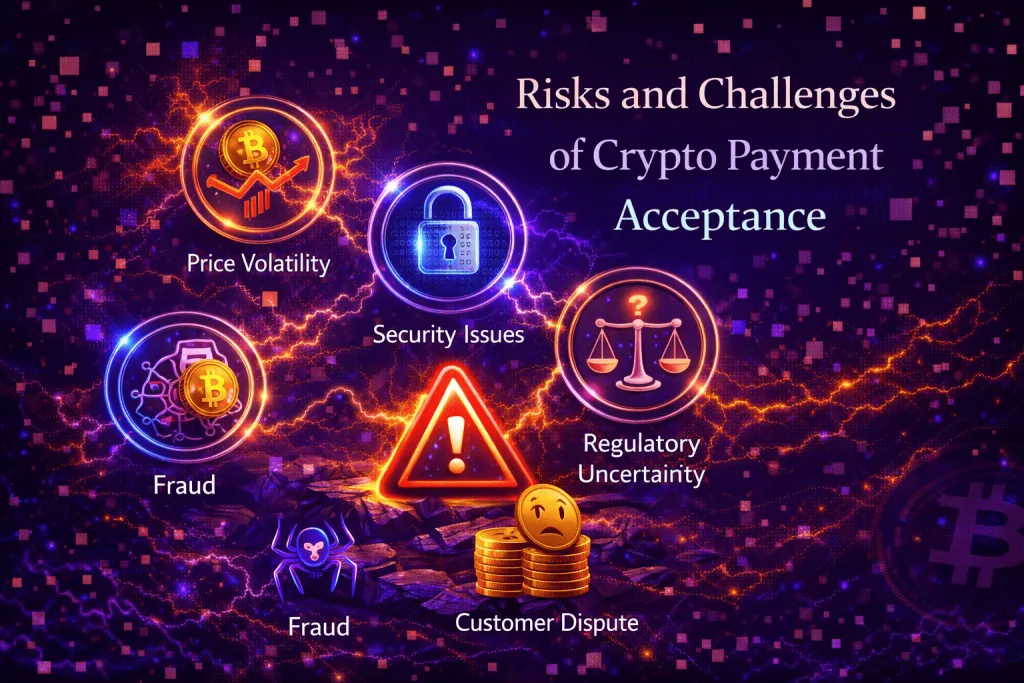
Price volatility is easier to bypass with major crypto payment gateways. They provide helpful auto-conversion, locking the value of fiat or stablecoin at the exact time of sale. That keeps the merchant’s income safe from price fall.
Regulatory uncertainty remains a challenge beyond the EU. While MiCA gives European companies clear rules, other countries might still be developing their laws. Just check if your provider has licenses for your area.
Custody risk will always exist. Most custodial platforms (BitPay, CoinGate, NOWPayments) have one limitation: locked funds increase your risk exposure to a counterparty. The entire industry has suffered from frozen accounts or the inability to access a trust during a substantial regulatory or liquidity crisis. Non-custodial platforms can bring down this risk, but wallet security is on you.
User experience friction is there but lessening. Cryptocurrency payment checkout usually adds only one or two steps to a card stored checkout. We recommend businesses to offer crypto payment as an additional option, not a replacement.
How to Integrate a Crypto Payment Gateway: Step-by-Step
- Choose your crypto payment gateway: Go through the above comparison table and see which one matches your requirements and then choose your provider.
- Register and perform KYC: Present business documentation, ID verification, and bank details for fiat settlement. Most crypto payment processors take 1-5 business days to approve your application. CoinRemitter does not require KYC.
- Pick your integration method: Use the API for developing custom systems. Make use of the plugin for WooCommerce, Shopify, Magento, or WHMCS. Drop in a payment link for no-code setups.
- Decide on your settlement currency: Choose among BTC, ETH, USDC, USDT, and fiat. Set auto-convert on to avoid volatility exposure.
- Before going live, test a crypto payment flow in sandbox mode, including webhooks, confirmation events, and refund logic. (This step is crucial when choosing among the best crypto payment platforms for businesses 2026.)
- Go live: Switch from test credentials to production credentials. Communicate the new crypto payment option to your customers, and watch the first transactions on your dashboard.
Frequently Asked Questions about Crypto Payment Gateways
What is a crypto payment gateway?
A crypto payment gateway is an intermediary that allows online retailers to accept payments in cryptocurrency by managing the checkout process and the conversion to fiat or stablecoin wherever applicable.
How do crypto payments work?
After the crypto payment gateway has generated a new payment address, the customer sends the crypto to this address. The blockchain network verifies the payment. Finally, the crypto payment provider settles the funds either in crypto or in fiat after conversion.
What fees do crypto payment gateways charge?
Typical transaction fees range from a low 0.23% (CoinRemitter) to 1.5% (Stripe) with additional costs such as network/gas, conversion, and withdrawal fees piling on top of the base rate.
Is accepting crypto payments legal?
Yes, it is legal in most countries. MiCA sets out a compliance framework for the EU member states specifically. However, we advise to verify the licensing requirements of your local jurisdiction and to consult a legal professional if in doubt.
Can I settle in fiat currency?
Definitely. CoinGate, BitPay, and Stripe all offer automatic conversions from crypto to fiat with direct bank settlement. Third-party partner support from NOWPayments allows for fiat payouts.
What cryptocurrencies are supported?
Almost all crypto payment processors accept BTC, ETH, USDC, and USDT as baseline assets. NOWPayments supports more than 350 assets and CoinGate supports over 70.
How long does the KYC onboarding process take?
Most individual accounts can expect 1 to 5 business days. CoinRemitter, however, does not require a KYC. Due to stricter compliance measures, onboarding at BitPay on the enterprise level may take longer.
What are e-commerce plugins available?
Most major crypto payment solutions providers offer integrations for WooCommerce, Shopify, Magento, PrestaShop, WHMCS, and OpenCart. CoinGate and NOWPayments stand out for plugin breadth, which is one reason they are often listed among the best crypto payment gateways 2026.
What is the difference between custodial and non-custodial?
In a custodial crypto payment gateway, the provider temporarily holds your funds before forwarding them to your account. Non-custodial platforms direct the payment immediately to your wallet, minimizing the counterparty risk. But in this case, you are responsible for managing your private keys.
How do you do refunds?
Blockchain transactions are everlasting. A refund means sending crypto back to the customer’s wallet address manually. Remember to have a clear refund policy before accepting your first crypto payment.
How to Find the Best Crypto Payment Gateway for Business
Opting for the right crypto payment gateway, you can lower transaction fees, prevent fraudulent chargebacks, and introduce your business globally, all while receiving funds in your desired currency.
Whether you are a European merchant looking at CoinGate, an enterprise team considering BitPay, or a developer deploying NOWPayments or CoinRemitter, the crypto payment processing infrastructure is ready to meet you where you are. The top cryptocurrency payment gateways for merchants 2025-2026 balance compliance, integrations, and settlement speed.