
Once again, the Bitcoin price appears to be heading in the direction of a major decline due to rising geopolitical risks, specifically those emanating from mounting tensions between the United States and Iran, which resulted in an increase in global volatility and a decrease in investor appetite for risk.
In response to the escalated tensions, on Tuesday morning, President Donald Trump warned Iran through his social media platform Truth Social that “a whole civilization will die tonight” if Iran does not comply with U.S. demands to allow Iranian oil tankers to pass through the Strait of Hormuz by this evening (by 8 p.m. ET). This escalation has caused an additional layer of uncertainty in already volatile markets.
Financial markets reacted quickly to the heightening tensions. Futures contracts for both the S & P 500 and NASDAQ 100 were down 0.4% and 0.6%, respectively. Also, prior to market opening, futures contracts for the DOW Jones Industrial Average had plummeted approximately 140 points. However, oil prices rose sharply. West Texas Intermediate Crude(WTI) reached approximately $115/barrel. North Sea Brent also spiked, reaching $110/bbl; since last month’s highs, oil prices have risen by 70%. These sharp increases in oil prices reflect increased disruption in global oil supplies.
Cryptocurrency markets reflected the same risk-off sentiments seen in financial markets. On Tuesday, Bitcoin was trading at about $68,500, or down 2% compared to Monday. Ethereum also dropped approximately 3%, showing once again that cryptocurrency values do not provide investors with safe havens when there is geopolitical unrest.
Bearish Structure Remains Intact
Technically speaking, the overall structure of Bitcoin continues to disintegrate. A lower low-lower high pattern has been evident in the price since roughly late 2025; it is likely that bears have maintained dominance. Therefore, there are no impediments for a drop to approximately $55,000 if the key area of $65,000 breaks down on the downside.
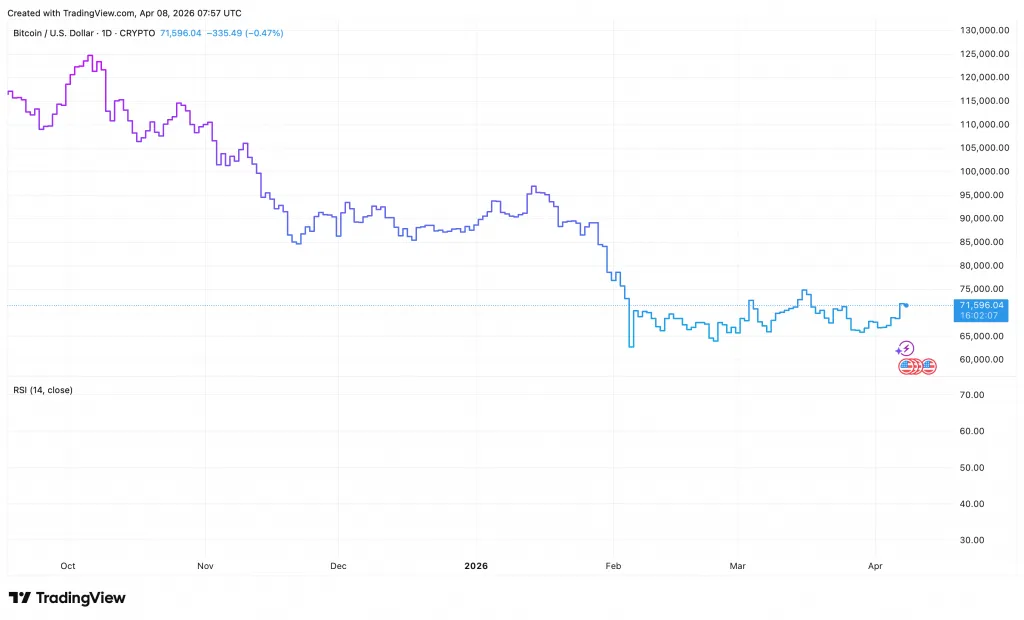
Supporting this view are several other major metrics. The 50-period Exponential Moving Average is still under the 200-period Exponential Moving Average, which indicates a “Death Cross” situation; historically, a Death Cross is an indication of significant extended downtrends. In addition, the Average Directional Index (ADX) is currently at 12.8; therefore, the directional trend in the cryptocurrency market does appear very weak but also indicates continued indecisiveness from market participants.
Finally, the RSI reading of 47.9 represents neutrality in terms of direction, although it is slightly trending into the oversold range. Also, the Squeeze Momentum indicator is indicating increasing downward pressure and thus is biased towards selling/bearish; often a sign preceding large price declines.
Market Sentiment Tilts Bearish
As we can see, prediction markets are also showing increasing pessimism. The current belief among traders is that it’s more likely for Bitcoin to drop to $55,000 than rise to new highs. Sentiment regarding a near-term crypto recovery continues to be weak; most still expect further declines.
However, many analysts believe that Bitcoin has entered a long-term bottoming process due to its 45% decline from an all-time high. However, no confirmation exists. For bulls to have confidence in their assessment (that Bitcoin has turned), they will first need to retake $75,000 and observe improving trends using trend indicators, as well as reversing direction on moving averages – neither of these exists at present.
Any advance above this point could simply be another false run-up in the ongoing bearish trend.