The Flare price prediction 2026 debate feels strange right away. Flare is built on solid technical ideas: decentralized data, XRP▲$1.39 DeFi, FAssets, the Flare Time Series Oracle, cross-chain tools, and tokenomics changes meant to reduce supply pressure over time. On paper, it looks exactly like the kind of infrastructure project traders claim to want when markets favor real utility.
Flare (FLR) Market Data
| Market Cap | $581.97M |
|---|---|
| Fully Diluted Valuation (FDV) | $713.12M |
| Volume (24h) | $5.26M |
| Volume / Market Cap | 0.0090 |
| Circulating Supply | 86.96B FLR |
| Total Supply | 106.55B FLR |
| Max Supply | — |
| All-Time High (ATH) | $0.1501 |
| All-Time Low (ATL) | $0.00586043 |
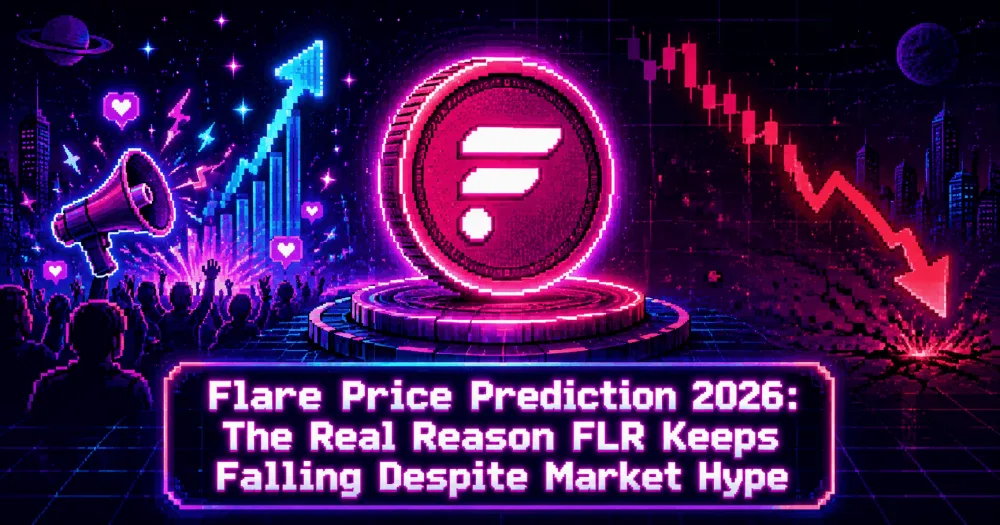
Yet something does not line up. FLR▼$0.00647417 continues to drop.
That gap between story and price tells you almost everything. Flare is not falling because nobody understands the project. It is falling because buyers understand something uncomfortable: great technology alone does not create token demand. When excess supply, thin liquidity, and sluggish adoption take control, excitement cannot push prices higher indefinitely.
A realistic Flare price prediction 2026 begins right here. If FAssets takes off and XRPFi catches on, FLR could climb higher. Yet unless buying power clearly beats token supply growth and selling pressure, each upswing may simply become another chance for holders to cash out.
Related: What Is Bio Protocol Crypto? Why This AI-Powered DeSci Token Is Exploding in 2026
Contents
- Why Flare Keeps Drawing Attention Despite Challenges
- The Real Reason FLR Keeps Falling
- FLR Market Shows Fragile Patterns Behind Simple Trends
- FAssets and XRPFi Signal Potential Growth on Flare
- Tokenomics After FIP.16
- Why Hype Falls Short
- Flare Price Forecast 2026: Possible Outcomes
- Signs That a Change Might Be Happening
- What Could Create More Pain?
- FLR vs. Other Infrastructure Tokens
- Flare Price Outlook for 2026 Based on Current Trends
- Final Takeaway
- FAQ
Why Flare Keeps Drawing Attention Despite Challenges
Here’s the thing about Flare: it is not trying to mirror Ethereum with flashier branding. Instead, its focus lands squarely on powering dApps that depend heavily on real-world data.
Flare runs on key infrastructure such as the Flare Time Series Oracle, which feeds live prices and data without central control. On top of that, the Flare Data Connector pulls information from outside blockchains and web sources into smart contracts. This setup gives Flare a clear identity: not just a network for moving tokens, but a blockchain designed to move trusted data safely through decentralized systems.
That matters because many DeFi setups rely on outside information they can trust. Prices keep lending platforms running. Outcomes decide what happens in prediction markets. Cross-chain systems depend on verified proofs. AI-linked applications need data that holds up under scrutiny. Flare’s argument is simple: blockchains require decentralized facts just as much as they require shared computation.
Right now, most Flare price prediction 2026 scenarios rest on that hopeful foundation. If Flare becomes a key hub for data sharing across blockchains, FLR could eventually benefit from network expansion. Yet so far, that potential has not shown up clearly in market value.
The Real Reason FLR Keeps Falling
What drags FLR down is not one single cause. A tangle of issues pulls at it all at once.
First, FLR has faced heavy selling pressure from excess token supply. Year after year, holders watched rewards, distributions, and incentives add more coins to circulation. Progress on code meant little when more units kept appearing. Here’s the catch: buyers must absorb every incoming batch just to keep prices steady. Only after that can FLR climb without collapsing again.
Second, Flare’s purpose has taken time to become clear in market terms. The ideas behind it are solid, but investors look for activity levels, locked value, fees, working apps, and real appetite for FLR tokens. Without clear signs that people actually need FLR, buyers see potential instead of demand. That gap shapes how the token trades today.
Third, many people who bought FLR expected faster results. The XRP connection brought a large built-in audience, but it also created a dangerous assumption: gains would come automatically because XRP holders were watching. Reality stepped in slowly, leaving those hopes behind.
Fourth, patience wears thin when charts swing like angry bats. Not every solid tech idea gets rewarded in the 2026 altcoin market. Traders are rewarding tokens with fast-moving stories, real income, or sudden momentum. Flare has a story that grabs attention, but its price action still feels like waiting under storm clouds. Momentum matters more than merit now.
That is why the Flare price prediction 2026 question is not simply “is Flare good?” It is: when does Flare’s utility become strong enough to overcome its supply and sentiment problems?
Related: Zcash vs Bitcoin in 2026: Is Zcash a Better Privacy Coin Than Bitcoin for Investors?
FLR Market Shows Fragile Patterns Behind Simple Trends
Ugly — that is how FLR’s price action looks lately. The token remains far beneath its old peaks and trades near depressed levels. Key moving averages are still out of reach. Each time FLR tries to climb, selling pressure appears quickly instead of breakout momentum. Strength gets sold by those looking to exit.
Here’s why it counts. Price movement gets attention now; fundamentals may earn attention later.
Beneath key resistance, FLR often slows as buyers step back. Momentum traders wait for confirmation before moving. “Accumulation” comes up in long-term discussions — sometimes signaling real belief, more often serving as a phrase people fall back on when better arguments run thin.
Even so, the chart misses some important details. If real-world use starts showing up, Flare may get a meaningful boost, changing how people view its value through 2026.
What really matters is whether buyers see FLR as useful and wanted — or just tied to a project taking its time to grow while losing value. At this point, the slower story still holds more weight.
FAssets and XRPFi Signal Potential Growth on Flare
The biggest bullish case for Flare is FAssets.
Outside smart contracts, XRP remains largely idle despite wide ownership. Flare tries to change that picture. Through FAssets, assets like XRP can move into DeFi environments. This is not just about linking systems. It is about bridging value directly. Idle coins gain new roles. Legacy assets become active. XRP steps into open finance.
If this succeeds, the impact could be significant. XRP holders could gain access to yield opportunities, lending, liquidity pools, and broader DeFi strategies while staying connected to the XRP environment. Flare would act less like a tool and more like a connector, linking idle assets to active financial markets.
FAssets v1.3 also makes the system smoother, thanks to simpler token creation and smarter routes into FXRP. That matters because complicated crypto tools often collapse not from technical flaws, but from user indifference. Average people skip products that feel too fiddly. Smooth steps may seem dull, but they matter more than flash.
Related: What Is CDOF Crypto: Legit Investment or Just Another High-Risk Hype Token?
This is where the Flare price prediction 2026 outlook starts to shift. Rising FXRP use could help, especially if users keep moving into XRP yield vaults. If Flare becomes the go-to platform for XRPFi, pressure on FLR supply may ease as demand grows.
Here’s the catch, though: lasting activity matters more than early spikes. A capped vault filling fast is promising. Building something that runs on its own is much harder.
Tokenomics After FIP.16
One of the most important Flare developments in 2026 is the tokenomics shift through FIP.16.
Here’s why it counts. The proposal aims to cut inflation, improve long-term balance, and tie FLR more closely to real network use instead of theory. The old flaw was obvious: too many tokens entered the market while too little actual demand showed up.
A cleaner tokenomics model can help in several ways.
It can reduce dilution.
Staking may become more attractive.
Burn intensity could rise because of adjusted incentives.
Buyback logic could become stronger.
Token value may tie more directly to network usage.
Market confidence can grow when traders see steady progress.
This is where the Flare price prediction 2026 outlook gets interesting for optimists. If FIP.16 shifts FLR away from runaway supply and toward real-world utility, pricing could adjust over time.
But “eventually” carries heavy weight. Token design changes will not rescue weak price action overnight. Progress depends on time, usage, and trust. Crypto traders have heard enough promises of self-reinforcing scarcity to develop allergic reactions.
Why Hype Falls Short
Support behind Flare is not hard to find. Loyal users stick around, many come from XRP circles, and ambitious technical goals shape the roadmap. That backing counts. Still, excitement by itself will not keep a token alive forever.
The problem is that many traders bought FLR because they thought every catalyst would push price up immediately. FAssets launch? Price should rise. XRPFi narrative? Same expectation. New tokenomics plan? Same reaction. Fresh integrations? Again, price should rise.
Markets do not operate like that.
A catalyst matters only when it changes supply and demand. When users try something but fail to generate meaningful fees, locked value, collateral demand, or long-term activity, price may stay flat. News can look strong and still get sold when fresh tokens enter the market and buyers hesitate.
This explains why FLR can move forward as a project while still falling as a token. The market is not saying the work means nothing. It is saying that what Flare offers is not urgently needed yet.
Flare Price Forecast 2026: Possible Outcomes
| Scenario | What Needs to Happen | Possible FLR Outcome |
|---|---|---|
| Bullish recovery | FAssets usage grows, XRPFi gains traction, FIP.16 improves tokenomics | Price climbs back toward prior resistance zones |
| Base case | Flare keeps building, but adoption grows slowly | Choppy price action with rallies that fade fast |
| Bear case | Supply pressure and weak sentiment continue | Further downside or long sideways movement |
| Breakout case | XRPFi becomes a major narrative and FLR demand rises clearly | Fast upside move, but with high volatility |
A single figure cannot capture what Flare might do by 2026. Success depends on how quickly people actually start using it. If Flare powers most XRP-based finance apps, today’s value may look low in hindsight. Yet even solid technology can stall without traction, leaving prices flat regardless.
Here sits the awkward balance: Flare holds enough weight to remain relevant, but lacks the price strength to command full trust. It lingers where relevance meets doubt.
Signs That a Change Might Be Happening
A real shift will not happen just because posts go viral. Meaningful change runs deeper than likes and shares.
First, FLR must regain major resistance zones and stay above them. A brief spike will not do much. What matters is seeing demand step in when prices climb. Only then does confidence grow.
Second, price climbs mean little unless trading activity grows too. Quiet upswings usually fade fast.
Related: WLFI Crypto Price Prediction 2026: Why the Token Is in a Permanent Downtrend and Keeps Falling
Third, FAssets must move beyond launch-phase excitement. FXRP creation matters, but ongoing involvement in vaults matters too. Collateral use has to keep rising. Connections with DeFi platforms must expand. What counts is steady pressure from real use.
Fourth, FLR’s token structure must clearly improve. Cutting inflation is useful, but people want proof that burns, staking, and system revenue work at scale.
Fifth, the wider altcoin market needs to cooperate. FLR is not Bitcoin. When fear takes over, even strong projects can sink fast. A mid-sized infrastructure token will not hover untouched while chaos spreads below.
Only if these signs line up does a hopeful Flare price prediction 2026 gain real weight.
What Could Create More Pain?
Lower levels could still come. The drop may not be finished.
Supply pressure remains the main problem. If buyers view FLR as spread too thin, price gains may face steady selling. Even small rallies can trigger exits if confidence stays low. Trust needs rebuilding before momentum changes. Without tighter distribution, interest may continue fading.
Adoption could also take too long. FAssets sounds good on paper, but plenty of smart crypto ideas have gone nowhere. It does not matter how sharp the concept is. What matters is daily behavior: do real users keep coming back?
Competition also pulls attention in different directions. Flare is up against oracles, bridges, base-layer networks, DeFi platforms, and XRP-focused infrastructure. The race is not about who shows up first. It is about staying power when the noise fades.
Mood can also drag on long after facts start looking better. If traders label FLR as “good project, bad token,” price may stay flat despite steady development behind the scenes.
That is the main worry behind every Flare price prediction 2026: Flare may succeed as a platform long before FLR succeeds as an investment.
FLR vs. Other Infrastructure Tokens
| Factor | Flare | Chainlink | Axelar | LayerZero |
|---|---|---|---|---|
| Main focus | Data-rich Layer 1, FAssets, XRPFi | Oracles and data feeds | Cross-chain interoperability | Omnichain messaging |
| Core opportunity | Unlocking non-smart-contract assets for DeFi | Securing external data for smart contracts | Connecting chains and assets | Cross-chain app infrastructure |
| Main challenge | Turning utility into FLR demand | Mature valuation and competition | Security and adoption pressure | Token value capture questions |
| 2026 watch item | FAssets, FIP.16, FXRP adoption | Data services and CCIP growth | Cross-chain usage | App-level adoption |
What helps Flare stand out? It links data flows, cross-chain access, EVM support, XRPFi ideas, and DeFi uses. The challenge appears when trying to squeeze all of that into one clear investment case.
Oracles? That is Chainlink.
Cross-chain infrastructure? That is Axelar.
Omnichain messaging? That is LayerZero.
Flare steps in with a data-rich base layer, decentralized information, FAssets, and XRPFi bundled together. That may be more precise, but it is harder to shout during a rally.
Something interesting happens when technology meets culture. Flare has enough function for users who care about systems. Yet it has not caught on like wildfire. A solid foundation exists. What is missing is meme-market fit: jokes, trends, shared moments, and emotional urgency. Right now, utility leads, but emotion lags behind. Success often needs both.
Related: What Is ISOR Crypto? The Oil-Themed Solana Token Everyone Is Talking About in 2026
Flare Price Outlook for 2026 Based on Current Trends
A cautious Flare price prediction 2026 should separate potential from probability.
If things go south, FLR might stay low or fall further as selling pressure builds, liquidity stays thin, and most altcoins remain sluggish. Failure is not necessary here. A steady lack of buyers is enough to keep price down.
A sideways grind could define FLR’s path deep into 2026, where bumps tied to FAssets, XRPFi, or tokenomics updates fade without stronger adoption. That kind of stalemate is irritating for optimists and skeptics alike — which means markets will probably enjoy it. Annoying participants is basically how price action stays in shape.
Bullish outlooks could lift FLR quickly, especially once FAssets catches on. If XRP supporters shift real funds toward Flare’s DeFi ecosystem, momentum could build quietly. Confidence may change if FIP.16 shifts perception and makes token supply less of a central concern.
In the breakout scenario, Flare becomes the top XRPFi platform. FXRP begins climbing, slowly at first, then steadily. Users start locking FLR, paying fees, running services, and shrinking supply over time. This is the version where FLR stops acting like digital dust and starts acting like infrastructure under load.
Final Takeaway
One thing is clear: Flare aims high with its technology, but trader trust remains shaky. Built on open data streams, FAssets, XRPFi potential, and EVM support, it shows real effort. A fresh tokenomics proposal through FIP.16 adds weight. All of that matters.
Still, FLR keeps falling because the market no longer buys blueprints alone. Proof matters now. Traders want to see how usage creates real demand for the token. Without that proof, excitement hits the same walls: excess supply, weak sentiment, and loud skepticism in every trade.
The reason FLR keeps dropping is simple: progress has moved faster than demand.
Change is possible. If FAssets launches widely and token incentives work, FLR could outperform expectations in 2026. Until price action supports that outcome, reality remains blunt: Flare has a credible recovery case, but no proof of sustained momentum yet.
FAQ
What is the Flare price prediction 2026?
The Flare price prediction 2026 depends on whether FAssets adoption, XRPFi demand, and FIP.16 tokenomics changes can overcome supply pressure and weak sentiment. Rising confidence could spark a rebound. Without stronger adoption, FLR may stay flat or fall further.
Why does FLR keep falling despite market hype?
FLR keeps falling because excitement has not produced enough real buying interest. Despite technical upgrades, excess supply weighs on price. Adoption is still developing, liquidity remains thin, and trust feels shaky. Progress exists, but doubt remains louder.
Can FLR recover by 2026?
FLR can recover in 2026 if FAssets gains traction and XRP users move into Flare’s DeFi ecosystem. A stronger tokenomics setup could also ease concerns about supply growth. Without these shifts, the climb becomes slower and less reliable.
What is the biggest catalyst for FLR?
The biggest catalyst is FAssets, especially FXRP adoption. If Flare becomes a key DeFi platform for XRP liquidity, FLR could see more demand through lending, staking, fees, collateral use, and ecosystem activity.
Does Flare have long-term crypto potential?
Flare has serious long-term infrastructure potential, but holding FLR remains risky. Its future depends on whether real network use becomes strong enough to support token demand beyond community enthusiasm.